
Tasmanian Devil
Sarcophilus harrisii
Red List assessment
Endangeredon the IUCN Red List
- EXExtinct
- EWExtinct in the Wild
- CRCritically Endangered
- ENEndangered
- VUVulnerable
- NTNear Threatened
- LCLeast Concern
The Tasmanian Devil is recorded in one country, Australia across Oceania. The IUCN Red List assesses the Tasmanian Devil as Endangered. Estimated at 20,000 to 50,000 mature individuals in the wild, with an overall declining trend, though some regions show signs of stabilization.
- Family
- Dasyuridae
- Order
- Dasyuromorphia
- Genus
- Sarcophilus
- Countries recorded
- 1
- Continents
- Oceania
- Red List category
- Endangered
- Data updated
- August 9, 2026
What is the Tasmanian Devil?
The Tasmanian Devil is the largest surviving carnivorous marsupial, found exclusively on the island of Tasmania, Australia. It is renowned for its powerful bite force relative to body size, its eerie screeching vocalizations, and its role as a scavenger that helps keep ecosystems clean. Once widespread on mainland Australia, it has been restricted to Tasmania for centuries. The species has become a global conservation icon due to a devastating transmissible cancer threatening its survival.
Where does the Tasmanian Devil live?
Tasmania, Australia
Endemic to the Australian island state of Tasmania, occurring across most of the island except for the most intensively urbanized areas. Historically present on the Australian mainland, but disappeared there roughly 3,000 years ago, likely due to dingo competition and Aboriginal hunting pressure.
Altitude and depth
Sea level to approximately 1,400 meters, though most populations occur at lower to mid elevations across Tasmania.
Seasonal movements
No migration or hibernation; however, breeding is strongly seasonal, occurring mainly in March, with a synchronized birthing period in April.
Habitat of the Tasmanian Devil
Devils inhabit a wide range of habitats including dry and wet sclerophyll forests, coastal scrublands, woodlands, and agricultural land. They require dense vegetation or rocky outcrops for denning and shelter, and are highly adaptable to disturbed landscapes.
Adaptations to its environment
Devils possess extremely powerful jaws and teeth capable of crushing bone, allowing full carcass consumption including fur and bones, which reduces competition and waste in the ecosystem. Their black coloration provides camouflage at night, and their nocturnal habits reduce thermal stress and predation risk.
Conservation status and numbers
Listed as Endangered (EN) by the IUCN due to a population decline exceeding 80% since the mid-1990s, driven primarily by Devil Facial Tumour Disease (DFTD). Some subpopulations have shown partial recovery or stabilization due to disease dynamics and conservation interventions.
Estimated population
Estimated at 20,000 to 50,000 mature individuals in the wild, with an overall declining trend, though some regions show signs of stabilization.
What threatens the Tasmanian Devil?
The primary threat is Devil Facial Tumour Disease (DFTD), a contagious cancer transmitted through biting during social interactions. Secondary threats include road mortality, habitat fragmentation, and historical persecution by humans.
Diseases and parasites
The most significant disease is Devil Facial Tumour Disease (DFTD), a transmissible cancer causing facial tumors and near-universal mortality; devils also host various internal and external parasites such as ticks and nematodes.
What is being done to protect it?
Conservation efforts include the Save the Tasmanian Devil Program, insurance populations maintained in captivity and on disease-free islands (e.g., Maria Island), and ongoing research into tumor immunology and potential vaccines. Devils are also protected by Tasmanian and Australian wildlife legislation.
Recommended actions
Priority actions include continued monitoring of wild populations, expansion of disease-free insurance populations, genetic management to preserve diversity, and habitat protection to reduce fragmentation and road mortality.
What the Tasmanian Devil looks like
Devils have a stocky, muscular build with black fur often marked with white patches on the chest and rump. They have a large head, powerful jaws, pink ears that flush red when agitated, and a thick tail used for fat storage.
Size
Body length ranges from 52 to 80 cm, with a tail length of 23 to 30 cm; shoulder height is roughly 25-30 cm.
Weight
Males typically weigh 6-13 kg, while females are smaller, weighing 4-8 kg.
Distinctive features
Distinguished from other dasyurids by its robust build, disproportionately large head and jaw muscles, and characteristic white chest markings. Its loud screeching and growling vocalizations during feeding are also highly distinctive.
Differences between males and females
Males are generally larger and heavier than females, with more robust heads and stronger jaw musculature.
Behaviour and diet of the Tasmanian Devil
Devils are largely solitary but exhibit social feeding behavior at carcasses, where multiple individuals may congregate and establish temporary dominance hierarchies through vocal and physical displays.
When it is active
Primarily nocturnal and crepuscular, with peak activity occurring at dusk and throughout the night; they rest in dens or dense vegetation during the day.
Diet
Devils are opportunistic carnivorous scavengers, feeding mainly on carrion but also hunting live prey such as small mammals, birds, reptiles, and insects when available.
How it feeds and hunts
They rely heavily on scavenging using an acute sense of smell to locate carcasses over long distances, but can also ambush slower-moving live prey, using powerful jaws to kill and consume it entirely.
Communication
Communication includes loud screeches, growls, and coughing barks, especially during feeding disputes, along with body postures, scent marking, and gaping jaw displays to signal aggression or submission.
Interactions with other species
Devils have few natural predators as adults, though young may be taken by owls or quolls; historically they may have competed with the extinct thylacine and now interact with introduced species like foxes and feral cats as competitors.
Role in its ecosystem
As Tasmania's primary scavenger, devils play a crucial ecological role in nutrient cycling and disease control by rapidly consuming carcasses, which limits the spread of pathogens and blowfly populations.
Reproduction and lifecycle
Breeding occurs once yearly around March, with a gestation period of about 21 days. Females give birth to up to 40 tiny young, but only 2-4 survive to occupy the pouch's teats.
Raising the young
Young remain in the mother's pouch for about 4 months, then are left in a den while she forages, being weaned at around 5-6 months. Only the mother provides parental care, with no paternal investment.
Maturity and lifespan
Sexual maturity is reached at about 2 years of age; lifespan in the wild is typically 5-6 years, while captive individuals can live up to 7-8 years.
Taxonomy and naming of the Tasmanian Devil
Classification
Class Mammalia > Order Dasyuromorphia > Family Dasyuridae > Genus Sarcophilus > Species Sarcophilus harrisii
Scientific synonyms
Sarcophilus ursinus, Diabolus ursinus
What research says
Recent studies
Recent studies have documented rapid evolutionary changes in wild devil populations that may confer partial tumor resistance, alongside promising developments in immunotherapy and vaccine research against DFTD.
Genome and DNA
The Tasmanian Devil genome has been fully sequenced, revealing low genetic diversity that increases susceptibility to DFTD; the species has 14 chromosomes (2n=14).
Compared with similar species
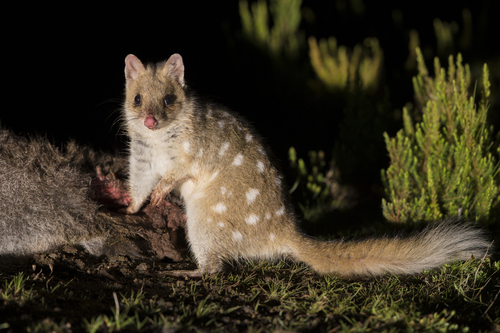
Compared to other dasyurids like quolls, the Tasmanian Devil is considerably larger and more robust, with a stronger bite force relative to body size, and its diet is more heavily scavenging-based rather than active predation.
The Tasmanian Devil and people
Despite its name, the devil's fearsome screeches are mostly used to intimidate rivals rather than signal genuine aggression toward threats. It has one of the strongest bites relative to body size of any living mammal, and its species name 'harrisii' honors naturalist George Harris who first described it in 1807.
Where and how to see it
The best places to observe Tasmanian Devils include wildlife sanctuaries such as Bonorong Wildlife Sanctuary and Trowunna Wildlife Park, as well as nighttime spotting in Tasmania's national parks like Narawntapu and Mount William, particularly around dusk when they become active.
Risks to humans
Devils are not dangerous to humans under normal circumstances and avoid contact when possible; bites can occur if handled or cornered, but no significant disease transmission risk to humans has been recorded.
Human uses
Historically, devils were trapped by early settlers who viewed them as pests threatening poultry, but today they hold significant value in ecotourism, scientific research, and as a national conservation symbol of Tasmania.
Myths and legends
The Tasmanian Devil's eerie nocturnal screams and fierce feeding behavior inspired early European settlers to give it its demonic name; it later became globally famous through the Looney Tunes character 'Taz,' though the real animal is far less aggressive toward humans.
Countries where the Tasmanian Devil is recorded
The 1 countries named in the range description of its IUCN Red List assessment.
Questions about the Tasmanian Devil
Where does the Tasmanian Devil live?
The Tasmanian Devil is recorded in Australia across Oceania. These countries come from the range description of its IUCN Red List assessment, and they are what place the species on the interactive map.
Is the Tasmanian Devil endangered?
Yes. The IUCN Red List assesses the Tasmanian Devil as Endangered, one of the three threatened categories. The species faces a very high risk of extinction in the wild — a step below Critically Endangered, but still on a trajectory that ends badly without intervention.
How many are left in the wild?
Estimated at 20,000 to 50,000 mature individuals in the wild, with an overall declining trend, though some regions show signs of stabilization. This figure comes from the species assessment on the IUCN Red List; population estimates for wild mammals are ranges, not counts, and are revised at each assessment.
What habitat does the Tasmanian Devil live in?
Devils inhabit a wide range of habitats including dry and wet sclerophyll forests, coastal scrublands, woodlands, and agricultural land.
What is the scientific name of the Tasmanian Devil?
The Tasmanian Devil is Sarcophilus harrisii, in the family Dasyuridae, order Dasyuromorphia.
Other species in the family Dasyuridae

Species that share its range
Sources
Conservation status, range description and population estimate come from the IUCN Red List assessment for Sarcophilus harrisii. Countries are derived from that range description, not from a mapped country list. Last refreshed on .
The distribution map is drawn from the IUCN Red List spatial data compiled in 2008. IUCN (International Union for Conservation of Nature)