
Eastern Quoll
Dasyurus viverrinus
Red List assessment
Endangeredon the IUCN Red List
- EXExtinct
- EWExtinct in the Wild
- CRCritically Endangered
- ENEndangered
- VUVulnerable
- NTNear Threatened
- LCLeast Concern
The Eastern Quoll is recorded in 2 countries across Europe and Oceania. The IUCN Red List assesses the Eastern Quoll as Endangered. Estimated at fewer than 20,000-25,000 mature individuals in Tasmania, with populations considered to be declining or fluctuating; mainland reintroduced populations remain very small and experimental.
- Family
- Dasyuridae
- Order
- Dasyuromorphia
- Genus
- Dasyurus
- Countries recorded
- 2
- Continents
- Europe and Oceania
- Red List category
- Endangered
- Data updated
- August 9, 2026
What is the Eastern Quoll?
The Eastern Quoll is a small, cat-sized carnivorous marsupial native to Australia, now surviving mainly in Tasmania after disappearing from the mainland in the mid-20th century. It is known for its striking spotted coat and agile, nocturnal hunting habits. This species plays an important ecological role as a mid-level predator controlling insect and small vertebrate populations. Its dramatic mainland extinction and Tasmanian stronghold make it a flagship species for Australian marsupial conservation.
Where does the Eastern Quoll live?
Tasmania, Australia (mainland Australia population extinct in the wild, with recent reintroduction attempts in New South Wales)
Historically found across southeastern mainland Australia including Victoria, New South Wales, and South Australia, the species is now restricted to Tasmania, particularly the northern, eastern, and midland regions. Reintroduction trials have begun in fenced mainland sanctuaries such as Booderee National Park in New South Wales.
Altitude and depth
Sea level up to approximately 1500 meters in Tasmanian highland areas
Seasonal movements
Eastern Quolls do not migrate or hibernate but show seasonal breeding synchrony, with mating occurring in early winter (May-June) tied to photoperiod cues.
Habitat of the Eastern Quoll
Eastern Quolls inhabit a range of environments including dry sclerophyll forests, woodlands, coastal heath, alpine areas, and grasslands, often near forest edges. They favor mosaic landscapes with a mix of open ground for foraging and vegetation cover for denning and shelter.
Adaptations to its environment
They possess sharp claws and strong hind legs for climbing and rapid pursuit of prey across varied terrain. Their coat color morphs (fawn or black) may provide camouflage advantages in different habitat types, and their nocturnal habits help avoid daytime heat and some predators.
Conservation status and numbers
Endangered (EN) according to IUCN, having suffered a catastrophic decline including complete extirpation from mainland Australia by the 1960s due to combined pressures of disease, predation, and habitat loss. Tasmanian populations have also fluctuated significantly, raising ongoing conservation concern.
Estimated population
Estimated at fewer than 20,000-25,000 mature individuals in Tasmania, with populations considered to be declining or fluctuating; mainland reintroduced populations remain very small and experimental.
What threatens the Eastern Quoll?
Major threats include predation by introduced red foxes and feral cats, habitat fragmentation from agriculture and development, road mortality, and historical population crashes linked to disease outbreaks (possibly distemper-like epizootics) in the early 20th century.
Diseases and parasites
Historical population crashes are believed linked to a distemper-like disease epidemic in the early 1900s; they can also host various endoparasites and ectoparasites including ticks and intestinal worms.
What is being done to protect it?
Conservation actions include legal protection under Australian and Tasmanian wildlife laws, captive breeding programs, and reintroduction projects at fenced predator-free mainland sanctuaries like Booderee National Park and Barrington Tops. Organizations such as Rewilding Australia and Aussie Ark have been central to these efforts.
Recommended actions
Priority actions include continued predator control (foxes and cats) in Tasmania, expansion of predator-proof mainland reintroduction sites, genetic management of captive and wild populations, and long-term monitoring to detect early signs of decline or disease.
What the Eastern Quoll looks like
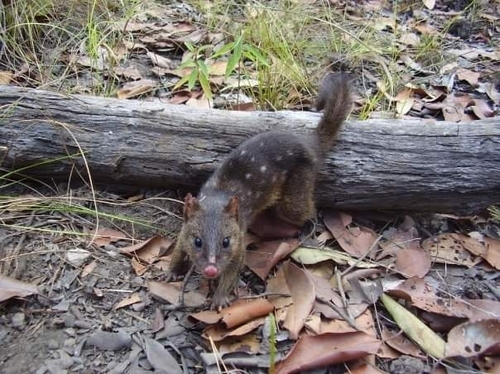
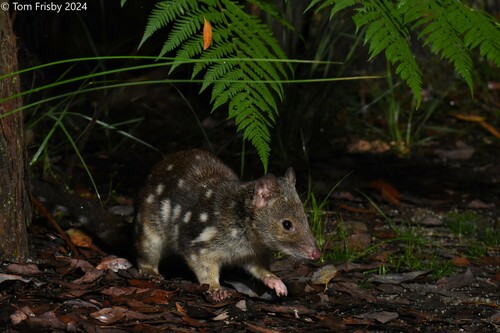
The Eastern Quoll has soft fur that comes in two color morphs, fawn/brown or black, both covered in numerous white spots across the back and sides but not on the tail. It has a pointed muzzle, large rounded ears, dark eyes, and a long bushy tail without spots.
Size
Head-body length of 28-45 cm, with a tail of 17-24 cm
Weight
Males typically weigh 900-2000 grams, while females are smaller at 700-1200 grams
Distinctive features
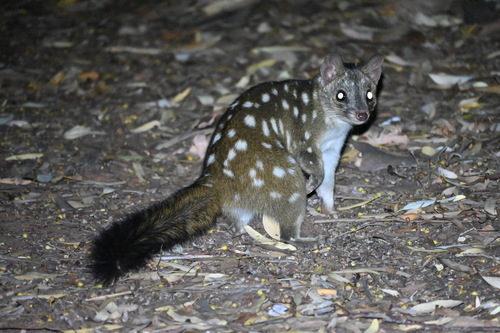
Unlike the Spotted-tailed Quoll, the Eastern Quoll lacks spots on its tail and is notably smaller in body size. Its more slender build and finer spotting pattern also differentiate it from other quoll species.
Differences between males and females
Males are noticeably larger and heavier than females, sometimes by nearly double the body weight, though coloration and spotting patterns are similar between sexes.
Behaviour and diet of the Eastern Quoll
Eastern Quolls are largely solitary animals, coming together only briefly for mating, with each individual maintaining its own home range that may overlap with others.
When it is active
They are primarily nocturnal and crepuscular, resting in burrows, hollow logs, or dense vegetation during the day and becoming active to forage after dusk.
Diet
Their diet is omnivorous, consisting mainly of invertebrates like beetles and insects, small mammals, birds, reptiles, carrion, and some fruits or plant material depending on availability.
How it feeds and hunts
Eastern Quolls hunt using a combination of stealth and quick pouncing, relying on keen smell and hearing to locate prey on the ground, and are also opportunistic scavengers of carrion.
Communication
Communication includes vocalizations such as hisses, screeches, and chattering during aggressive or mating encounters, as well as scent marking via feces and glandular secretions to signal territory and reproductive status.
Interactions with other species
Eastern Quolls face predation and competition from introduced species like red foxes and feral cats, and historically coexisted with Tasmanian Devils, which may have suppressed some feral predator populations. They also compete with other native carnivorous marsupials for similar prey resources.
Role in its ecosystem
As a mesopredator, the Eastern Quoll helps regulate populations of insects and small vertebrates, contributing to ecosystem balance, while also serving as prey for larger predators and scavenging carrion which aids nutrient cycling.
Reproduction and lifecycle
Breeding occurs once yearly around May-June, with a short gestation period of about 21 days, after which up to 30 tiny young are born though only 6-8 can survive by attaching to the mother's teats in her pouch.
Raising the young
Only the female cares for the young, carrying them in her pouch for around 8-9 weeks, after which they are left in a den while she forages before being fully weaned by around 18-20 weeks of age.
Maturity and lifespan
Sexual maturity is reached at about 1 year of age, with a typical lifespan in the wild of 2-4 years, while captive individuals may live up to 5-7 years.
Taxonomy and naming of the Eastern Quoll
Classification
Class Mammalia > Order Dasyuromorphia > Family Dasyuridae > Genus Dasyurus > Species Dasyurus viverrinus
Scientific synonyms
Dasyurus vivverinus, Satanellus vivverinus
What research says
Recent studies
Recent research has focused on genetic diversity within captive and wild populations to guide reintroduction strategies, as well as monitoring survival and adaptation of reintroduced individuals at mainland sanctuary sites like Booderee National Park.
Genome and DNA
The Eastern Quoll has a diploid chromosome number of 2n=14, and genetic studies have been used to assess population diversity and inform reintroduction breeding programs.
Compared with similar species
Compared to the larger Spotted-tailed Quoll (Dasyurus maculatus), the Eastern Quoll is smaller, has a spot-free tail, and inhabits more open habitats rather than dense forest. It is more similar in size to the Northern Quoll but geographically separated and ecologically distinct.
The Eastern Quoll and people
Eastern Quolls come in two distinct color morphs (fawn and black) within the same litter, they can produce up to 30 young at birth despite only having 6-8 teats, and they were once thought extinct on mainland Australia until recent successful reintroduction trials began.
Where and how to see it
The best places to observe Eastern Quolls are in Tasmanian rural and semi-forested areas at night, such as Mount William National Park or private conservation reserves, using spotlighting techniques during dusk or after dark in cooler months.
Risks to humans
No notable risk to humans; they are shy and avoid contact, though like other carnivorous marsupials they may bite defensively if handled or cornered.
Human uses
There is no significant commercial use of Eastern Quolls; however, they are important in ecotourism and conservation education efforts highlighting Australian marsupial biodiversity.
Myths and legends
While not as prominent as the Tasmanian Devil in folklore, Eastern Quolls hold cultural significance in Australian conservation narratives as a symbol of mainland extinction and hope for ecological restoration efforts.
Countries where the Eastern Quoll is recorded
The 2 countries named in the range description of its IUCN Red List assessment.
Questions about the Eastern Quoll
Where does the Eastern Quoll live?
The Eastern Quoll is recorded in Australia and United Kingdom across Europe and Oceania. These countries come from the range description of its IUCN Red List assessment, and they are what place the species on the interactive map.
Is the Eastern Quoll endangered?
Yes. The IUCN Red List assesses the Eastern Quoll as Endangered, one of the three threatened categories. The species faces a very high risk of extinction in the wild — a step below Critically Endangered, but still on a trajectory that ends badly without intervention.
How many are left in the wild?
Estimated at fewer than 20,000-25,000 mature individuals in Tasmania, with populations considered to be declining or fluctuating; mainland reintroduced populations remain very small and experimental. This figure comes from the species assessment on the IUCN Red List; population estimates for wild mammals are ranges, not counts, and are revised at each assessment.
What habitat does the Eastern Quoll live in?
Eastern Quolls inhabit a range of environments including dry sclerophyll forests, woodlands, coastal heath, alpine areas, and grasslands, often near forest edges.
What is the scientific name of the Eastern Quoll?
The Eastern Quoll is Dasyurus viverrinus, in the family Dasyuridae, order Dasyuromorphia.
Other species in the genus Dasyurus
Other species in the family Dasyuridae

Species that share its range
Sources
Conservation status, range description and population estimate come from the IUCN Red List assessment for Dasyurus viverrinus. Countries are derived from that range description, not from a mapped country list. Last refreshed on .
The distribution map is drawn from the IUCN Red List spatial data compiled in 2016. IUCN (International Union for Conservation of Nature)