
Bare-nosed Wombat
Vombatus ursinus
Red List assessment
Least Concernon the IUCN Red List
- EXExtinct
- EWExtinct in the Wild
- CRCritically Endangered
- ENEndangered
- VUVulnerable
- NTNear Threatened
- LCLeast Concern
The Bare-nosed Wombat is recorded in 2 countries across Europe and Oceania. The IUCN Red List assesses the Bare-nosed Wombat as Least Concern. Population estimated at several hundred thousand individuals, considered stable overall, though some localized populations are declining due to disease.
- Family
- Vombatidae
- Order
- Diprotodontia
- Genus
- Vombatus
- Countries recorded
- 2
- Continents
- Europe and Oceania
- Red List category
- Least Concern
- Data updated
- August 9, 2026
What is the Bare-nosed Wombat?
The Bare-nosed Wombat, also called the Common Wombat, is a stout, burrowing marsupial native to southeastern Australia. It is the largest burrowing herbivorous mammal in the world, known for its powerful digging abilities and distinctive cube-shaped droppings. This species is remarkable for its backward-facing pouch, which prevents dirt from entering while digging, and its cartilaginous rump used to block burrow entrances against predators.
Where does the Bare-nosed Wombat live?
Southeastern Australia, including Tasmania and some Bass Strait islands
Found in southeastern Australia including Victoria, New South Wales, South Australia, and throughout Tasmania, as well as Flinders Island in Bass Strait. Populations are patchy and closely tied to suitable soil types for burrowing.
Altitude and depth
Sea level to approximately 1,800 meters in alpine regions of southeastern Australia
Habitat of the Bare-nosed Wombat
Wombats inhabit forests, woodlands, grasslands, and coastal heathlands with soil suitable for burrowing. They prefer areas with adequate vegetation cover and well-drained soil for constructing extensive burrow systems.
Adaptations to its environment
Wombats have powerful forelimbs and claws adapted for digging extensive burrow systems that provide protection from predators and extreme temperatures. Their backward-facing pouch prevents soil from entering during digging, and their slow metabolism allows them to survive on low-quality, fibrous vegetation.
Conservation status and numbers
Listed as Least Concern by IUCN due to a wide distribution and generally stable population, though some regional populations face significant pressure from disease and habitat loss.
Estimated population
Population estimated at several hundred thousand individuals, considered stable overall, though some localized populations are declining due to disease.
What threatens the Bare-nosed Wombat?
Major threats include sarcoptic mange (caused by introduced mites), vehicle collisions, habitat fragmentation, and competition with livestock for food. Climate change and increased fire frequency also pose emerging risks.
Diseases and parasites
Sarcoptic mange, caused by the mite Sarcoptes scabiei, is a significant and often fatal disease affecting wombat populations, causing severe skin lesions and secondary infections. Wombats can also host various internal parasites and ticks.
What is being done to protect it?
Wombats are protected under various state wildlife acts in Australia, with mange treatment programs implemented in affected areas like Narawntapu National Park in Tasmania. Wildlife rehabilitation centers actively treat injured and orphaned wombats.
Recommended actions
Priority actions include expanded mange monitoring and treatment programs, wildlife road-crossing infrastructure, and habitat corridor preservation to reduce fragmentation impacts on isolated populations.
What the Bare-nosed Wombat looks like
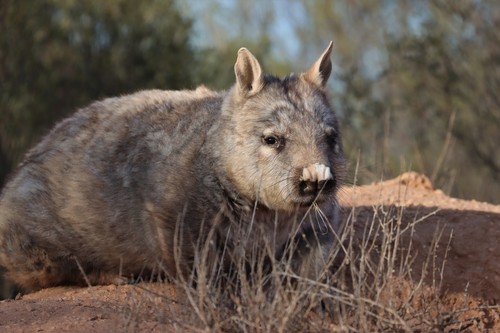
Wombats have a stocky, bear-like build with coarse fur ranging from sandy brown to black, short powerful legs, and a broad head with small eyes and ears. Their nose is bare (hence the common name), distinguishing them from the hairy-nosed wombat species.
Size
Body length ranges from 85 to 130 cm, with a shoulder height of approximately 25-35 cm and a very short, stubby tail of about 2.5 cm.
Weight
Adults typically weigh between 20 and 35 kg, with males generally slightly larger than females, though sexual dimorphism is minimal.
Distinctive features
The bare, unfurred nose is the key feature distinguishing this species from the two hairy-nosed wombat species (Lasiorhinus species). It also has 15 pairs of ribs compared to 13 in hairy-nosed wombats, and generally shorter, rounder ears.
Differences between males and females
Minimal sexual dimorphism; males may be slightly heavier than females, but external differences are subtle and not easily used for field identification.
Behaviour and diet of the Bare-nosed Wombat
Wombats are largely solitary and territorial, defending burrow systems from other wombats, though home ranges can overlap. They communicate territorial boundaries through scent marking rather than direct social interaction.
When it is active
Primarily nocturnal and crepuscular, though wombats may become more diurnal in cooler months or in areas with fewer human disturbances.
Diet
Strict herbivores, wombats feed mainly on native grasses, sedges, roots, and occasionally bark. Their diet is high in fiber and low in nutrients, requiring slow digestion facilitated by an extended gut passage time.
Communication
Wombats communicate primarily through scent marking with cube-shaped feces placed on prominent rocks and logs to establish territory. They also produce hissing, growling, and grunting vocalizations, especially during territorial disputes.
Interactions with other species
Adult wombats have few natural predators, though Tasmanian devils and dingoes may prey on juveniles. Their burrows are frequently used by other species, including echidnas, snakes, and various small mammals, making wombats important ecosystem engineers.
Role in its ecosystem
As ecosystem engineers, wombats create extensive burrow systems that provide shelter for numerous other species and aerate and mix soil, contributing to nutrient cycling. Their grazing helps maintain grassland structure and diversity.
Reproduction and lifecycle
Breeding can occur year-round but peaks in the cooler months; gestation lasts about 20-30 days, unusually short for a mammal of this size. A single joey is born and immediately crawls into the mother's pouch, remaining there for approximately 6 months.
Raising the young
Mothers provide sole parental care, nursing the joey in the pouch for around 6 months and then allowing it to remain in the burrow, with weaning occurring at 12-15 months. Joeys may stay near their mother for up to 18 months before becoming fully independent.
Maturity and lifespan
Sexual maturity is reached at approximately 2 years of age. Wombats can live 5-15 years in the wild, with captive individuals often living 20 years or more.
Taxonomy and naming of the Bare-nosed Wombat
Classification
Class Mammalia > Order Diprotodontia > Family Vombatidae > Genus Vombatus > Species Vombatus ursinus
Subspecies
Three recognized subspecies: Vombatus ursinus ursinus (Tasmania), V. u. hirsutus (mainland Australia), and V. u. tasmaniensis (some Bass Strait islands, though taxonomy is debated).
Scientific synonyms
Didelphis ursina (original 1798 description), Phascolomys ursinus
What research says
Recent studies
Recent studies have focused on the mechanism behind wombats' unique cube-shaped feces, revealing that varying elasticity in the intestinal walls creates this distinctive shape. Research has also examined genetic diversity and mange treatment efficacy across populations.
Genome and DNA
The wombat genome has been studied for insights into marsupial biology, with a diploid chromosome number of 2n=14. Genetic research has also focused on immune responses related to mange resistance.
Compared with similar species
Compared to the Southern and Northern Hairy-nosed Wombats, the Bare-nosed Wombat has a hairless nose, more rounded ears, and generally inhabits a broader range with more varied habitat types. It is also more commonly encountered due to its wider distribution and less restrictive habitat requirements.
The Bare-nosed Wombat and people
Wombats produce distinctively cube-shaped droppings, one of the only animals known to do so, which they stack to mark territory without them rolling away. They can run up to 40 km/h in short bursts despite their stocky build, and their backward pouch prevents dirt from getting on their young while digging.
Where and how to see it
Best observed at dusk or dawn in Tasmanian national parks such as Cradle Mountain or Narawntapu, where wombats are relatively habituated to human presence. Patience and quiet observation near burrow entrances in grassy clearings increase chances of sightings.
Risks to humans
Generally low risk to humans, though wombats can inflict serious injury with their powerful legs and sharp claws if cornered or threatened. Vehicle collisions involving wombats pose a greater practical risk to human drivers than direct wombat aggression.
Human uses
Wombats have limited direct commercial use, though they are popular tourist attractions and symbols of Australian wildlife conservation. Historically, some Aboriginal communities hunted wombats for meat and fur.
Myths and legends
In Aboriginal Australian mythology, wombats feature in various Dreamtime stories, often depicted as stubborn or slow-witted characters who nonetheless outsmart more agile animals. They hold cultural significance as a distinctly Australian icon in modern folklore and popular culture.
Countries where the Bare-nosed Wombat is recorded
The 2 countries named in the range description of its IUCN Red List assessment.
Questions about the Bare-nosed Wombat
Where does the Bare-nosed Wombat live?
The Bare-nosed Wombat is recorded in Australia and United Kingdom across Europe and Oceania. These countries come from the range description of its IUCN Red List assessment, and they are what place the species on the interactive map.
Is the Bare-nosed Wombat endangered?
The IUCN Red List assesses the Bare-nosed Wombat as Least Concern. The species is widespread and abundant enough not to qualify for any threatened category. It does not mean the species is safe forever, only that nothing in the current data raises an alarm.
How many are left in the wild?
Population estimated at several hundred thousand individuals, considered stable overall, though some localized populations are declining due to disease. This figure comes from the species assessment on the IUCN Red List; population estimates for wild mammals are ranges, not counts, and are revised at each assessment.
What habitat does the Bare-nosed Wombat live in?
Wombats inhabit forests, woodlands, grasslands, and coastal heathlands with soil suitable for burrowing.
What is the scientific name of the Bare-nosed Wombat?
The Bare-nosed Wombat is Vombatus ursinus, in the family Vombatidae, order Diprotodontia.
Other species in the family Vombatidae

Species that share its range

Sources
Conservation status, range description and population estimate come from the IUCN Red List assessment for Vombatus ursinus. Countries are derived from that range description, not from a mapped country list. Last refreshed on .
The distribution map is drawn from the IUCN Red List spatial data compiled in 2024. sRedList