
Atherton Antechinus
Antechinus godmani
Red List assessment
Least Concernon the IUCN Red List
- EXExtinct
- EWExtinct in the Wild
- CRCritically Endangered
- ENEndangered
- VUVulnerable
- NTNear Threatened
- LCLeast Concern
The Atherton Antechinus is recorded in one country, Australia across Oceania. The IUCN Red List assesses the Atherton Antechinus as Least Concern. No precise global population estimate is available; population trend is considered broadly stable but potentially declining locally due to ongoing predation pressure and climate projections for reduced rainfall in the Wet Tropics.
- Family
- Dasyuridae
- Order
- Dasyuromorphia
- Genus
- Antechinus
- Countries recorded
- 1
- Continents
- Oceania
- Red List category
- Least Concern
- Data updated
- August 9, 2026
What is the Atherton Antechinus?
The Atherton Antechinus is a small, shrew-like carnivorous marsupial endemic to the upland rainforests of the Atherton Tablelands in northeastern Queensland, Australia. It belongs to the family Dasyuridae and is one of many Antechinus species remarkable for their semelparous mating system, in which all males die after a single, frenzied breeding season. It occupies montane rainforest habitats within the globally significant Wet Tropics World Heritage Area. Despite its modest size and cryptic nocturnal habits, it plays an important role as an insectivore in its ecosystem.
Where does the Atherton Antechinus live?
Atherton Tablelands, northeastern Queensland, Australia (Wet Tropics bioregion)
Endemic to Australia; restricted to the Atherton Tablelands and surrounding upland areas of the Wet Tropics region in northeastern Queensland, roughly between Ravenshoe and the mountains near Kuranda, including areas around Malanda, Yungaburra, and Mount Hypipamee.
Altitude and depth
Primarily found between approximately 600 m and 1,600 m above sea level; most abundant in montane rainforests above 700 m, associated with the highland core of the Wet Tropics.
Seasonal movements
No seasonal migration; activity may intensify during the short, synchronised late-winter/spring breeding season (approximately July–September). There is no hibernation, though activity patterns may shift slightly with seasonal temperature and rainfall changes.
Habitat of the Atherton Antechinus
Primarily upland and montane tropical rainforest, including complex notophyll and mesophyll vine forests characteristic of the Wet Tropics. It favors dense understorey with abundant leaf litter, fallen logs, and rotting timber that provide foraging sites and shelter.
Adaptations to its environment
Its slender body and long, flexible snout are well-adapted to probing leaf litter and bark crevices for invertebrates. Like all Antechinus, males undergo a dramatic physiological stress response during mating, involving surging corticosteroids that suppress immunity — a trade-off maximising sperm competition. Dense, insulating fur suits the cooler montane environment.
Conservation status and numbers
Least Concern (LC) on the IUCN Red List. Although its range is geographically restricted, no rapid population decline has been detected, and significant portions of its habitat fall within protected areas. However, its small, fragmented range means it could be vulnerable to future environmental change.
Estimated population
No precise global population estimate is available; population trend is considered broadly stable but potentially declining locally due to ongoing predation pressure and climate projections for reduced rainfall in the Wet Tropics.
What threatens the Atherton Antechinus?
Invasive predators (feral cats and red foxes) pose the greatest ongoing threat. Climate change is a serious concern, as rising temperatures and altered rainfall may compress or eliminate suitable montane rainforest habitat. Habitat loss from past clearing of lowland rainforest has already restricted connectivity.
Diseases and parasites
Susceptible to ectoparasites including mites, ticks, and fleas common to small Australian marsupials. Internal parasites such as nematodes and coccidia have been recorded in related Antechinus species. Feral cat-transmitted diseases (e.g., toxoplasmosis) may pose a threat in areas of high cat density.
What is being done to protect it?
Much of the species' range falls within the Wet Tropics of Queensland World Heritage Area and Queensland national parks (e.g., Mount Hypipamee, Wooroonooran). Feral predator control programs operate in parts of the region. The species benefits from the overarching Threatened Species Strategy of the Australian Government.
Recommended actions
Expansion and intensification of feral cat and fox control programs within the range; long-term climate change modelling to identify refugia; establishment of connectivity corridors between highland habitat patches; targeted population monitoring to detect early declines.
What the Atherton Antechinus looks like
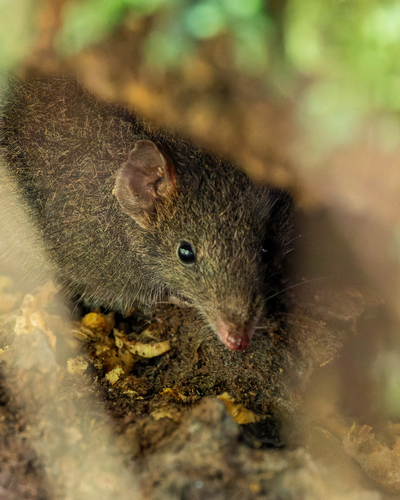
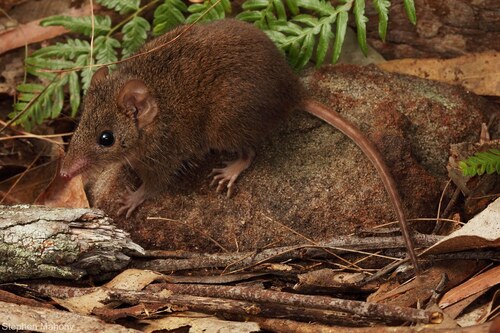
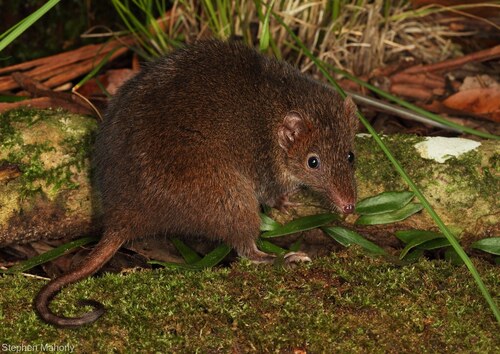
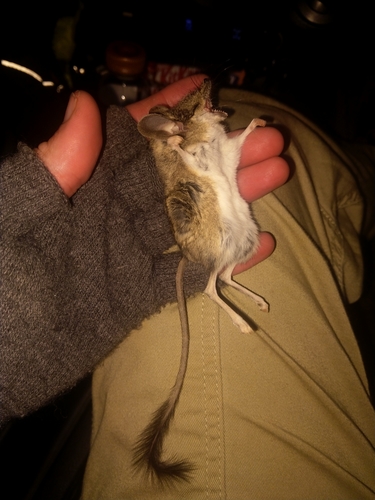
Fur is greyish-brown to warm brown on the dorsal surface, grading to pale grey or cream on the underparts. The face is pointed with large, dark eyes suited to nocturnal vision. The ears are rounded and moderately large. The tail is slender and lightly haired.
Size
Head-body length approximately 95–135 mm in males and 80–110 mm in females; tail length 85–110 mm; a typical small Antechinus with no external pouch in females (young cling to abdominal teats).
Weight
Males typically 55–85 g; females typically 25–50 g; males are noticeably heavier, especially during the pre-breeding season.
Distinctive features
Distinguished from the sympatric Rusty Antechinus (Antechinus adustus) by its generally greyer dorsal colouration and less rufous flanks. Compared to the lowland-occurring Yellow-footed Antechinus (A. flavipes), it lacks the strongly contrasting yellow-orange flanks and occupies higher-altitude habitat.
Differences between males and females
Males are substantially larger and heavier than females, a pattern common across the genus. There is no notable colour difference between sexes. Males develop visibly prominent scrotal testes during the breeding season.
Behaviour and diet of the Atherton Antechinus
Predominantly solitary outside the breeding season. Individuals maintain overlapping home ranges, with males ranging more widely than females. No persistent pair bonds or stable social groups are formed.
When it is active
Primarily nocturnal and scansorial, foraging on the ground and in the understorey from dusk onwards. Activity levels are highest in the hours after sunset and before dawn.
Diet
Carnivorous/insectivorous; diet consists mainly of invertebrates including beetles, cockroaches, crickets, spiders, centipedes, and earthworms. Larger individuals may occasionally take small lizards or nestling birds. It is an opportunistic predator of whatever arthropods are locally abundant.
How it feeds and hunts
Hunts by active searching through leaf litter, under bark, and in rotting logs using its acute sense of smell and hearing. It pounces on and subdues prey with its sharp, pointed teeth. Prey is located primarily by olfaction and sound rather than vision.
Communication
Uses high-pitched squeaks and chittering calls during aggressive or mating encounters. Scent marking via urine and sternal glands is likely important for territory demarcation and mate assessment. Tactile communication occurs during prolonged copulation.
Interactions with other species
Predated upon by powerful owls (Ninox strenua), rufous owls (N. rufa), spotted-tailed quolls (Dasyurus maculatus), carpet pythons (Morelia spilota), and feral cats. Competes for invertebrate prey with other insectivorous species including other Antechinus, melomys, and skinks. Helps regulate insect populations.
Role in its ecosystem
Functions as a mid-trophic insectivore, helping to control invertebrate populations in montane rainforest. As prey for larger predators, it contributes to energy flow up the food chain. Its burrowing and foraging in leaf litter may assist nutrient cycling.
Reproduction and lifecycle
Breeding is highly synchronised, occurring once per year in a brief window (1–3 weeks) in late winter to early spring (July–September). Gestation lasts approximately 28–35 days. Litter size is typically 6–10 young, matching the number of abdominal teats. After leaving the teat, young are deposited in a leaf-lined nest.
Raising the young
The mother provides all parental care; fathers die universally after mating and play no subsequent role. Young attach to abdominal teats (no true pouch) for roughly 5 weeks, then are left in a nest while the female forages. Weaning occurs at approximately 4–5 months of age, with juveniles dispersing before the next breeding season.
Maturity and lifespan
Sexual maturity is reached at approximately 11 months of age, just before the first and only breeding season. All males die by the age of ~12 months (semelparity); females can survive to a second or, rarely, a third breeding season, giving a maximum wild lifespan of about 2–3 years.
Taxonomy and naming of the Atherton Antechinus
Classification
Mammalia > Dasyuromorphia > Dasyuridae > Antechinus > Antechinus godmani
Scientific synonyms
Historically considered conspecific with or a subspecies of Antechinus stuartii; described by Dollman in 1926 and sometimes listed as Antechinus stuartii godmani in older literature.
What research says
Recent studies
Molecular systematic revisions of the Antechinus genus in the 2010s confirmed A. godmani as a valid, distinct species and led to the description of several new species within the genus. Research into the neuroendocrinology of semelparous die-off across antechinuses, including A. godmani, has shed light on the hormonal cascade (corticosteroid surge) driving male die-off after mating.
Genome and DNA
Detailed genomic data specific to A. godmani are limited; related Antechinus species typically have a diploid chromosome number of 2n=14. Molecular phylogenetic studies (e.g., Baker et al. 2012–2015) have helped clarify species boundaries within the genus.
Compared with similar species
Most closely related to other members of the Antechinus stuartii species group. The sympatric Rusty Antechinus (A. adustus), described more recently, shares overlapping habitat but tends to be more rufous in colour. The Atherton Antechinus occupies higher elevations than the lowland Yellow-footed Antechinus (A. flavipes). All Antechinus share the unique semelparous mating system, distinguishing them from most other mammals.
The Atherton Antechinus and people
Every single male Atherton Antechinus dies after its first and only mating season — the frenzied, multi-day mating effort causes a fatal hormonal crash that destroys their immune system. Copulation bouts in antechinuses can last up to 12–14 hours without interruption, making them among the most prolonged mating events in the mammal world. Despite weighing less than a AA battery, males will travel large distances and fight rival males relentlessly during the brief breeding window.
Where and how to see it
Best observed at night in montane rainforests of the Atherton Tablelands — areas around Lake Eacham (Yungaburra), Malanda Falls, and Mount Hypipamee National Park are productive locations. Using a red-filtered headlamp increases chances of spotting without disturbing the animal. The late-winter breeding season (July–August) is when males are most active and encounters most likely.
Risks to humans
No notable risk to humans. It may bite if handled, but poses no venom, significant disease transmission risk, or other danger.
Human uses
No significant commercial, agricultural, or traditional uses. The species is of scientific interest as a model organism for studying semelparous reproduction and comparative marsupial biology.
Countries where the Atherton Antechinus is recorded
The 1 countries named in the range description of its IUCN Red List assessment.
Questions about the Atherton Antechinus
Where does the Atherton Antechinus live?
The Atherton Antechinus is recorded in Australia across Oceania. These countries come from the range description of its IUCN Red List assessment, and they are what place the species on the interactive map.
Is the Atherton Antechinus endangered?
The IUCN Red List assesses the Atherton Antechinus as Least Concern. The species is widespread and abundant enough not to qualify for any threatened category. It does not mean the species is safe forever, only that nothing in the current data raises an alarm.
How many are left in the wild?
No precise global population estimate is available; population trend is considered broadly stable but potentially declining locally due to ongoing predation pressure and climate projections for reduced rainfall in the Wet Tropics. This figure comes from the species assessment on the IUCN Red List; population estimates for wild mammals are ranges, not counts, and are revised at each assessment.
What habitat does the Atherton Antechinus live in?
Primarily upland and montane tropical rainforest, including complex notophyll and mesophyll vine forests characteristic of the Wet Tropics.
What is the scientific name of the Atherton Antechinus?
The Atherton Antechinus is Antechinus godmani, in the family Dasyuridae, order Dasyuromorphia.
Other species in the genus Antechinus

Other species in the family Dasyuridae

Sources
Conservation status, range description and population estimate come from the IUCN Red List assessment for Antechinus godmani. Countries are derived from that range description, not from a mapped country list. Last refreshed on .
The distribution map is drawn from the IUCN Red List spatial data compiled in 2008. IUCN (International Union for Conservation of Nature)