
Habbema Dasyure
Murexia habbema
Red List assessment
Least Concernon the IUCN Red List
- EXExtinct
- EWExtinct in the Wild
- CRCritically Endangered
- ENEndangered
- VUVulnerable
- NTNear Threatened
- LCLeast Concern
The Habbema Dasyure is recorded in 2 countries across Asia and Oceania. The IUCN Red List assesses the Habbema Dasyure as Least Concern. No precise global population estimate is available.
- Family
- Dasyuridae
- Order
- Dasyuromorphia
- Genus
- Murexia
- Countries recorded
- 2
- Continents
- Asia and Oceania
- Red List category
- Least Concern
- Data updated
- August 9, 2026
What is the Habbema Dasyure?
The Habbema Dasyure is a small, carnivorous marsupial of the family Dasyuridae, endemic to the montane forests of New Guinea. Named after Lake Habbema in the Jayawijaya Mountains of West Papua (Indonesia), the site of its type locality discovered during the 1938–1939 Archbold Expedition. It is a highland specialist and one of the few marsupial predators adapted to high-altitude New Guinea environments. Like other members of its genus, it feeds primarily on insects and small invertebrates, playing an important role as a mesopredator in montane ecosystems.
Where does the Habbema Dasyure live?
Highlands of New Guinea: Indonesian Papua and West Papua provinces (Jayawijaya Mountains, Star Mountains) and the Highlands region of Papua New Guinea (Eastern Highlands, Simbu/Chimbu).
Endemic to the island of New Guinea. Range includes the Jayawijaya (Snow) Mountains and Star Mountains of Indonesian Papua/West Papua, and extends into the central highlands of Papua New Guinea, including the Eastern Highlands and Simbu provinces.
Altitude and depth
Typically found between 2,000 and 3,600 m above sea level. The type locality, Lake Habbema, lies at approximately 3,225 m, indicating a preference for high-altitude montane zones.
Habitat of the Habbema Dasyure
Montane tropical forests, mossy cloud forests, and subalpine shrublands at high elevation. The species favors dense, humid forest with abundant leaf litter and fallen logs, which provide shelter and rich foraging grounds for invertebrates.
Adaptations to its environment
Possesses short, dense fur providing insulation against the cold temperatures of high-altitude forests. Its pointed snout, sensitive vibrissae, and sharp teeth are well-suited for locating and capturing invertebrate prey in leaf litter. Like all dasyurids, it has a high metabolic rate relative to body size, requiring near-continuous foraging.
Conservation status and numbers
Least Concern (LC) on the IUCN Red List. The species is considered stable within its highland range, which remains relatively intact. Precise population data are lacking, and its inaccessible montane habitat affords some natural protection from human disturbance.
Estimated population
No precise global population estimate is available. The population trend is presumed stable, though the species is rarely detected and remains poorly monitored due to the remoteness of its habitat.
What threatens the Habbema Dasyure?
Incremental habitat loss from logging, subsistence agriculture expansion, and road construction penetrating the New Guinea highlands. Long-term climate change poses a significant threat by pushing montane forest zones upward, potentially compressing and fragmenting the available habitat at elevation.
Diseases and parasites
No specific diseases or parasites have been documented for this species. General dasyurid ecto- and endoparasites (mites, fleas, nematodes, protozoans) are likely present, as documented in related taxa.
What is being done to protect it?
The species benefits indirectly from several protected areas within its range, most notably Lorentz National Park in West Papua (Indonesia), a UNESCO World Heritage Site covering about 2.5 million hectares of New Guinea highland and lowland ecosystems. Various highland conservation zones in Papua New Guinea also provide partial protection.
Recommended actions
Systematic field surveys using live-trapping and camera traps to clarify the species' range and population size. Long-term monitoring of highland forest integrity in both Indonesia and Papua New Guinea. Integration into national biodiversity monitoring frameworks and support for community-based conservation in highland areas.
What the Habbema Dasyure looks like
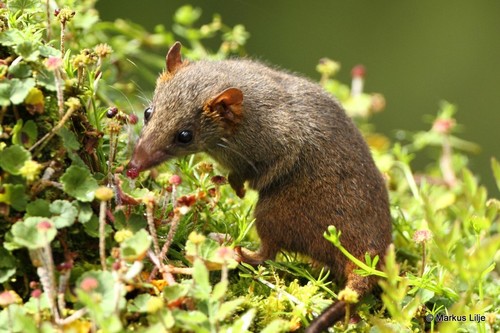
A small, mouse-like marsupial with short, dense fur that is brownish to grayish-brown dorsally and pale cream or whitish ventrally. The muzzle is distinctly pointed, the eyes are relatively large and dark, the ears are rounded, and the slender tail is covered with fine hairs.
Size
Head-body length approximately 90–145 mm; tail length approximately 100–165 mm.
Weight
Estimated 25–65 g; precise sex-specific data are not available for this species.
Distinctive features
Distinguished from the closely related Murexia longicaudata by its strict highland distribution and slightly more compact morphology. Compared to Murexia rothschildi, it is generally smaller in body size. The combination of high-altitude range and short, soft fur helps separate it from congeners in the field.
Differences between males and females
Minimal; males may be marginally larger than females, as is common in small dasyurids, but pronounced sexual dimorphism is not documented for this species.
Behaviour and diet of the Habbema Dasyure
Presumed to be solitary outside of the breeding season, with individuals maintaining separate home ranges, as is typical for small dasyurids. Social interactions are likely limited to brief encounters during reproduction.
When it is active
Presumed primarily nocturnal. Forages at night for invertebrate prey among leaf litter, roots, and low vegetation. During the day, individuals likely shelter in hollow logs, dense moss, or rocky crevices.
Diet
Carnivorous and insectivorous. Diet is thought to consist primarily of insects (beetles, orthopterans, larvae), spiders, earthworms, and other invertebrates. Small vertebrates such as lizards, frogs, or nestling birds may be taken opportunistically.
How it feeds and hunts
Active, opportunistic forager. Uses its sensitive vibrissae and olfactory senses to detect prey beneath leaf litter and in soil. Prey is quickly seized with the jaws and dispatched with sharp, pointed teeth. May also probe under bark and mossy substrate.
Communication
Likely relies on scent marking to delineate territories and communicate reproductive status, as well as high-pitched vocalizations (squeaks and chirps) during close-range interactions. Tactile and postural signals are also probable during social and mating encounters.
Interactions with other species
Subject to predation by highland owls (notably Tyto tenebricosa and other Strigidae), large arboreal snakes, and diurnal raptors. Competes with other small insectivorous mammals and possibly with shrew-like species sharing the same montane habitat.
Role in its ecosystem
Functions as a mesopredator and primary consumer of invertebrates in high-altitude forest ecosystems, contributing to the regulation of invertebrate populations. It also serves as prey for larger predators, linking trophic levels in montane food webs.
Reproduction and lifecycle
Breeding biology is poorly documented for this species. As in other small dasyurids, gestation is presumed to be very short (approximately 2–4 weeks). The genus Murexia has a rudimentary or absent marsupial pouch; newborns attach to teats and are carried by the mother, later transitioning to a nest.
Raising the young
Maternal care is the norm. The mother nurses and protects young in a concealed nest after the teat-attachment phase. Litter size in related Murexia species ranges from approximately 4 to 8 young. Paternal care is not expected, as in most dasyurids.
Maturity and lifespan
Sexual maturity is likely achieved within the first year of life, consistent with related small dasyurids. Wild lifespan is estimated at 2–4 years; no captive longevity data are available for this species.
Taxonomy and naming of the Habbema Dasyure
Classification
Mammalia > Dasyuromorphia > Dasyuridae > Murexia > Murexia habbema
Scientific synonyms
Originally described as Phascogale habbema Tate & Archbold, 1941; also referred to as Antechinus habbema. Formerly sometimes treated as a subspecies of Murexia longicaudata.
What research says
Recent studies
The genus Murexia has been subject to ongoing taxonomic revision using molecular phylogenetics, which has helped clarify species boundaries among New Guinea dasyurids and supported the recognition of M. habbema as a distinct highland species. Broader dasyurid genomic studies have shed light on marsupial evolutionary history but species-specific genetic studies for M. habbema remain absent from the published literature.
Compared with similar species
Most closely related to Murexia longicaudata (Short-furred Dasyure), from which it is separated primarily by elevation and subtle morphological differences. It converges ecologically with Australian antechinuses (genus Antechinus) in body size, diet, and habitat use, representing a remarkable case of ecological parallelism across the Torres Strait. Unlike the Australian antechinuses, semelparity (post-mating male die-off) has not been confirmed in Murexia.
The Habbema Dasyure and people
The Habbema Dasyure's type locality, Lake Habbema at 3,225 m in the Jayawijaya Mountains, was one of the most inaccessible places on Earth when the species was first described in 1941, reachable only after weeks of overland trekking. Despite being a marsupial, it is so mouse-like in appearance that it exemplifies convergent evolution with placental rodents and shrews on an extraordinary scale. Its high metabolic rate likely means it must consume a quantity of invertebrate prey close to its own body weight every single day to survive the cold highland nights.
Where and how to see it
Best sought in the montane forests of the New Guinea highlands, particularly within or adjacent to Lorentz National Park (West Papua, Indonesia) and in the Simbu and Eastern Highlands provinces of Papua New Guinea. Night surveys with headlamps along forest edges and near streams offer the best chance of detection. Targeted live-trapping programs are generally required for confirmed records, as the species is cryptic and very rarely observed by chance.
Risks to humans
No notable risk to humans. This small marsupial is not venomous and poses no danger; it may bite defensively if handled.
Countries where the Habbema Dasyure is recorded
The 2 countries named in the range description of its IUCN Red List assessment.
Questions about the Habbema Dasyure
Where does the Habbema Dasyure live?
The Habbema Dasyure is recorded in Indonesia and Papua New Guinea across Asia and Oceania. These countries come from the range description of its IUCN Red List assessment, and they are what place the species on the interactive map.
Is the Habbema Dasyure endangered?
The IUCN Red List assesses the Habbema Dasyure as Least Concern. The species is widespread and abundant enough not to qualify for any threatened category. It does not mean the species is safe forever, only that nothing in the current data raises an alarm.
How many are left in the wild?
No precise global population estimate is available. This figure comes from the species assessment on the IUCN Red List; population estimates for wild mammals are ranges, not counts, and are revised at each assessment.
What habitat does the Habbema Dasyure live in?
Montane tropical forests, mossy cloud forests, and subalpine shrublands at high elevation.
What is the scientific name of the Habbema Dasyure?
The Habbema Dasyure is Murexia habbema, in the family Dasyuridae, order Dasyuromorphia.
Other species in the genus Murexia

Other species in the family Dasyuridae

Species that share its range
Sources
Conservation status, range description and population estimate come from the IUCN Red List assessment for Murexia habbema. Countries are derived from that range description, not from a mapped country list. Last refreshed on .
The distribution map is drawn from the IUCN Red List spatial data compiled in 2008. IUCN (International Union for Conservation of Nature)