
Spotted Bolo Mouse
Necromys punctulatus
Red List assessment
Data Deficienton the IUCN Red List
- EXExtinct
- EWExtinct in the Wild
- CRCritically Endangered
- ENEndangered
- VUVulnerable
- NTNear Threatened
- LCLeast Concern
Data Deficient has no position on the scale above — it records the absence of an assessment, not a degree of risk.
The Spotted Bolo Mouse is recorded in 2 countries across South America. The IUCN Red List records the Spotted Bolo Mouse as Data Deficient. No reliable population estimate exists; the species is known only from a limited number of museum specimens and localities, with population trend unknown.
- Family
- Cricetidae
- Order
- Rodentia
- Genus
- Necromys
- Countries recorded
- 2
- Continents
- South America
- Red List category
- Data Deficient
- Data updated
- August 9, 2026
What is the Spotted Bolo Mouse?
Necromys punctulatus, commonly known as the Spotted Bolo Mouse, is a small sigmodontine rodent native to the high-altitude grasslands of the central Andes. It belongs to a group of South American 'bolo mice' known for their compact bodies adapted to cold, open habitats. Very little is known about its biology due to its remote distribution and infrequent sampling, which is why it is classified as Data Deficient. Its discovery and taxonomic history reflect the complex diversification of Akodontini rodents in the Andes.
Where does the Spotted Bolo Mouse live?
High Andean grasslands of southern Peru and western Bolivia
Known from scattered localities in southern Peru (Puno region) and western Bolivia (La Paz department), within the high Andean plateau. Its full range remains poorly documented due to limited survey effort in this remote region.
Altitude and depth
Approximately 3500 to 4500 meters above sea level, within high-altitude puna zones.
Seasonal movements
No confirmed seasonal migration; likely remains active year-round with possible reduced activity during the coldest, driest months typical of the Andean dry season.
Habitat of the Spotted Bolo Mouse
Inhabits high-altitude puna grasslands and páramo-like habitats characterized by tussock grasses, low shrubs, and rocky outcrops. It is typically found in open, cold environments above the treeline rather than in forested areas.
Adaptations to its environment
Likely possesses dense fur and a compact body form to conserve heat in the cold, high-altitude environment typical of puna-dwelling rodents. Burrowing behavior probably provides shelter from extreme temperature fluctuations and predators.
Conservation status and numbers
Listed as Data Deficient (DD) by the IUCN due to insufficient information on population size, distribution, and threats. Its poorly known ecology and remote habitat have prevented a more precise conservation assessment.
Estimated population
No reliable population estimate exists; the species is known only from a limited number of museum specimens and localities, with population trend unknown.
What threatens the Spotted Bolo Mouse?
Potential threats include habitat degradation from overgrazing by livestock, climate change affecting high-altitude grassland ecosystems, and agricultural expansion into puna zones, though specific impacts on this species are unconfirmed.
What is being done to protect it?
No species-specific conservation programs are currently in place, though its range may overlap with existing protected areas in the Peruvian and Bolivian Andes that could offer indirect habitat protection.
Recommended actions
Increased field surveys to clarify distribution and population status, taxonomic reassessment to confirm species boundaries, and habitat monitoring in high-altitude grasslands are recommended priorities.
What the Spotted Bolo Mouse looks like
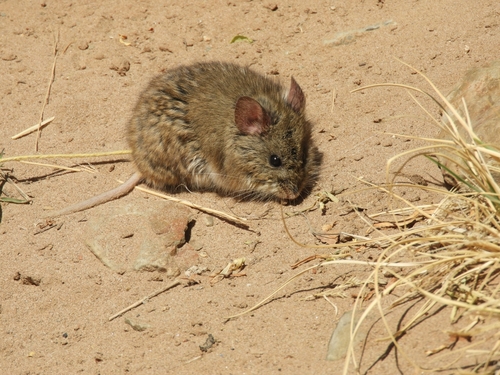
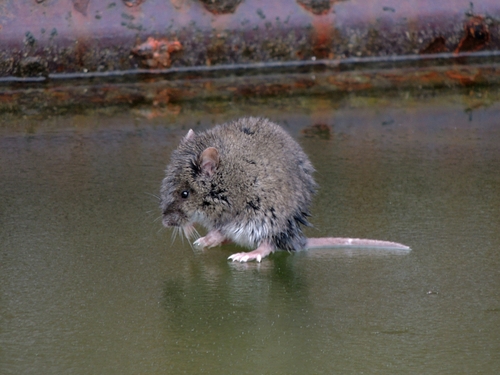
Likely has grayish-brown to dark brown dorsal fur with a paler, grayish underside, and short, dense fur suited to cold climates. The common name 'spotted' may refer to subtle mottling or speckling in the coat pattern.
Size
Body length approximately 8-11 cm, with a tail slightly shorter than the body, typical of small akodontine rodents.
Weight
Estimated weight range of 15-30 grams, consistent with similarly sized Necromys species.
Distinctive features
Distinguished from related Necromys species primarily through cranial and dental characteristics rather than obvious external features, making field identification challenging without specimen examination.
Behaviour and diet of the Spotted Bolo Mouse
Presumed to be largely solitary, as is typical for small akodontine rodents, though social structure has not been specifically studied in this species.
When it is active
Likely nocturnal or crepuscular, consistent with the activity patterns of related small rodents in similar high-altitude habitats.
Diet
Presumed omnivorous, likely feeding on seeds, grasses, and invertebrates found in puna grassland ecosystems, similar to other Necromys species.
How it feeds and hunts
Likely forages on the ground among grass tussocks and burrows, opportunistically consuming plant material and small invertebrates rather than actively hunting prey.
Communication
Likely uses vocalizations, scent marking, and tactile cues typical of small rodents, though no specific studies have documented communication in this species.
Interactions with other species
Likely preyed upon by Andean raptors, foxes, and small carnivores; may compete with other small rodents for resources in the puna ecosystem.
Role in its ecosystem
Plays a role in high-altitude grassland ecosystems as a seed disperser and prey species, contributing to nutrient cycling and serving as a food source for predators.
Reproduction and lifecycle
Reproductive biology is undocumented; related Necromys species typically breed seasonally with litters of 2-6 offspring after a gestation period of approximately 21-25 days.
Raising the young
Presumed maternal care typical of small rodents, with females nursing and protecting young in burrows until weaning, though specific behaviors are undocumented for this species.
Maturity and lifespan
Sexual maturity likely reached within a few months, with a lifespan of 1-2 years in the wild, consistent with similar small rodent species.
Taxonomy and naming of the Spotted Bolo Mouse
Classification
Class Mammalia > Order Rodentia > Family Cricetidae > Genus Necromys > Species Necromys punctulatus
Scientific synonyms
Akodon punctulatus (former generic placement); Bolomys punctulatus
What research says
Recent studies
Limited recent research exists; most knowledge derives from historical museum specimens and broader phylogenetic studies of the Akodontini tribe rather than species-specific fieldwork.
Compared with similar species
Similar in size and ecology to other high-altitude Necromys species such as Necromys lactens, but distinguished by subtle morphological and genetic differences requiring specialist identification.
The Spotted Bolo Mouse and people
This species is so poorly studied that its exact appearance and behavior remain largely a mystery to science, exemplifying how much biodiversity in remote Andean habitats is still undocumented. It survives in one of the most extreme rodent habitats in South America, at elevations rivaling those of mountain-dwelling ungulates.
Where and how to see it
Observation opportunities are extremely limited due to its remote high-altitude habitat and poorly known distribution; specialized rodent surveys in the puna grasslands of southern Peru or western Bolivia would be required, ideally with expert guidance.
Risks to humans
No notable risk to humans.
Countries where the Spotted Bolo Mouse is recorded
The 2 countries named in the range description of its IUCN Red List assessment.
Questions about the Spotted Bolo Mouse
Where does the Spotted Bolo Mouse live?
The Spotted Bolo Mouse is recorded in Bolivia and Peru across South America. These countries come from the range description of its IUCN Red List assessment, and they are what place the species on the interactive map.
Is the Spotted Bolo Mouse endangered?
The IUCN Red List assesses the Spotted Bolo Mouse as Data Deficient. There is not enough information to judge the risk of extinction, usually because the species is rarely seen or has never been surveyed. It is not a reassuring category: several species were Data Deficient right up to the point they were found to be Critically Endangered.
How many are left in the wild?
No reliable population estimate exists; the species is known only from a limited number of museum specimens and localities, with population trend unknown. This figure comes from the species assessment on the IUCN Red List; population estimates for wild mammals are ranges, not counts, and are revised at each assessment.
What habitat does the Spotted Bolo Mouse live in?
Inhabits high-altitude puna grasslands and páramo-like habitats characterized by tussock grasses, low shrubs, and rocky outcrops.
What is the scientific name of the Spotted Bolo Mouse?
The Spotted Bolo Mouse is Necromys punctulatus, in the family Cricetidae, order Rodentia.
Other species in the genus Necromys
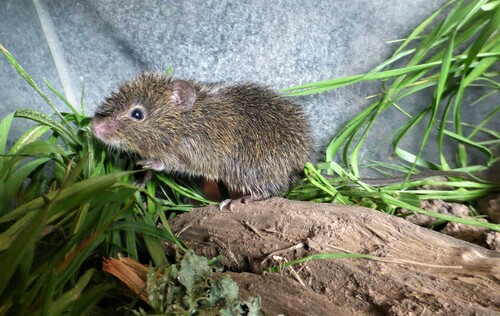
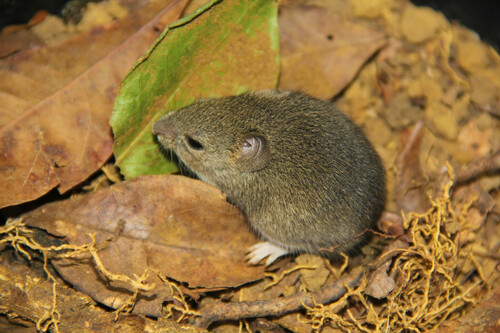
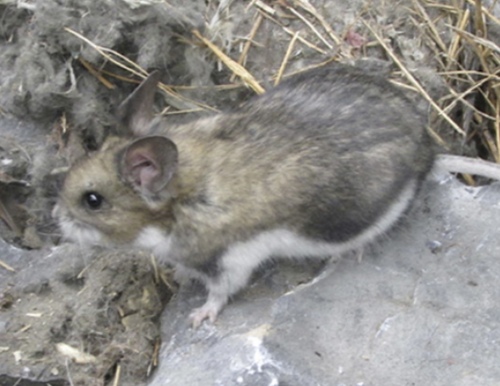
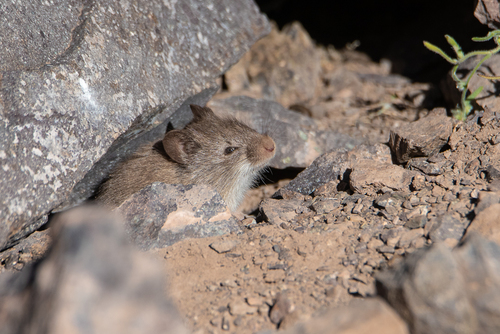
Other species in the family Cricetidae
Sources
Conservation status, range description and population estimate come from the IUCN Red List assessment for Necromys punctulatus. Countries are derived from that range description, not from a mapped country list. Last refreshed on .
The distribution map is drawn from the IUCN Red List spatial data compiled in 2018. IUCN SSC Small Mammal Specialist Group