
Southern Elephant Seal
Mirounga leonina
Red List assessment
Least Concernon the IUCN Red List
- EXExtinct
- EWExtinct in the Wild
- CRCritically Endangered
- ENEndangered
- VUVulnerable
- NTNear Threatened
- LCLeast Concern
The Southern Elephant Seal is recorded in 2 countries across Asia and South America. The IUCN Red List assesses the Southern Elephant Seal as Least Concern. Approximately 650,000-750,000 individuals globally, with populations generally stable, though regional variations exist (e.g., decline at South Georgia, increase at Antarctic Peninsula colonies).
- Family
- Phocidae
- Order
- Carnivora
- Genus
- Mirounga
- Countries recorded
- 2
- Continents
- Asia and South America
- Red List category
- Least Concern
- Data updated
- August 9, 2026
What is the Southern Elephant Seal?
The Southern Elephant Seal is the largest of all pinnipeds, with males reaching up to 4,000 kg. It inhabits sub-Antarctic and Antarctic waters, breeding on remote islands and beaches. Known for extreme sexual dimorphism and deep-diving abilities, it is a remarkable example of marine mammal adaptation to extreme cold environments.
Where does the Southern Elephant Seal live?
Sub-Antarctic islands and Antarctic coastal regions, including South Georgia, Kerguelen Islands, Macquarie Island, and Peninsula Valdés in Argentina
Circumpolar distribution in the Southern Ocean, with major breeding colonies on South Georgia, Kerguelen Islands, Macquarie Island, Heard Island, and Peninsula Valdés (Argentina); forages widely across the Southern Ocean and Antarctic continental shelf.
Altitude and depth
Dives regularly to depths of 300-800m, with maximum recorded dives exceeding 2000m; spends most time at sea in pelagic zones far from shore.
Seasonal movements
Highly migratory, spending up to 8-10 months per year at sea foraging, returning to breeding beaches in austral spring (September-November) for mating and molting in summer (January-March).
Habitat of the Southern Elephant Seal
Breeds on sub-Antarctic and Antarctic beaches, often rocky or sandy shores; spends most of the year foraging in open pelagic and deep sub-Antarctic waters, including areas near sea ice.
Adaptations to its environment
Thick blubber layer (up to 10cm) provides insulation and energy reserves for fasting during breeding; specialized hemoglobin and myoglobin allow extended breath-holding for deep dives; countercurrent heat exchange in flippers minimizes heat loss.
Conservation status and numbers
Listed as Least Concern by IUCN; global population has been relatively stable or slowly increasing after historical depletion from sealing, though some populations (e.g., South Georgia) show ongoing declines due to environmental factors.
Estimated population
Approximately 650,000-750,000 individuals globally, with populations generally stable, though regional variations exist (e.g., decline at South Georgia, increase at Antarctic Peninsula colonies).
What threatens the Southern Elephant Seal?
Historical commercial sealing caused massive population declines; current threats include climate change affecting prey availability and sea ice patterns, entanglement in fishing gear, and pollution.
Diseases and parasites
Susceptible to various parasites including nematodes and lice; documented cases of leptospirosis and other bacterial infections in some populations.
What is being done to protect it?
Protected under various national and international agreements including CCAMLR; breeding sites are within protected areas such as South Georgia and Macquarie Island Nature Reserve; long-term monitoring programs track population trends.
Recommended actions
Continued monitoring of population trends across colonies, research into climate change impacts on foraging success, and maintenance of protected breeding habitat status.
What the Southern Elephant Seal looks like
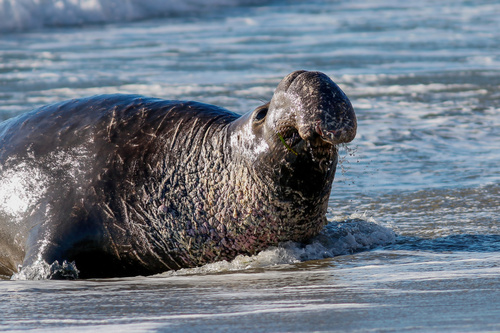
Grey-brown coat that appears darker when wet, lighter and more silvery after molting; males possess a large proboscis (trunk-like nose) used in vocal displays; skin often scarred from fighting.
Size
Males: 4.5-5.8m in length; Females: 2.6-3.5m in length.
Weight
Males: 1,500-4,000 kg; Females: 350-800 kg, representing one of the most extreme size dimorphisms among mammals.
Distinctive features
Distinguished from Northern Elephant Seals by larger body size, different vocalizations, and geographic range; the proboscis in males is more pendulous and less upturned than in Northern Elephant Seals.
Differences between males and females
Extreme dimorphism: males are 3-10 times heavier than females and possess an inflatable proboscis absent in females; males also have thicker, scarred neck skin ('chest shield') used in combat.
Behaviour and diet of the Southern Elephant Seal
Highly polygynous breeding system with dominant 'beachmaster' males controlling harems of 40-50 females; otherwise largely solitary at sea; forms dense breeding aggregations on land.
When it is active
Cathemeral at sea with continuous diving cycles day and night for foraging; on land during breeding and molting, activity is concentrated during daylight hours for social interactions and thermoregulation.
Diet
Carnivorous, feeding primarily on squid and fish, including myctophids (lanternfish) and various cephalopod species found at depth in the Southern Ocean.
How it feeds and hunts
Deep diving forager using suction feeding to capture prey; relies on stored oxygen and slowed heart rate (bradycardia) during dives; may use vibrissae to detect prey in dark waters.
Communication
Males produce loud, resonant vocalizations amplified by the proboscis during territorial and mating displays; body posturing and physical combat are also important for establishing dominance.
Interactions with other species
Preyed upon by killer whales and large sharks (e.g., great white sharks) during at-sea foraging; competes with other pinnipeds for breeding space on shared colonies.
Role in its ecosystem
Serves as a mid-to-upper trophic level predator in the Southern Ocean ecosystem, linking deep-sea prey populations (squid, fish) to apex predators like killer whales.
Reproduction and lifecycle
Breeding occurs once yearly in spring; gestation lasts about 11 months including delayed implantation; single pup born per season after highly synchronized birthing period on breeding beaches.
Raising the young
Mothers nurse pups intensively for 3-4 weeks with extremely fat-rich milk, then abruptly wean and depart to sea; pups fast for several weeks before learning to swim and forage independently.
Maturity and lifespan
Females reach sexual maturity around 3-4 years; males around 4-6 years but rarely breed successfully until 8-10 years due to competition; lifespan averages 20-22 years in the wild.
Taxonomy and naming of the Southern Elephant Seal
Classification
Mammalia > Carnivora > Phocidae > Mirounga > Mirounga leonina
Scientific synonyms
Phoca leonina (Linnaeus, 1758)
What research says
Recent studies
Recent satellite tracking studies have revealed detailed foraging patterns and diving behavior across seasons, providing insight into how climate change may affect prey distribution and seal foraging success.
Genome and DNA
Diploid chromosome number of 2n=34; genetic studies have revealed population structure differences between South Atlantic and Indian Ocean sub-Antarctic colonies.
Compared with similar species
Compared to the Northern Elephant Seal (Mirounga angustirostris), the Southern species is notably larger, has a different vocal repertoire, and inhabits colder, more southerly waters exclusively in the Southern Hemisphere.
The Southern Elephant Seal and people
Southern Elephant Seals can dive continuously for up to 2 hours and reach depths comparable to some whales; males can weigh as much as a small truck; their blubber layer alone can weigh over 1000kg in large males.
Where and how to see it
Best observed at breeding colonies such as South Georgia, Peninsula Valdés (Argentina), or Macquarie Island during the breeding season (September-November) when large numbers gather on beaches.
Risks to humans
Generally low risk to humans if given appropriate distance; large males can be aggressive during breeding season and should not be approached closely due to their size and unpredictable movements.
Human uses
Historically hunted extensively for blubber oil during the 18th-19th centuries; today primarily valued for ecotourism and scientific research rather than direct exploitation.
Myths and legends
Early sealers and explorers regarded these seals as fearsome sea monsters due to their massive size and loud vocalizations, contributing to sailor folklore about giant sea creatures.
Countries where the Southern Elephant Seal is recorded
The 2 countries named in the range description of its IUCN Red List assessment.
Questions about the Southern Elephant Seal
Where does the Southern Elephant Seal live?
The Southern Elephant Seal is recorded in Argentina and Georgia across Asia and South America. These countries come from the range description of its IUCN Red List assessment, and they are what place the species on the interactive map.
Is the Southern Elephant Seal endangered?
The IUCN Red List assesses the Southern Elephant Seal as Least Concern. The species is widespread and abundant enough not to qualify for any threatened category. It does not mean the species is safe forever, only that nothing in the current data raises an alarm.
How many are left in the wild?
Approximately 650,000-750,000 individuals globally, with populations generally stable, though regional variations exist (e.g., decline at South Georgia, increase at Antarctic Peninsula colonies). This figure comes from the species assessment on the IUCN Red List; population estimates for wild mammals are ranges, not counts, and are revised at each assessment.
What habitat does the Southern Elephant Seal live in?
Breeds on sub-Antarctic and Antarctic beaches, often rocky or sandy shores; spends most of the year foraging in open pelagic and deep sub-Antarctic waters, including areas near sea ice.
What is the scientific name of the Southern Elephant Seal?
The Southern Elephant Seal is Mirounga leonina, in the family Phocidae, order Carnivora.
Other species in the genus Mirounga
Other species in the family Phocidae
Species that share its range
Sources
Conservation status, range description and population estimate come from the IUCN Red List assessment for Mirounga leonina. Countries are derived from that range description, not from a mapped country list. Last refreshed on .
The distribution map is drawn from the IUCN Red List spatial data compiled in 2015. Greg Hofmeyr