
Harbour Seal
Phoca vitulina
Red List assessment
Least Concernon the IUCN Red List
- EXExtinct
- EWExtinct in the Wild
- CRCritically Endangered
- ENEndangered
- VUVulnerable
- NTNear Threatened
- LCLeast Concern
The Harbour Seal is recorded in 9 countries across Asia, Europe and North America. The IUCN Red List assesses the Harbour Seal as Least Concern. Global population estimated at 350,000-500,000 individuals, with overall stable trend though some subpopulations experiencing fluctuations
- Family
- Phocidae
- Order
- Carnivora
- Genus
- Phoca
- Countries recorded
- 9
- Continents
- Asia, Europe and North America
- Red List category
- Least Concern
- Data updated
- August 9, 2026
What is the Harbour Seal?
The Harbour Seal is one of the most widespread pinniped species, found along temperate and Arctic coastlines throughout the Northern Hemisphere. It is a true seal (earless) known for its adaptability to diverse coastal habitats and its distinctive spotted coat pattern. This species is notable for its curious, dog-like face and its ability to haul out on rocks, sandbars, and ice.
Where does the Harbour Seal live?
Coastal waters of the Northern Hemisphere including North America (both Atlantic and Pacific coasts), Northern Europe, and parts of Asia (Japan, Korea)
Found along coasts of the North Atlantic and North Pacific, including Canada, USA, Greenland, Iceland, UK, Scandinavia, Netherlands, Germany, Russia, Japan, and Korea; also present in a unique freshwater population in Quebec, Canada
Altitude and depth
Typically dives to 20-100m but capable of dives exceeding 400m; spends significant time at surface and on land/ice haul-out sites
Seasonal movements
Generally non-migratory but may show local seasonal movements tied to breeding, molting, and prey availability; pupping season varies by region from February to July
Habitat of the Harbour Seal
Coastal and estuarine environments including rocky shores, sandbars, mudflats, and sea ice; also found in bays, harbors, and occasionally freshwater lakes and rivers connected to the sea
Adaptations to its environment
Streamlined body and strong flippers for efficient swimming; thick blubber layer for insulation in cold waters; ability to slow heart rate during dives (bradycardia) for extended underwater foraging; vibrissae (whiskers) highly sensitive for detecting prey movement in murky water
Conservation status and numbers
Least Concern (LC) according to IUCN, as the global population is large and stable overall, though some regional populations face localized declines due to disease outbreaks and human disturbance
Estimated population
Global population estimated at 350,000-500,000 individuals, with overall stable trend though some subpopulations experiencing fluctuations
What threatens the Harbour Seal?
Habitat disturbance from human activity, pollution and contaminants, entanglement in fishing gear, disease outbreaks (phocine distemper virus), and historical hunting pressures in some regions
Diseases and parasites
Susceptible to phocine distemper virus (has caused mass die-offs), influenza strains, and various internal/external parasites including lungworms and seal lice
What is being done to protect it?
Protected under Marine Mammal Protection Act in the US, Habitats Directive in EU, and various national wildlife laws; monitored through population surveys and health assessments; some marine protected areas include key haul-out sites
Recommended actions
Continue monitoring for disease outbreaks, reduce bycatch in fishing operations, protect critical haul-out and pupping habitats from disturbance, and address pollution in coastal waters
What the Harbour Seal looks like
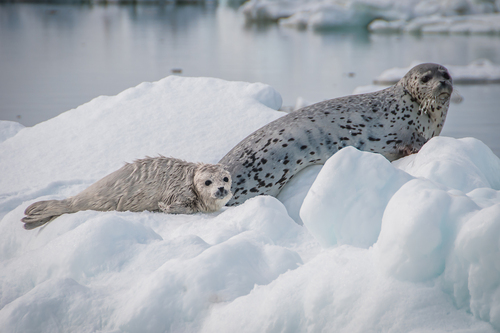
Coat coloration is highly variable, ranging from light gray to dark brown/black, typically covered in dark spots or rings; body is rounded with a small rounded head and large dark eyes giving a dog-like appearance
Size
Body length typically 1.2-2.0 meters, with males slightly larger on average than females
Weight
Adults typically weigh 55-170 kg, with males averaging heavier than females; weight varies significantly by region and season
Distinctive features
Distinguished from other seals by V-shaped nostrils, lack of external ears, spotted coat pattern, and relatively small size compared to gray seals; shorter snout than harp or gray seals
Differences between males and females
Minimal sexual dimorphism; males are slightly larger and heavier than females but coloration and general appearance are similar between sexes
Behaviour and diet of the Harbour Seal
Generally solitary or found in small loose groups, though they may haul out in larger aggregations of dozens to hundreds of individuals on favored sites; not strongly hierarchical
When it is active
Cathemeral (active both day and night), with activity patterns often influenced by tidal cycles which dictate haul-out availability
Diet
Carnivorous, feeding primarily on fish such as herring, cod, flatfish, and sand eels, as well as squid and crustaceans depending on regional availability
How it feeds and hunts
Solitary hunters using stealth and speed to capture prey underwater; rely heavily on vibrissae to detect prey in low-visibility conditions and can perform deep dives to access benthic prey
Communication
Vocalizations include grunts, growls, and roars particularly during breeding season; underwater vocalizations used for mate attraction; body posturing and physical contact also used in social interactions
Interactions with other species
Predators include orcas, sharks (great white, sleeper sharks), and occasionally polar bears in Arctic regions; competes with other pinnipeds for haul-out sites and food resources; sometimes preyed upon by large birds of prey when pups are vulnerable
Role in its ecosystem
Plays a role as a mid-level marine predator, helping regulate fish populations and serving as prey for larger marine predators, thus contributing to coastal food web dynamics
Reproduction and lifecycle
Breeding season varies by region (roughly May-September); gestation lasts about 9-11 months (including delayed implantation); females give birth to a single pup that can swim within hours of birth
Raising the young
Pups are precocial and can swim almost immediately after birth; mothers nurse pups for approximately 4-6 weeks with rich milk before weaning; there is no paternal care, and males do not participate in raising young
Maturity and lifespan
Sexual maturity reached at 3-7 years; lifespan averages 20-30 years in the wild, with some individuals living up to 35 years in captivity
Taxonomy and naming of the Harbour Seal
Classification
Class Mammalia > Order Carnivora > Family Phocidae > Genus Phoca > Species Phoca vitulina
Subspecies
Five recognized subspecies: P. v. vitulina (Eastern Atlantic), P. v. concolor (Western Atlantic), P. v. richardii (Eastern Pacific), P. v. stejnegeri (Western Pacific), P. v. mellonae (freshwater population in Lac des Loups Marins, Quebec)
Scientific synonyms
Phoca variegata, Callocephalus vitulinus, historically also referred to as Common Seal
What research says
Recent studies
Recent research has focused on the impacts of climate change on prey availability, tracking movement patterns via satellite tags, and studying disease transmission dynamics following distemper outbreaks
Genome and DNA
Diploid chromosome number is 32; genetic studies have been used to distinguish regional subspecies and track population structure and connectivity
Compared with similar species
Similar in appearance to the spotted seal (Phoca largha) but harbour seals have a more rounded head and different geographic range; smaller and less aggressive than gray seals (Halichoerus grypus)
The Harbour Seal and people
Harbour seals can sleep underwater, surfacing periodically to breathe without fully waking; they have excellent underwater vision adapted for low-light conditions; some populations exhibit unique behaviors like resting vertically in water ('bottling')
Where and how to see it
Best observed during low tide when seals haul out on rocks or sandbars; coastal areas of Scotland, the Wadden Sea, and New England are popular viewing locations, especially during pupping season in late spring/summer
Risks to humans
Generally low risk to humans, though seals can bite if approached too closely or harassed; can carry zoonotic diseases in rare cases, so direct contact should be avoided
Human uses
Historically hunted for meat, oil, and pelts by indigenous and coastal communities; today primarily valued for ecotourism and scientific research rather than commercial exploitation
Myths and legends
In Celtic and Scottish folklore, seals are associated with 'selkies'—mythical beings that can transform from seals into humans by shedding their skin
Countries where the Harbour Seal is recorded
The 9 countries named in the range description of its IUCN Red List assessment.
Questions about the Harbour Seal
Where does the Harbour Seal live?
The Harbour Seal is recorded in Canada, Germany, Greenland, Iceland and Japan, among 9 countries in total across Asia, Europe and North America. These countries come from the range description of its IUCN Red List assessment, and they are what place the species on the interactive map.
Is the Harbour Seal endangered?
The IUCN Red List assesses the Harbour Seal as Least Concern. The species is widespread and abundant enough not to qualify for any threatened category. It does not mean the species is safe forever, only that nothing in the current data raises an alarm.
How many are left in the wild?
Global population estimated at 350,000-500,000 individuals, with overall stable trend though some subpopulations experiencing fluctuations This figure comes from the species assessment on the IUCN Red List; population estimates for wild mammals are ranges, not counts, and are revised at each assessment.
What habitat does the Harbour Seal live in?
Coastal and estuarine environments including rocky shores, sandbars, mudflats, and sea ice; also found in bays, harbors, and occasionally freshwater lakes and rivers connected to the sea
What is the scientific name of the Harbour Seal?
The Harbour Seal is Phoca vitulina, in the family Phocidae, order Carnivora.
Other species in the genus Phoca
Other species in the family Phocidae
Species that share its range


Sources
Conservation status, range description and population estimate come from the IUCN Red List assessment for Phoca vitulina. Countries are derived from that range description, not from a mapped country list. Last refreshed on .
The distribution map is drawn from the IUCN Red List spatial data compiled in 2016. NPI