
Mediterranean Monk Seal
Monachus monachus
Red List assessment
Vulnerableon the IUCN Red List
- EXExtinct
- EWExtinct in the Wild
- CRCritically Endangered
- ENEndangered
- VUVulnerable
- NTNear Threatened
- LCLeast Concern
The Mediterranean Monk Seal is recorded in 6 countries across Africa, Asia and Europe. The IUCN Red List assesses the Mediterranean Monk Seal as Vulnerable. Estimated at around 700-800 mature individuals globally, with the population considered to be slowly increasing in some areas (Greece, Cabo Blanco) after decades of decline.
- Family
- Phocidae
- Order
- Carnivora
- Genus
- Monachus
- Countries recorded
- 6
- Continents
- Africa, Asia and Europe
- Red List category
- Vulnerable
- Data updated
- August 9, 2026
What is the Mediterranean Monk Seal?
The Mediterranean Monk Seal is one of the world's rarest and most endangered pinnipeds, historically ranging across the Mediterranean Sea, Black Sea, and adjacent Atlantic coasts. It is remarkable for surviving in relict populations despite centuries of persecution and habitat loss, now relying on remote sea caves for pupping. As one of only two surviving Monachus species, it represents an ancient lineage of tropical/warm-water seals.
Where does the Mediterranean Monk Seal live?
Fragmented populations in the eastern Mediterranean (Greece, Turkey), the northeastern Atlantic (Cabo Blanco, Mauritania/Western Sahara), and Madeira (Desertas Islands, Portugal).
Primarily found in the eastern Mediterranean around Greece and Turkey, with smaller colonies in Croatia, Cyprus, and Madeira; the largest single population is at Cabo Blanco on the border of Mauritania and Western Sahara in the northeastern Atlantic.
Altitude and depth
Coastal and shallow marine waters, typically foraging from the surface down to about 100-200m depth, though most activity occurs within the first 50m.
Seasonal movements
No long-distance migration; individuals tend to be site-faithful year-round, though pupping shows seasonal peaks, often in autumn in the Mediterranean and varying elsewhere.
Habitat of the Mediterranean Monk Seal
Rocky coastlines with hidden marine caves accessible only by underwater entrances, used for resting and pupping; also found on remote beaches, islets, and shallow coastal waters with rocky reefs rich in fish and cephalopods.
Adaptations to its environment
Streamlined body and strong flippers enable efficient swimming and diving for fish; nocturnal cave-use behavior evolved as an adaptation to human disturbance rather than an ancestral trait. Thick blubber layer provides insulation and energy reserves.
Conservation status and numbers
Classified as Vulnerable by the IUCN, having improved slightly from Critically Endangered in past decades due to targeted conservation, but the species remains highly vulnerable due to small, fragmented populations and continued threats.
Estimated population
Estimated at around 700-800 mature individuals globally, with the population considered to be slowly increasing in some areas (Greece, Cabo Blanco) after decades of decline.
What threatens the Mediterranean Monk Seal?
Historical hunting nearly eradicated the species; current threats include entanglement in fishing gear, deliberate killing by fishermen, habitat degradation from coastal development and tourism, pollution, and stochastic events like disease outbreaks or mass mortality events.
Diseases and parasites
Susceptible to morbillivirus outbreaks (linked to mass mortality events in the 1990s), as well as parasitic infections from nematodes and other endoparasites.
What is being done to protect it?
Protected under international law (CITES Appendix I, EU Habitats Directive) with dedicated marine protected areas such as the National Marine Park of Alonnisos in Greece and protections at Cabo Blanco; NGOs like MOm and the IUCN Monk Seal specialist group run monitoring, rescue, and rehabilitation programs.
Recommended actions
Expand and enforce marine protected areas, reduce bycatch through fishing gear modifications, strengthen anti-poaching enforcement, monitor genetic diversity, and engage local fishing communities in coexistence programs.
What the Mediterranean Monk Seal looks like
Adults have dark brown to black coloring on the back with a lighter, often yellowish-white belly patch, especially prominent in males; pups are born with a distinctive black lanugo coat.
Size
Adults typically reach 2.4 to 2.8 meters in body length.
Weight
Adults weigh between 240 and 300 kg, with females sometimes slightly smaller than males.
Distinctive features
Distinguished from other seals by its uniquely rounded head, robust body, and the pale ventral patch; it lacks external ear flaps typical of true seals (family Phocidae) and has a short, broad snout.
Differences between males and females
Males tend to be slightly darker and larger than females, with a more prominent pale belly patch, though sexual dimorphism is relatively modest compared to other pinnipeds.
Behaviour and diet of the Mediterranean Monk Seal
Generally solitary or found in small, loose aggregations at haul-out caves; not highly social like eared seals, though mothers and pups maintain close bonds during nursing.
When it is active
Primarily diurnal at sea for foraging but has become increasingly nocturnal in cave use for resting and pupping as a response to human disturbance.
Diet
Carnivorous, feeding mainly on a variety of fish (including eels, mullet, and octopus) and cephalopods found in coastal and reef habitats.
How it feeds and hunts
Forages by diving from the surface and using agile swimming to chase and capture fish and cephalopods near rocky reefs and the seafloor.
Communication
Communicates through vocalizations such as grunts and barks, especially between mothers and pups, along with body posturing and physical contact for social interactions.
Interactions with other species
Natural predators are rare due to its position near the top of coastal food webs, though sharks may occasionally pose a threat to pups; the species competes with fisheries for similar prey resources, leading to conflict.
Role in its ecosystem
Acts as an apex or near-apex predator in coastal marine ecosystems, helping regulate fish and cephalopod populations, and its presence can indicate the health of coastal marine habitats.
Reproduction and lifecycle
Breeding season varies by region but often peaks in autumn; gestation lasts about 9 months (including possible delayed implantation), typically resulting in a single pup per birth.
Raising the young
Mothers nurse and protect pups in secluded caves for several weeks (typically 4-6 weeks) before weaning; there is no paternal care, and mothers may leave pups temporarily to forage.
Maturity and lifespan
Sexual maturity is typically reached around 4-6 years of age; lifespan in the wild is estimated at 20-30 years, with limited data from captivity given the species is rarely kept.
Taxonomy and naming of the Mediterranean Monk Seal
Classification
Class Mammalia > Order Carnivora > Family Phocidae > Genus Monachus > Species Monachus monachus
Scientific synonyms
Phoca monachus (Hermann, 1779) is the original combination before reclassification into the genus Monachus.
What research says
Recent studies
Recent research has focused on genetic connectivity between Mediterranean and Atlantic populations, disease surveillance following past morbillivirus outbreaks, and satellite tracking to better understand foraging ranges and habitat use.
Genome and DNA
Genetic studies have revealed low genetic diversity across the remaining fragmented populations, raising concerns about inbreeding depression and long-term adaptive potential.
Compared with similar species
Closely related to the Hawaiian Monk Seal (Neomonachus schauinslandi), the only other surviving Monachus-lineage species, while the Caribbean Monk Seal (Neomonachus tropicalis) went extinct in the 20th century; the Mediterranean species is distinguished by its darker coloration and cave-dwelling behavior.
The Mediterranean Monk Seal and people
It is one of the most endangered marine mammals in the world and the only seal species native to the Mediterranean Sea; it has adapted to give birth in hidden sea caves largely due to centuries of human persecution, a behavior not seen in its ancestors.
Where and how to see it
Best observed via responsible boat tours around the National Marine Park of Alonnisos in Greece or in protected waters near Cabo Blanco, ideally with expert guides who minimize disturbance to haul-out sites.
Risks to humans
No notable risk to humans; the species is generally shy and avoids human contact, though caution should be taken not to disturb resting individuals or pups in caves.
Human uses
Historically hunted for oil, fur, and meat, though today there is no legal exploitation; it now serves primarily as a flagship species for Mediterranean marine conservation and ecotourism.
Myths and legends
Ancient Greek texts, including works attributed to Homer and Aristotle, reference monk seals, and the animal was considered sacred to sea gods like Poseidon and Apollo in ancient Mediterranean cultures.
Countries where the Mediterranean Monk Seal is recorded
The 6 countries named in the range description of its IUCN Red List assessment.
Questions about the Mediterranean Monk Seal
Where does the Mediterranean Monk Seal live?
The Mediterranean Monk Seal is recorded in Croatia, Cyprus, Greece, Mauritania and Portugal, among 6 countries in total across Africa, Asia and Europe. These countries come from the range description of its IUCN Red List assessment, and they are what place the species on the interactive map.
Is the Mediterranean Monk Seal endangered?
Yes. The IUCN Red List assesses the Mediterranean Monk Seal as Vulnerable, one of the three threatened categories. The species faces a high risk of extinction in the wild. It is the first of the three threatened categories: numbers are falling, the range is shrinking, or the population is small enough that a single bad event could do lasting damage.
How many are left in the wild?
Estimated at around 700-800 mature individuals globally, with the population considered to be slowly increasing in some areas (Greece, Cabo Blanco) after decades of decline. This figure comes from the species assessment on the IUCN Red List; population estimates for wild mammals are ranges, not counts, and are revised at each assessment.
What habitat does the Mediterranean Monk Seal live in?
Rocky coastlines with hidden marine caves accessible only by underwater entrances, used for resting and pupping; also found on remote beaches, islets, and shallow coastal waters with rocky reefs rich in fish and cephalopods.
What is the scientific name of the Mediterranean Monk Seal?
The Mediterranean Monk Seal is Monachus monachus, in the family Phocidae, order Carnivora.
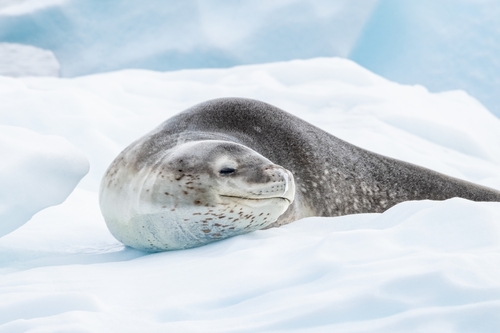
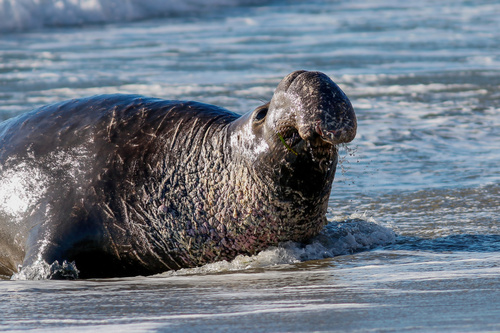
Other species in the family Phocidae
Species that share its range
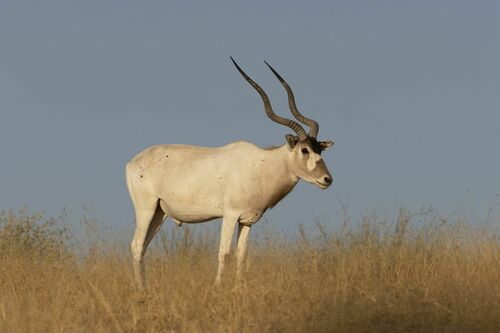
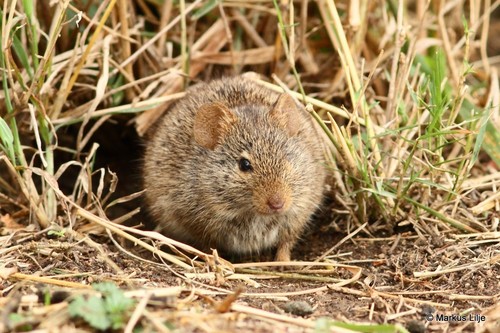
Sources
Conservation status, range description and population estimate come from the IUCN Red List assessment for Monachus monachus. Countries are derived from that range description, not from a mapped country list. Last refreshed on .
The distribution map is drawn from the IUCN Red List spatial data compiled in 2023. European Red List; IUCN & EU