
Northern Elephant Seal
Mirounga angustirostris
Red List assessment
Least Concernon the IUCN Red List
- EXExtinct
- EWExtinct in the Wild
- CRCritically Endangered
- ENEndangered
- VUVulnerable
- NTNear Threatened
- LCLeast Concern
The Northern Elephant Seal is recorded in 2 countries across North America. The IUCN Red List assesses the Northern Elephant Seal as Least Concern. Approximately 200,000 individuals, with a stable to increasing population trend following recovery from near extinction.
- Family
- Phocidae
- Order
- Carnivora
- Genus
- Mirounga
- Countries recorded
- 2
- Continents
- North America
- Red List category
- Least Concern
- Data updated
- August 9, 2026
What is the Northern Elephant Seal?
The Northern Elephant Seal is a massive pinniped known for its extreme sexual size dimorphism and the male's large proboscis used in vocal displays. It breeds on isolated beaches and islands along the California and Baja California coast and spends most of the year foraging in the deep Pacific Ocean. Once hunted nearly to extinction, it has become a remarkable conservation success story with populations rebounding from a few dozen survivors to hundreds of thousands today.
Where does the Northern Elephant Seal live?
Pacific coast of North America, from Baja California, Mexico to central California and occasionally Oregon/Washington, USA
Found along the eastern North Pacific coast, breeding colonies range from Isla Guadalupe and other islands off Baja California, Mexico, north through the Channel Islands, Point Reyes, and Año Nuevo in California, with foraging migrations extending into the Gulf of Alaska and offshore central Pacific waters.
Altitude and depth
Dives regularly to depths of 300-800 m, with maximum recorded dives exceeding 1,500 m; spends most time submerged at sea.
Seasonal movements
Exhibits two annual migrations to sea (post-breeding and post-molt) each lasting several months, punctuated by hauling out on land to breed in winter (December-March) and to molt in spring/summer.
Habitat of the Northern Elephant Seal
Sandy and rocky beaches on offshore islands and remote mainland coasts are used for breeding and molting, while the open pelagic waters and deep continental slope of the North Pacific serve as foraging habitat.
Adaptations to its environment
Thick blubber layer provides insulation and energy reserves for extended fasting periods on land; specialized hemoglobin and myoglobin allow for oxygen storage during deep, prolonged dives lasting up to 100 minutes; the male's inflatable proboscis amplifies vocalizations for dominance displays.
Conservation status and numbers
Listed as Least Concern by the IUCN due to a strong population recovery since near-extinction in the late 1800s, though genetic diversity remains low due to the historical population bottleneck.
Estimated population
Approximately 200,000 individuals, with a stable to increasing population trend following recovery from near extinction.
What threatens the Northern Elephant Seal?
Current threats include entanglement in fishing gear, oil spills, disease outbreaks, harmful algal blooms, and potential impacts from climate change on prey distribution and haul-out sites.
Diseases and parasites
Susceptible to influenza viruses, herpesviruses, and various parasites including nematodes and lice; harmful algal toxins (domoic acid) have also caused mortality events.
What is being done to protect it?
Protected under the U.S. Marine Mammal Protection Act and Mexican wildlife laws; breeding colonies are safeguarded within protected areas such as Año Nuevo State Park and Isla Guadalupe Biosphere Reserve.
Recommended actions
Continued monitoring of genetic diversity, protection of breeding and haul-out sites from human disturbance, mitigation of fishing gear entanglement, and research into climate change impacts on foraging grounds.
What the Northern Elephant Seal looks like
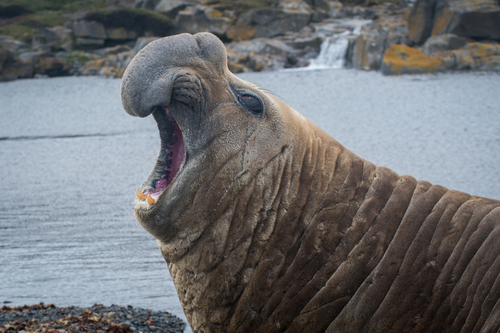
Seals have a smooth, grayish-brown coat that becomes lighter and more silvery after molting; males possess a large, pendulous proboscis that hangs over the mouth and inflates during vocal displays.
Size
Adult males reach 4-5 m in length, while females are considerably smaller at 2.5-3.5 m.
Weight
Males can weigh 1,500-2,300 kg, whereas females typically weigh 400-800 kg.
Distinctive features
The male's enlarged nose, extreme size compared to females, and battle scars from male-male combat on the neck and chest distinguish this species from other seals.
Differences between males and females
Pronounced dimorphism exists, with males being up to 3-4 times heavier than females and possessing the characteristic enlarged proboscis absent in females.
Behaviour and diet of the Northern Elephant Seal
Highly social during breeding season, forming large colonies with a strict male dominance hierarchy where a few dominant bulls monopolize mating; otherwise largely solitary at sea.
When it is active
Primarily diurnal on land during breeding and molting periods, but shows continuous diving activity both day and night while foraging at sea.
Diet
Carnivorous, feeding mainly on deep-sea fish and squid, including species such as Pacific hake, ratfish, and various cephalopods.
How it feeds and hunts
Forages via deep, repeated dives to depths where prey concentrate, using suction feeding and sometimes benthic foraging along the seafloor to capture fish and squid.
Communication
Males produce loud, rhythmic guttural vocalizations amplified by the proboscis to assert dominance and deter rivals; pups and mothers use vocal calls for mutual recognition amid crowded colonies.
Interactions with other species
Natural predators include great white sharks and orcas; the species competes with other pinnipeds for haul-out space but generally does not interact aggressively with other marine mammals.
Role in its ecosystem
As a top marine predator, the elephant seal plays an important role in regulating deep-sea fish and squid populations and serves as prey for large marine predators, linking pelagic and benthic food webs.
Reproduction and lifecycle
Breeding occurs from December to March; after an 11-month gestation with delayed implantation, a single pup is born and nursed intensively for about 4 weeks before weaning.
Raising the young
Mothers provide sole parental care, fasting while nursing their pup with extremely fat-rich milk, then abruptly wean and depart to sea, leaving pups to fend for themselves.
Maturity and lifespan
Females typically reach sexual maturity around 3-4 years, males around 5-6 years though they rarely breed successfully until much older; lifespan in the wild averages 9 years for males and up to 20 years for females.
Taxonomy and naming of the Northern Elephant Seal
Classification
Mammalia > Carnivora > Phocidae > Mirounga > Mirounga angustirostris
Scientific synonyms
Macrorhinus angustirostris (Gill, 1866)
What research says
Recent studies
Recent biologging studies have revealed extraordinary diving capabilities, including near-continuous diving with minimal surface time, and tracked long-distance foraging migrations spanning thousands of kilometers across the North Pacific.
Genome and DNA
The species has 2n=34 chromosomes; genetic studies have documented notably low diversity due to a severe population bottleneck in the late 19th century.
Compared with similar species
Compared to the Southern Elephant Seal (Mirounga leonina), the Northern species is smaller overall but shares similar breeding biology, deep-diving behavior, and extreme sexual dimorphism.
The Northern Elephant Seal and people
Northern Elephant Seals can dive deeper and longer than almost any other seal, sometimes staying submerged for up to two hours; the species recovered from as few as 20-100 individuals in the 1890s to hundreds of thousands today; males can lose up to a third of their body weight during the breeding fasting period.
Where and how to see it
Año Nuevo State Park in California and Isla Guadalupe in Mexico are prime locations to observe breeding colonies, best visited during the winter breeding season from December through March when large numbers haul out on beaches.
Risks to humans
Generally low risk to humans if kept at a safe distance, but large males can be aggressive and dangerous if approached too closely during breeding season.
Human uses
Historically hunted extensively for blubber oil in the 19th century, nearly causing extinction; today the species has significant ecotourism value supporting wildlife viewing economies along the California and Mexican coasts.
Countries where the Northern Elephant Seal is recorded
The 2 countries named in the range description of its IUCN Red List assessment.
Questions about the Northern Elephant Seal
Where does the Northern Elephant Seal live?
The Northern Elephant Seal is recorded in Mexico and United States across North America. These countries come from the range description of its IUCN Red List assessment, and they are what place the species on the interactive map.
Is the Northern Elephant Seal endangered?
The IUCN Red List assesses the Northern Elephant Seal as Least Concern. The species is widespread and abundant enough not to qualify for any threatened category. It does not mean the species is safe forever, only that nothing in the current data raises an alarm.
How many are left in the wild?
Approximately 200,000 individuals, with a stable to increasing population trend following recovery from near extinction. This figure comes from the species assessment on the IUCN Red List; population estimates for wild mammals are ranges, not counts, and are revised at each assessment.
What habitat does the Northern Elephant Seal live in?
Sandy and rocky beaches on offshore islands and remote mainland coasts are used for breeding and molting, while the open pelagic waters and deep continental slope of the North Pacific serve as foraging habitat.
What is the scientific name of the Northern Elephant Seal?
The Northern Elephant Seal is Mirounga angustirostris, in the family Phocidae, order Carnivora.
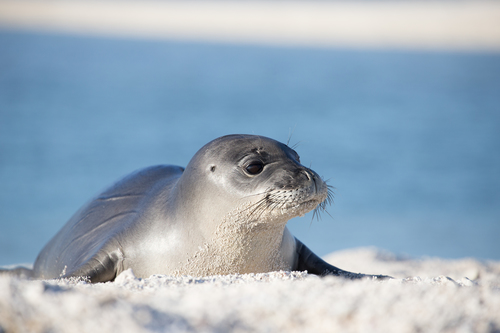
Other species in the genus Mirounga
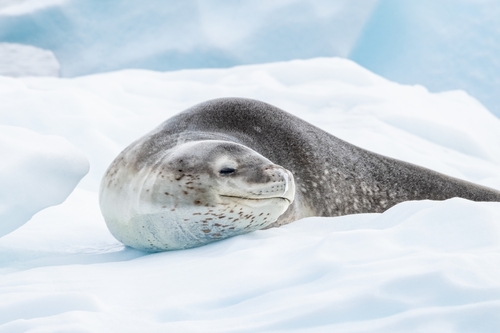
Other species in the family Phocidae
Species that share its range
Sources
Conservation status, range description and population estimate come from the IUCN Red List assessment for Mirounga angustirostris. Countries are derived from that range description, not from a mapped country list. Last refreshed on .
The distribution map is drawn from the IUCN Red List spatial data compiled in 2015. Luis Huckstad