
Harp Seal
Pagophilus groenlandicus
Red List assessment
Near Threatenedon the IUCN Red List
- EXExtinct
- EWExtinct in the Wild
- CRCritically Endangered
- ENEndangered
- VUVulnerable
- NTNear Threatened
- LCLeast Concern
The Harp Seal is recorded in 4 countries across Europe and North America. The IUCN Red List assesses the Harp Seal as Near Threatened. Global population estimated at 7.5-8 million individuals; historically increasing but showing signs of stabilization or decline in some regions due to poor ice conditions in recent years.
- Family
- Phocidae
- Order
- Carnivora
- Genus
- Pagophilus
- Countries recorded
- 4
- Continents
- Europe and North America
- Red List category
- Near Threatened
- Data updated
- August 9, 2026
What is the Harp Seal?
The harp seal is a medium-sized true seal renowned for its long-distance migrations across the North Atlantic and its dependence on pack ice for breeding and molting. It is famous for the striking white coat of its newborn pups ('whitecoats'), which has made the species both a cultural icon and a focal point of controversial commercial hunts. Highly gregarious, it forms massive breeding colonies on drifting ice each spring. Its adaptability to extreme cold and reliance on seasonal ice make it a sentinel species for Arctic climate change.
Where does the Harp Seal live?
North Atlantic and Arctic Ocean, primarily off Canada (Gulf of St. Lawrence, Newfoundland), Greenland, Norway (Jan Mayen), and Russia (White Sea)
Found across the North Atlantic and Arctic Ocean, with three main breeding populations: the Northwest Atlantic (Gulf of St. Lawrence and off Newfoundland/Labrador, Canada), the Greenland Sea (near Jan Mayen), and the White Sea (Russia). Non-breeding range extends into Arctic Canada, Greenland, Svalbard, and northern Scandinavia.
Altitude and depth
Primarily surface-dwelling but capable dives of 100-300 m, with maximum recorded dives exceeding 400 m; spends much time hauled out on ice at sea level.
Seasonal movements
Highly migratory: travels thousands of kilometers annually between summer feeding grounds in Arctic waters and southern breeding/pupping grounds on pack ice in late winter/early spring, then to molting sites in early summer.
Habitat of the Harp Seal
Pack ice and open ocean waters of the subarctic and Arctic; breeding and molting occur on drifting sea ice, while foraging takes place in open pelagic and coastal marine waters.
Adaptations to its environment
Thick blubber layer provides insulation and energy reserves in frigid waters; countercurrent heat exchange in flippers minimizes heat loss; dense fur and camouflage coloring aid survival on ice; strong swimming ability allows extensive migrations to track ice and prey.
Conservation status and numbers
Listed as Near Threatened by the IUCN; while populations are currently large and were increasing in past decades, they face growing risks from climate-driven sea ice loss and continued commercial harvest pressure.
Estimated population
Global population estimated at 7.5-8 million individuals; historically increasing but showing signs of stabilization or decline in some regions due to poor ice conditions in recent years.
What threatens the Harp Seal?
Loss of stable pack ice due to climate change (critical for pupping), commercial hunting/harvest quotas, bycatch in fishing gear, and pollution affecting Arctic marine ecosystems.
Diseases and parasites
Susceptible to phocine distemper virus, various helminth parasites (nematodes, cestodes), and skin parasites; disease outbreaks have caused mass mortality events in seal populations historically.
What is being done to protect it?
Managed under national harvest quotas (notably in Canada, Norway, and Russia) with international scientific monitoring by ICES and NAFO; some populations protected under CITES Appendix III listings and national marine mammal protection laws.
Recommended actions
Strengthen ice habitat monitoring and climate adaptation strategies, enforce sustainable harvest quotas based on updated population assessments, reduce fisheries bycatch, and expand international cooperation on Arctic conservation.
What the Harp Seal looks like
Adults have a silvery-gray coat with a distinctive black harp- or horseshoe-shaped marking on the back and a black face; pups are born with soft white lanugo fur that molts within weeks to a spotted gray coat.
Size
Adults typically measure 1.5-1.9 m in body length.
Weight
Adults weigh between 115-140 kg, with males slightly larger than females on average.
Distinctive features
The adult's harp-shaped black dorsal marking and black facial mask distinguish it from other Northern Hemisphere seals; the iconic white-coated pups are a hallmark not shared by most other phocid species.
Differences between males and females
Minimal sexual dimorphism; males are marginally larger and may have slightly more defined dark markings, but overall coloration and size are similar between sexes.
Behaviour and diet of the Harp Seal
Highly gregarious, forming enormous breeding and molting aggregations on ice that can number in the tens of thousands; otherwise generally solitary or in small groups while foraging at sea.
When it is active
Primarily diurnal foraging activity but capable of activity at any time of day; haul-out and social behaviors are concentrated during daylight hours on ice.
Diet
Carnivorous, feeding on a wide variety of fish and invertebrates including capelin, herring, polar cod, shrimp, and crustaceans, with diet varying seasonally and regionally.
How it feeds and hunts
Forages by diving to pursue schooling fish and invertebrates, using agile underwater maneuvering and keen underwater vision/whisker-based prey detection in dark or turbid waters.
Communication
Communicates through a range of vocalizations including barks, roars, and underwater clicks and trills, especially during breeding aggregations; visual and olfactory cues are also used for mother-pup recognition.
Interactions with other species
Preyed upon by polar bears, orcas, and Greenland sharks; competes with other pinnipeds and seabirds for fish resources; pups are especially vulnerable to predation and ice instability.
Role in its ecosystem
Serves as a key mid-trophic level predator in Arctic and subarctic marine food webs, linking fish and invertebrate populations to top predators like polar bears and killer whales.
Reproduction and lifecycle
Breeding occurs in late February to March on pack ice; females give birth to a single pup after an 11.5-month gestation (including delayed implantation), followed by an intense 12-day nursing period before abrupt weaning.
Raising the young
Mothers provide highly concentrated maternal care, nursing pups exclusively with extremely rich milk (~45% fat) for about 12 days before departing to mate again, after which pups are left to fend for themselves.
Maturity and lifespan
Sexual maturity is typically reached at 4-6 years of age; lifespan in the wild averages 20-30 years, with some individuals recorded living up to 35 years.
Taxonomy and naming of the Harp Seal
Classification
Class Mammalia > Order Carnivora > Family Phocidae > Genus Pagophilus > Species Pagophilus groenlandicus
Scientific synonyms
Phoca groenlandica (Erxleben, 1777); Pagophoca groenlandica
What research says
Recent studies
Recent research using satellite tracking and genomic tools has revealed fine-scale migratory patterns and highlighted the impact of declining sea ice extent on pup survival rates in the Gulf of St. Lawrence.
Genome and DNA
Diploid chromosome number is 2n=32; genomic studies have been used to assess population structure and connectivity among the three major breeding stocks.
Compared with similar species
Similar in size and habitat to the ringed seal and harbor seal but distinguished by its unique harp-shaped dorsal pattern and extensive long-distance migrations, unlike the more sedentary ringed seal.
The Harp Seal and people
Newborn harp seal pups can gain up to 2 kg per day due to their mother's extraordinarily fat-rich milk; they are strong swimmers within weeks of weaning despite having no maternal guidance after separation.
Where and how to see it
Best observed during late winter/early spring on the ice floes of the Gulf of St. Lawrence or off Newfoundland, where guided ecotourism boat and helicopter tours allow close viewing of breeding colonies.
Risks to humans
No notable risk to humans under normal circumstances, though adult seals can bite if threatened or cornered.
Human uses
Historically and currently hunted for fur, meat, and oil, particularly in Canada, Greenland, and Norway; also a major subject of ecotourism and wildlife documentation.
Myths and legends
The harp seal's white-coated pups have become a global symbol of animal rights campaigns since the mid-20th century, sparking international debates and legislation on commercial seal hunting.
Countries where the Harp Seal is recorded
The 4 countries named in the range description of its IUCN Red List assessment.
Questions about the Harp Seal
Where does the Harp Seal live?
The Harp Seal is recorded in Canada, Greenland, Norway and Russia across Europe and North America. These countries come from the range description of its IUCN Red List assessment, and they are what place the species on the interactive map.
Is the Harp Seal endangered?
The IUCN Red List assesses the Harp Seal as Near Threatened. The species does not qualify as threatened today, but it is close to the thresholds and likely to cross them soon. It is the category that most often changes at the next assessment.
How many are left in the wild?
Global population estimated at 7.5-8 million individuals; historically increasing but showing signs of stabilization or decline in some regions due to poor ice conditions in recent years. This figure comes from the species assessment on the IUCN Red List; population estimates for wild mammals are ranges, not counts, and are revised at each assessment.
What habitat does the Harp Seal live in?
Pack ice and open ocean waters of the subarctic and Arctic; breeding and molting occur on drifting sea ice, while foraging takes place in open pelagic and coastal marine waters.
What is the scientific name of the Harp Seal?
The Harp Seal is Pagophilus groenlandicus, in the family Phocidae, order Carnivora.
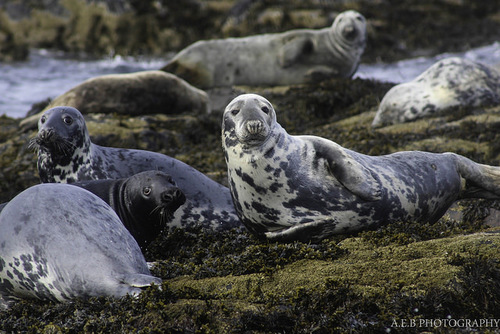
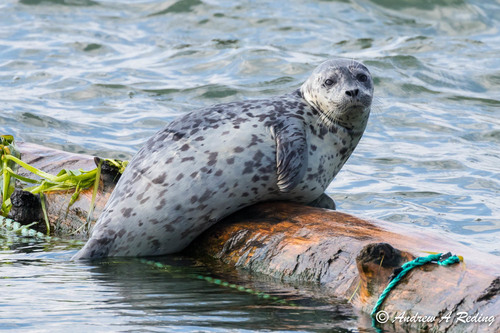
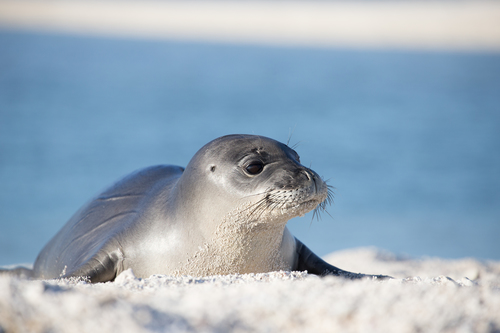
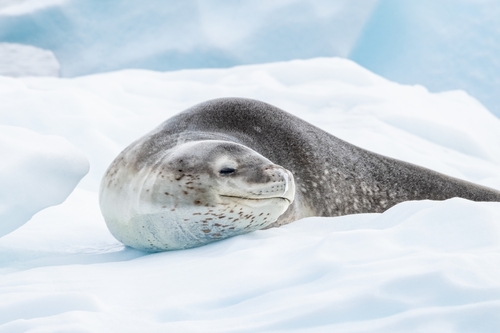
Other species in the family Phocidae
Species that share its range
Sources
Conservation status, range description and population estimate come from the IUCN Red List assessment for Pagophilus groenlandicus. Countries are derived from that range description, not from a mapped country list. Last refreshed on .
The distribution map is drawn from the IUCN Red List spatial data compiled in 2015. Kit Kovacs