
Prevost's Squirrel
Callosciurus prevostii
Red List assessment
Least Concernon the IUCN Red List
- EXExtinct
- EWExtinct in the Wild
- CRCritically Endangered
- ENEndangered
- VUVulnerable
- NTNear Threatened
- LCLeast Concern
The Prevost's Squirrel is recorded in 5 countries across Asia. The IUCN Red List assesses the Prevost's Squirrel as Least Concern. No precise global population estimate exists, but the species is considered common and widespread within suitable habitat; local populations may be declining due to deforestation.
- Family
- Sciuridae
- Order
- Rodentia
- Genus
- Callosciurus
- Countries recorded
- 5
- Continents
- Asia
- Red List category
- Least Concern
- Data updated
- August 9, 2026
What is the Prevost's Squirrel?
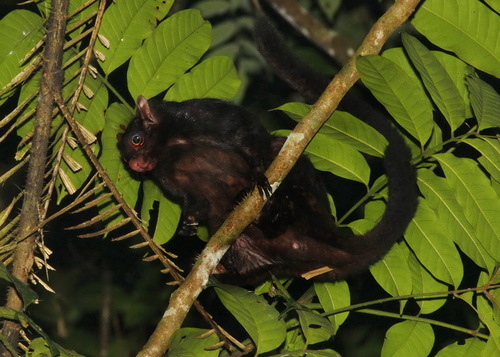
Prevost's Squirrel is a strikingly tricolored tree squirrel native to the rainforests of Southeast Asia, particularly Borneo, Sumatra, and the Malay Peninsula. It is one of the most colorful squirrel species in the world, often used as a flagship species for tropical forest conservation. Highly arboreal, it plays an important ecological role in seed dispersal within its forest habitat. Its bold black, white, and reddish-orange pattern makes it one of the most recognizable squirrels in Asia.
Where does the Prevost's Squirrel live?
Malaysia, Indonesia (Sumatra, Borneo), Brunei, southern Thailand
Native to the Malay Peninsula, Sumatra, Borneo, and several smaller Indonesian islands; introduced populations exist in Singapore and parts of Sulawesi.
Altitude and depth
Typically found from sea level up to about 1200 meters elevation.
Seasonal movements
No true hibernation or migration; breeding can occur year-round with possible peaks tied to fruiting seasons.
Habitat of the Prevost's Squirrel
Primarily found in lowland tropical and subtropical rainforests, including primary and secondary forest, as well as forest edges, plantations, and gardens near forested areas.
Adaptations to its environment
Sharp curved claws and strong hind limbs allow agile movement through the forest canopy, while a long bushy tail aids balance during leaps between branches. Its varied diet and generalist habits allow it to exploit disturbed and secondary forest habitats effectively.
Conservation status and numbers
Listed as Least Concern by the IUCN due to its wide distribution and adaptability to various forest types, though some subspecies and island populations may be more vulnerable to habitat loss.
Estimated population
No precise global population estimate exists, but the species is considered common and widespread within suitable habitat; local populations may be declining due to deforestation.
What threatens the Prevost's Squirrel?
Deforestation and habitat fragmentation from logging, palm oil plantations, and agricultural expansion are the main threats, along with localized hunting and pet trade collection.
Diseases and parasites
Susceptible to various ectoparasites such as mites and fleas, as well as endoparasitic worms, though specific disease studies are limited.
What is being done to protect it?
Protected in several national parks and reserves across its range, including areas in Borneo and Sumatra; benefits indirectly from broader rainforest conservation initiatives.
Recommended actions
Continued protection of lowland rainforest habitat, monitoring of subspecies with restricted ranges, and regulation of the exotic pet trade are recommended priorities.
What the Prevost's Squirrel looks like
This squirrel displays a bold tricolor pattern: typically black upperparts, a white or cream stripe along the flanks, and reddish-orange underparts, though color patterns vary greatly by subspecies and locality. It has a bushy tail, rounded ears, and sharp claws suited to climbing.
Size
Head-body length typically 20-27 cm, with a tail of similar or slightly greater length (20-26 cm).
Weight
Adults typically weigh between 250 and 400 grams.
Distinctive features
Its dramatic and highly variable tricolor pattern distinguishes it from other Callosciurus species, which tend to be more uniformly colored; the sharp contrast between black, white, and orange/red is particularly diagnostic.
Differences between males and females
Minimal sexual dimorphism; males and females are similar in size and coloration.
Behaviour and diet of the Prevost's Squirrel
Generally solitary or seen in loose pairs, though multiple individuals may share overlapping home ranges and feeding trees without strong social bonds.
When it is active
Diurnal, most active during early morning and late afternoon when foraging for food in the canopy.
Diet
Omnivorous, feeding mainly on fruits, seeds, nuts, and flowers, but also consuming insects, bird eggs, and occasionally small invertebrates.
How it feeds and hunts
Forages opportunistically in trees and on the ground, using sharp claws and teeth to access hard-shelled fruits and nuts; insect prey is caught opportunistically rather than through active hunting.
Communication
Communicates through vocal chirps and chattering calls, along with body postures and tail movements to signal alarm or territorial presence.
Interactions with other species
Preyed upon by raptors, snakes, and small carnivorous mammals; competes with other arboreal squirrels and primates for fruit resources, and may act as a minor seed disperser or predator of seeds.
Role in its ecosystem
Plays a role in seed dispersal and predation within tropical forest ecosystems, influencing plant regeneration dynamics in its habitat.
Reproduction and lifecycle
Breeding can occur throughout the year; gestation lasts approximately 5 weeks, with litters typically consisting of 1-3 young born in tree hollows or nests.
Raising the young
Females raise the young alone in a nest, nursing and protecting them until they are weaned and capable of independent foraging at a few months of age.
Maturity and lifespan
Reaches sexual maturity around 1 year of age; lifespan in the wild is estimated at 3-5 years, with captive individuals living up to 10-14 years.
Taxonomy and naming of the Prevost's Squirrel
Classification
Mammalia > Rodentia > Sciuridae > Callosciurus > Callosciurus prevostii
Subspecies
Over 40 subspecies have been described across the Sunda region, varying mainly in coloration; examples include C. p. prevostii (Sumatra/Borneo), C. p. borneoensis, and C. p. rafflesii, though taxonomy is still debated.
Scientific synonyms
Sciurus prevostii (original combination)
What research says
Recent studies
Recent taxonomic studies using molecular data have questioned the validity of many described subspecies, suggesting that color pattern variation may not always correspond to genetic distinctiveness.
Genome and DNA
Diploid chromosome number reported as 2n=40 in some Callosciurus species studies, though detailed genomic research on C. prevostii specifically is limited.
Compared with similar species
Compared to other Callosciurus species like the Plantain Squirrel (C. notatus), Prevost's Squirrel is generally more vividly tricolored, whereas relatives tend to have more subdued, uniform coats.
The Prevost's Squirrel and people
Its striking coloration has made it a popular exotic pet and inspiration for wildlife photography; it has also been introduced to places like Singapore and parts of Japan and the Netherlands as an escaped or released pet species; one of the most taxonomically complex squirrels due to its many described color morphs.
Where and how to see it
Best observed in lowland rainforests of Borneo or Sumatra during early morning hours when the squirrels are actively foraging in fruiting trees; national parks such as Bako or Gunung Leuser offer good viewing opportunities.
Risks to humans
No notable risk; though as with any wild rodent, bites can occur if handled and may carry minor risk of disease transmission.
Human uses
Occasionally kept as an exotic pet due to its attractive coloration; otherwise has limited direct economic use to humans.
Countries where the Prevost's Squirrel is recorded
The 5 countries named in the range description of its IUCN Red List assessment.
Questions about the Prevost's Squirrel
Where does the Prevost's Squirrel live?
The Prevost's Squirrel is recorded in Brunei, Indonesia, Malaysia, Singapore and Thailand across Asia. These countries come from the range description of its IUCN Red List assessment, and they are what place the species on the interactive map.
Is the Prevost's Squirrel endangered?
The IUCN Red List assesses the Prevost's Squirrel as Least Concern. The species is widespread and abundant enough not to qualify for any threatened category. It does not mean the species is safe forever, only that nothing in the current data raises an alarm.
How many are left in the wild?
No precise global population estimate exists, but the species is considered common and widespread within suitable habitat; local populations may be declining due to deforestation. This figure comes from the species assessment on the IUCN Red List; population estimates for wild mammals are ranges, not counts, and are revised at each assessment.
What habitat does the Prevost's Squirrel live in?
Primarily found in lowland tropical and subtropical rainforests, including primary and secondary forest, as well as forest edges, plantations, and gardens near forested areas.
What is the scientific name of the Prevost's Squirrel?
The Prevost's Squirrel is Callosciurus prevostii, in the family Sciuridae, order Rodentia.
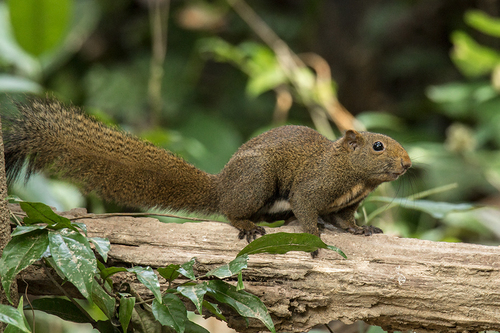
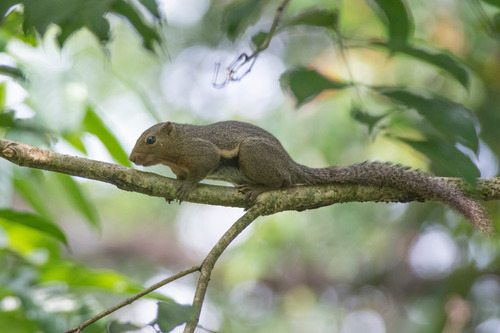
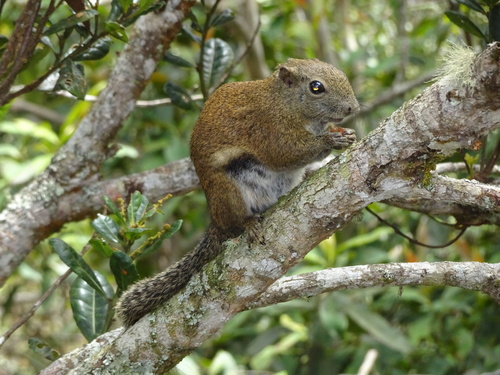
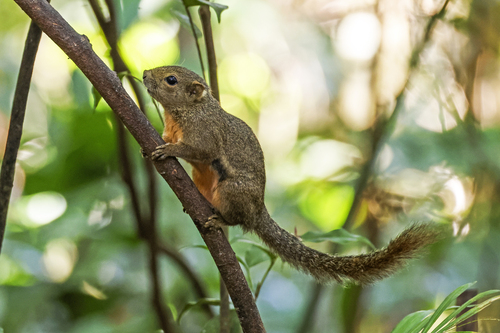
Other species in the genus Callosciurus
Other species in the family Sciuridae
Sources
Conservation status, range description and population estimate come from the IUCN Red List assessment for Callosciurus prevostii. Countries are derived from that range description, not from a mapped country list. Last refreshed on .
The distribution map is drawn from the IUCN Red List spatial data compiled in 2008. IUCN (International Union for Conservation of Nature)