
Plantain Squirrel
Callosciurus notatus
Red List assessment
Least Concernon the IUCN Red List
- EXExtinct
- EWExtinct in the Wild
- CRCritically Endangered
- ENEndangered
- VUVulnerable
- NTNear Threatened
- LCLeast Concern
The Plantain Squirrel is recorded in 5 countries across Asia. The IUCN Red List assesses the Plantain Squirrel as Least Concern. No precise global population estimate exists, but the species is considered abundant and stable across most of its range.
- Family
- Sciuridae
- Order
- Rodentia
- Genus
- Callosciurus
- Countries recorded
- 5
- Continents
- Asia
- Red List category
- Least Concern
- Data updated
- August 9, 2026
What is the Plantain Squirrel?
The Plantain Squirrel is a small, agile tree squirrel widespread across lowland Southeast Asia, frequently seen in gardens, plantations, and urban parks as well as forests. It is highly adaptable to human-modified landscapes, which has made it one of the most commonly observed squirrels in the region. Its bold coloration and lively, acrobatic behavior make it a familiar and charismatic urban wildlife species.
Where does the Plantain Squirrel live?
Southeast Asia, primarily Malaysia, Indonesia (Sumatra, Java, Bali, Borneo), Singapore, Thailand, and Brunei
Found throughout Peninsular Malaysia, Sumatra, Java, Bali, Borneo, Singapore, southern Thailand, and Brunei; introduced populations exist on some islands outside its native range.
Altitude and depth
Sea level up to approximately 1200 meters elevation
Seasonal movements
No true hibernation or migration; breeding can occur year-round with possible peaks correlating with fruiting seasons.
Habitat of the Plantain Squirrel
Inhabits tropical lowland rainforest, secondary forest, mangroves, plantations (oil palm, coconut, rubber), gardens, and urban parks, showing strong tolerance for disturbed and human-altered habitats.
Adaptations to its environment
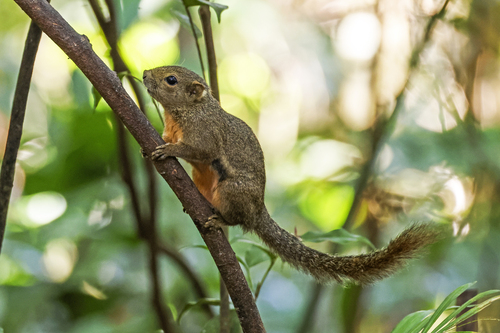
Sharp curved claws and strong hind limbs allow agile arboreal locomotion; a flexible diet enables exploitation of both natural forest resources and human-altered environments; keen eyesight aids in detecting predators and food from tree canopies.
Conservation status and numbers
Listed as Least Concern by IUCN due to its wide distribution, large population, tolerance of habitat disturbance, and lack of major range-wide threats.
Estimated population
No precise global population estimate exists, but the species is considered abundant and stable across most of its range.
What threatens the Plantain Squirrel?
Localized threats include deforestation, pesticide use in plantations, and occasional persecution as an agricultural pest, though none are severe enough to threaten the species overall.
Diseases and parasites
Susceptible to various ectoparasites such as mites and fleas, and may carry zoonotic pathogens, though no major disease outbreaks are documented specifically for this species.
What is being done to protect it?
No specific conservation programs are targeted at this species due to its stable status; it benefits indirectly from protected forest areas and national parks within its range.
Recommended actions
Continued habitat protection in remaining lowland forests and monitoring of plantation management practices to reduce human-wildlife conflict.
What the Plantain Squirrel looks like
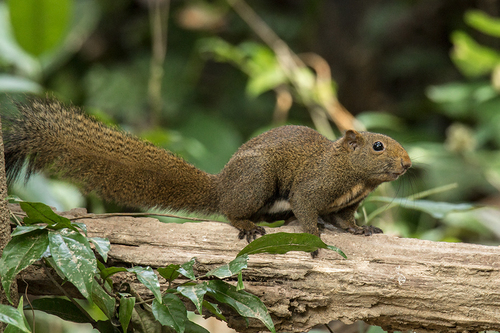
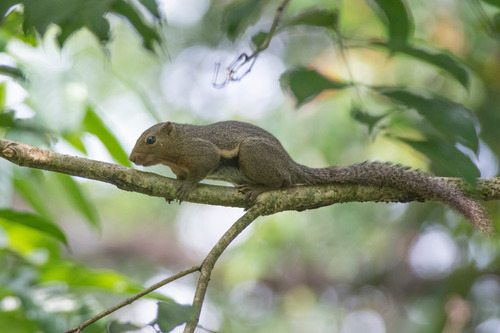
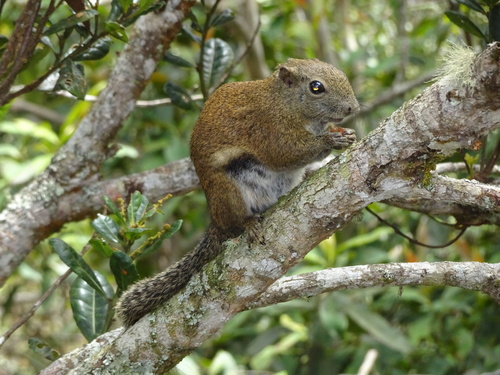
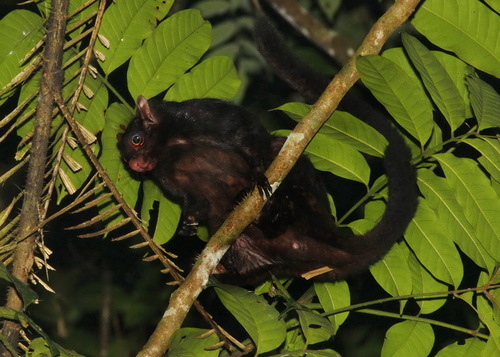
Fur color is variable but often olive-brown to blackish above with a distinctive pale to orange-buff underside; a black-and-cream lateral stripe runs along the flanks in many populations.
Size
Head-body length approximately 15-24 cm, with a tail nearly as long as the body (14-21 cm).
Weight
Typically weighs between 200-350 grams.
Distinctive features
Distinguished from related Callosciurus species by its lateral body stripe pattern and generally darker dorsal coloration, though color varies significantly among subspecies and islands.
Differences between males and females
Minimal sexual dimorphism; males and females are similar in size and coloration.
Behaviour and diet of the Plantain Squirrel
Generally solitary or seen in loose associations, with individuals maintaining home ranges that may overlap; occasional aggregations occur at abundant food sources.
When it is active
Strictly diurnal, most active during early morning and late afternoon hours.
Diet
Omnivorous, feeding on fruits, seeds, nuts, flowers, bark, insects, and occasionally bird eggs or nestlings; oil palm fruits are a significant food source in plantations.
Communication
Uses vocal chattering and tail-flicking to signal alarm or territorial disputes; scent marking via cheek and body glands helps establish territory boundaries.
Interactions with other species
Preyed upon by raptors, snakes, and small carnivores such as civets; competes with other squirrel species and birds for fruit resources, and can damage plantation crops leading to conflict with humans.
Role in its ecosystem
Plays a role in seed dispersal and forest regeneration by caching and transporting seeds, while also acting as prey within the forest food web.
Reproduction and lifecycle
Breeding occurs year-round with possible peaks tied to fruit availability; gestation lasts about 5 weeks, producing litters of 1-3 young.
Raising the young
Females alone care for and nurse the young in nests built in tree hollows or dense vegetation; weaning occurs after roughly 6-8 weeks before juveniles become independent.
Maturity and lifespan
Reaches sexual maturity around 8-12 months; lifespan in the wild is typically 3-5 years, with captive individuals living up to 10 years.
Taxonomy and naming of the Plantain Squirrel
Classification
Class Mammalia > Order Rodentia > Family Sciuridae > Genus Callosciurus > Species Callosciurus notatus
Subspecies
Multiple subspecies recognized including C. n. notatus (Java), C. n. miniatus (Sumatra), C. n. vittatus (Peninsular Malaysia), and several island forms, differing mainly in coloration and size.
Scientific synonyms
Sciurus notatus (original combination), Sciurus vittatus
What research says
Recent studies
Recent studies have examined its role as an urban-adapted species and its impact on oil palm plantations as a minor agricultural pest.
Compared with similar species
Similar to other Callosciurus species like the Prevost's Squirrel (C. prevostii), but generally smaller with less vivid tricolor patterning and more subdued brown-olive tones.
The Plantain Squirrel and people
Despite its common name, it does not primarily eat plantains but was named for its frequent presence in banana/plantain plantations; it is one of the most commonly seen mammals in Southeast Asian cities and gardens.
Where and how to see it
Easily observed in urban parks, botanical gardens, and plantations throughout Malaysia and Indonesia during daylight hours, especially early morning when foraging activity peaks.
Risks to humans
No notable risk to humans, though it can become a minor agricultural pest in fruit and palm oil plantations.
Human uses
Occasionally kept as an exotic pet in parts of its range, and sometimes hunted or trapped locally as a crop pest control measure, though no significant commercial trade exists.
Countries where the Plantain Squirrel is recorded
The 5 countries named in the range description of its IUCN Red List assessment.
Questions about the Plantain Squirrel
Where does the Plantain Squirrel live?
The Plantain Squirrel is recorded in Brunei, Indonesia, Malaysia, Singapore and Thailand across Asia. These countries come from the range description of its IUCN Red List assessment, and they are what place the species on the interactive map.
Is the Plantain Squirrel endangered?
The IUCN Red List assesses the Plantain Squirrel as Least Concern. The species is widespread and abundant enough not to qualify for any threatened category. It does not mean the species is safe forever, only that nothing in the current data raises an alarm.
How many are left in the wild?
No precise global population estimate exists, but the species is considered abundant and stable across most of its range. This figure comes from the species assessment on the IUCN Red List; population estimates for wild mammals are ranges, not counts, and are revised at each assessment.
What habitat does the Plantain Squirrel live in?
Inhabits tropical lowland rainforest, secondary forest, mangroves, plantations (oil palm, coconut, rubber), gardens, and urban parks, showing strong tolerance for disturbed and human-altered habitats.
What is the scientific name of the Plantain Squirrel?
The Plantain Squirrel is Callosciurus notatus, in the family Sciuridae, order Rodentia.
Other species in the genus Callosciurus
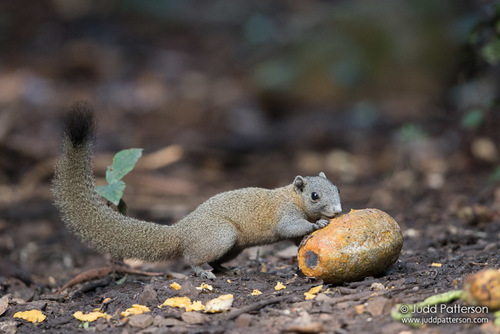
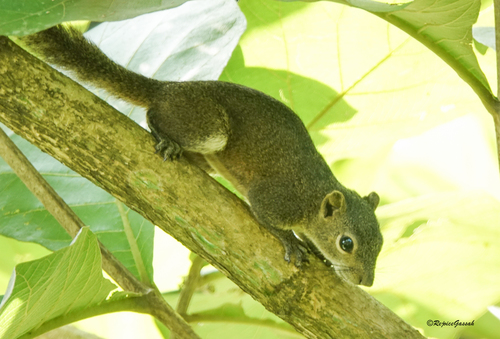
Other species in the family Sciuridae
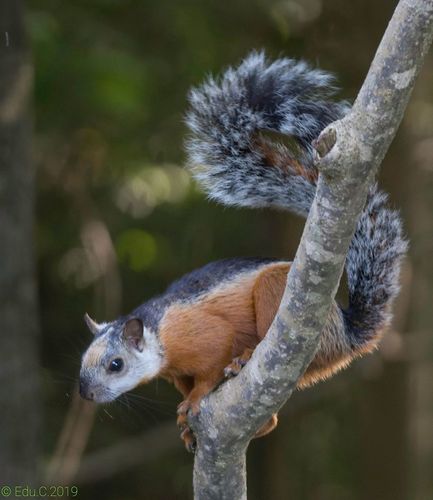
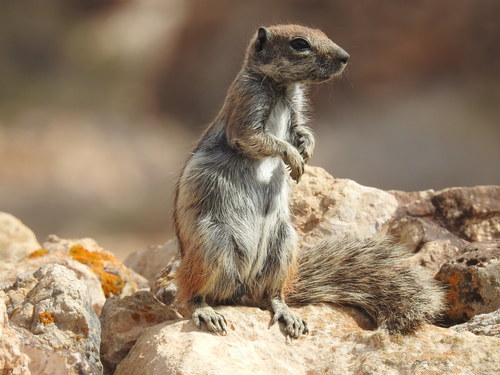
Sources
Conservation status, range description and population estimate come from the IUCN Red List assessment for Callosciurus notatus. Countries are derived from that range description, not from a mapped country list. Last refreshed on .
The distribution map is drawn from the IUCN Red List spatial data compiled in 2008. IUCN (International Union for Conservation of Nature)