
Pallas's Cat
Otocolobus manul
Red List assessment
Least Concernon the IUCN Red List
- EXExtinct
- EWExtinct in the Wild
- CRCritically Endangered
- ENEndangered
- VUVulnerable
- NTNear Threatened
- LCLeast Concern
The Pallas's Cat is recorded in 11 countries across Asia and Europe. The IUCN Red List assesses the Pallas's Cat as Least Concern. Global population is unknown precisely but estimated in the tens of thousands; considered stable overall, though some regional populations may be declining due to habitat and prey loss.
- Family
- Felidae
- Order
- Carnivora
- Genus
- Otocolobus
- Countries recorded
- 11
- Continents
- Asia and Europe
- Red List category
- Least Concern
- Data updated
- August 9, 2026
What is the Pallas's Cat?
The Pallas's cat, or manul, is a small wild felid native to the steppes and rocky landscapes of Central Asia. It is renowned for its unusually stocky build, dense fur, and flattened facial features adapted to cold, arid environments. Despite its wide range, it remains elusive and rarely observed due to its solitary and secretive nature. It is considered one of the more primitive felid species and holds particular interest for evolutionary biologists.
Where does the Pallas's Cat live?
Central Asia, including Mongolia, China, Russia, Kazakhstan, and parts of the Tibetan Plateau
Found across Mongolia, southern Russia (Siberia), western China, Kazakhstan, Kyrgyzstan, Tajikistan, Afghanistan, Iran, Pakistan, and parts of the Tibetan Plateau in India and Bhutan. Range is patchy and closely tied to suitable rocky steppe habitat.
Altitude and depth
Typically found between 500 and 5,000 meters elevation, with some populations recorded up to 5,050 meters in the Himalayas and Tibetan Plateau.
Seasonal movements
No true hibernation, but activity patterns shift seasonally; in winter, cats may shelter in burrows or rock crevices during extreme cold, and mating season occurs in late winter (December-March).
Habitat of the Pallas's Cat
Cold steppes, semi-desert, and montane grasslands with rocky outcrops, crevices, and sparse vegetation providing cover and denning sites. Avoids deep snow and dense forest, favoring open terrain with good visibility for hunting.
Adaptations to its environment
Extremely dense fur (the densest of any cat species) provides insulation against harsh cold; low-set ears reduce heat loss and aid in stealth; a broad, flattened skull and low-slung body allow it to blend into rocky terrain while stalking prey.
Conservation status and numbers
Listed as Least Concern by IUCN, though historically classified as Near Threatened; the species is considered locally threatened in parts of its range due to habitat degradation and prey base decline, but overall global population is believed stable.
Estimated population
Global population is unknown precisely but estimated in the tens of thousands; considered stable overall, though some regional populations may be declining due to habitat and prey loss.
What threatens the Pallas's Cat?
Habitat degradation from livestock grazing, poisoning campaigns targeting pikas (their main prey) which reduce food availability, incidental trapping in snares set for other species, and historical fur trade pressure.
Diseases and parasites
Susceptible to feline diseases such as toxoplasmosis and feline immunodeficiency virus in captivity; wild populations may carry external parasites like fleas and ticks, and are noted for unusually weak immune responses to certain pathogens.
What is being done to protect it?
Protected under CITES Appendix II; conservation efforts include the Pallas's Cat International Conservation Alliance (PICA), camera-trap monitoring programs in Mongolia, and habitat protection within various national parks across its range.
Recommended actions
Reduce pika poisoning campaigns that deplete prey populations, expand protected area coverage in key habitats, improve anti-poaching and anti-snaring enforcement, and increase population monitoring through camera trap networks.
What the Pallas's Cat looks like
Stocky, low-slung body with unusually thick, long fur that varies from pale grey to reddish-brown depending on season and locality. The face is flattened with high-set eyes, giving a distinctive 'grumpy' expression, and the tail is thick and ringed with dark bands.
Size
Body length: 46-65 cm, with a tail of 21-31 cm; shoulder height approximately 30 cm.
Weight
Typically 2.5-4.5 kg, with males slightly larger than females on average.
Distinctive features
Distinguished from other small felids by its extremely dense coat, flat face, low-set ears, and round pupils (unlike the vertical slit pupils of most cats); its stocky build and short legs give it a unique silhouette among wild cats.
Differences between males and females
Minimal sexual dimorphism; males are slightly larger and heavier than females, but coloration and markings are similar between sexes.
Behaviour and diet of the Pallas's Cat
Solitary and territorial, with individuals maintaining home ranges marked by scent; social interactions are limited mainly to mating encounters and mother-kitten groups.
When it is active
Primarily crepuscular and nocturnal, though can be active during daylight, especially in cooler months; relies on ambush tactics rather than pursuit due to limited stamina.
Diet
Carnivorous, feeding primarily on small mammals such as pikas, voles, and gerbils; will also take ground-dwelling birds, insects, and occasionally young marmots.
How it feeds and hunts
Uses stealth and ambush tactics, stalking low to the ground and freezing motionless to blend with rocky terrain before pouncing on prey near burrow entrances.
Communication
Communicates through scent marking (urine and feces at territory boundaries), body postures, and vocalizations including hisses, growls, and a distinctive 'gurgling' contact call between mother and kittens.
Interactions with other species
Preyed upon by larger carnivores such as wolves, eagles, and other raptors; competes with foxes and other small predators for similar prey resources like pikas and voles.
Role in its ecosystem
Functions as a mid-level predator in steppe ecosystems, helping regulate small mammal populations, particularly pikas and voles, which supports overall grassland ecosystem balance.
Reproduction and lifecycle
Breeding season occurs in late winter (December to early March); gestation lasts around 66-75 days, producing litters of 2-6 kittens, typically born in April or May.
Raising the young
Females raise kittens alone in dens located in rock crevices or burrows; kittens are weaned around 2 months and become independent by autumn of their first year.
Maturity and lifespan
Reaches sexual maturity around 9-12 months; lifespan in the wild is estimated at 6-8 years, while captive individuals can live up to 11-12 years.
Taxonomy and naming of the Pallas's Cat
Classification
Mammalia > Carnivora > Felidae > Otocolobus > Otocolobus manul
Subspecies
Otocolobus manul manul (Mongolia, Russia, northern China), Otocolobus manul nigripectus (Tibetan Plateau, Central Asian mountains), Otocolobus manul ferruginea (sometimes recognized in Turkmenistan/Iran region)
Scientific synonyms
Felis manul (original classification)
What research says
Recent studies
Recent camera-trap and GPS-collar studies in Mongolia have provided new insights into home range size, activity patterns, and habitat use, revealing the species is more widespread and adaptable than previously believed.
Genome and DNA
Diploid chromosome number of 2n=38, similar to other felids; genetic studies have helped clarify its phylogenetic placement as a distinct genus within Felidae rather than within Felis.
Compared with similar species
Compared to the domestic cat, the manul has a stockier build, denser fur, and a flatter face; unlike most felids, it has round pupils instead of vertical slits, a trait shared with larger cats like lions.
The Pallas's Cat and people
The Pallas's cat's face was reportedly one inspiration for the internet-famous 'grumpy cat' expression due to its naturally scowling appearance; it also has the densest fur of any cat species, with up to 9,000 hairs per square centimeter in winter.
Where and how to see it
Best observed in Mongolia's steppe regions, particularly in protected areas like Hustai National Park, during early morning or dusk in cooler months when activity is higher; patience and use of camera traps or spotting scopes greatly improve chances of sighting.
Risks to humans
No notable risk to humans; the species is shy and avoids human contact, posing no significant threat.
Human uses
Historically hunted for fur in some regions, though this practice has significantly declined; currently valued mainly for ecotourism and wildlife photography rather than commercial use.
Myths and legends
While not heavily featured in traditional folklore, the manul has become a popular internet phenomenon due to its distinctive facial expressions, often depicted humorously as perpetually grumpy or surprised.
Countries where the Pallas's Cat is recorded
The 11 countries named in the range description of its IUCN Red List assessment.
Questions about the Pallas's Cat
Where does the Pallas's Cat live?
The Pallas's Cat is recorded in Afghanistan, Bhutan, China, India and Iran, among 11 countries in total across Asia and Europe. These countries come from the range description of its IUCN Red List assessment, and they are what place the species on the interactive map.
Is the Pallas's Cat endangered?
The IUCN Red List assesses the Pallas's Cat as Least Concern. The species is widespread and abundant enough not to qualify for any threatened category. It does not mean the species is safe forever, only that nothing in the current data raises an alarm.
How many are left in the wild?
Global population is unknown precisely but estimated in the tens of thousands; considered stable overall, though some regional populations may be declining due to habitat and prey loss. This figure comes from the species assessment on the IUCN Red List; population estimates for wild mammals are ranges, not counts, and are revised at each assessment.
What habitat does the Pallas's Cat live in?
Cold steppes, semi-desert, and montane grasslands with rocky outcrops, crevices, and sparse vegetation providing cover and denning sites.
What is the scientific name of the Pallas's Cat?
The Pallas's Cat is Otocolobus manul, in the family Felidae, order Carnivora.
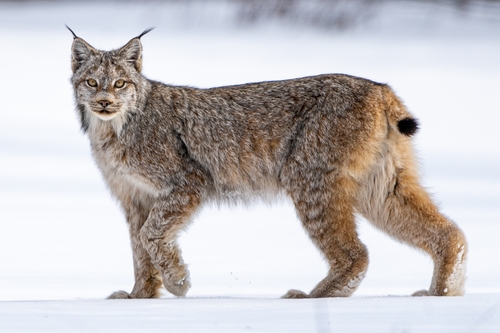
Other species in the family Felidae
Species that share its range
Sources
Conservation status, range description and population estimate come from the IUCN Red List assessment for Otocolobus manul. Countries are derived from that range description, not from a mapped country list. Last refreshed on .
The distribution map is drawn from the IUCN Red List spatial data compiled in 2020. IUCN (International Union for Conservation of Nature)