
Leopard
Panthera pardus
Red List assessment
Vulnerableon the IUCN Red List
- EXExtinct
- EWExtinct in the Wild
- CRCritically Endangered
- ENEndangered
- VUVulnerable
- NTNear Threatened
- LCLeast Concern
The Leopard is recorded in 3 countries across Asia. The IUCN Red List assesses the Leopard as Vulnerable. Global population is estimated at roughly 250,000 individuals, though this figure is uncertain due to the species' elusive nature; overall trend is declining, with some regional populations, especially in Asia, critically reduced.
- Family
- Felidae
- Order
- Carnivora
- Genus
- Panthera
- Countries recorded
- 3
- Continents
- Asia
- Red List category
- Vulnerable
- Data updated
- August 9, 2026
What is the Leopard?
The leopard is one of the five extant big cats of genus Panthera, renowned for its exceptional adaptability across diverse habitats from rainforest to desert. It is distinguished by its rosette-patterned coat, powerful build, and remarkable climbing ability, often hauling prey into trees to avoid scavengers. As a highly elusive and solitary predator, it remains one of the most widely distributed but least often seen big cats. Its ecological flexibility has allowed it to persist even in human-dominated landscapes where other large carnivores have disappeared.
Where does the Leopard live?
Sub-Saharan Africa, with fragmented populations in North Africa, the Middle East, and Asia including India, China, and the Russian Far East
Historically ranged across most of Africa, the Middle East, and Asia; today distribution is highly fragmented with strongholds in sub-Saharan Africa (particularly East and Southern Africa), parts of India, and small isolated populations in the Arabian Peninsula, Iran, Central Asia, China, and the Russian Far East (Amur leopard).
Altitude and depth
Sea level up to approximately 5,200 m in mountainous regions such as the Himalayas and parts of the Ethiopian highlands
Habitat of the Leopard
Extremely adaptable, occupying tropical and subtropical forests, savanna woodlands, grasslands, semi-desert and desert fringes, mountainous terrain, and even areas near human settlements. This habitat versatility is unmatched among big cats, allowing survival from sea level to high mountain ranges.
Adaptations to its environment
Exceptional climbing skill allows leopards to store kills in trees away from lions and hyenas. Their rosette coat pattern provides camouflage in dappled forest light and grassland, while a broad diet and opportunistic hunting style let them survive in habitats unsuitable for more specialized predators. Strong forelimbs and a muscular build enable them to carry prey much heavier than themselves up trees.
Conservation status and numbers
Classified as Vulnerable by the IUCN due to an estimated population decline exceeding 30% over the past three generations, driven by habitat loss, prey depletion, and human conflict. Several subspecies, such as the Amur and Arabian leopard, are Critically Endangered with only a few dozen to a few hundred individuals remaining.
Estimated population
Global population is estimated at roughly 250,000 individuals, though this figure is uncertain due to the species' elusive nature; overall trend is declining, with some regional populations, especially in Asia, critically reduced.
What threatens the Leopard?
Major threats include habitat fragmentation and loss from agricultural expansion and infrastructure development, prey base depletion due to bushmeat hunting, retaliatory killing from livestock conflict, and illegal trade in skins, bones, and body parts for traditional medicine and trophies.
Diseases and parasites
Susceptible to feline immunodeficiency virus (FIV), canine distemper virus, and various internal and external parasites including ticks, tapeworms, and mange mites, particularly in stressed or fragmented populations.
What is being done to protect it?
Leopards are listed on CITES Appendix I, protected under national wildlife laws across most range states, and included in numerous protected areas and transboundary conservation landscapes. Specific programs target critically endangered subspecies, such as the Amur Leopard and Tiger Alliance and Arabian Leopard Fund, focusing on anti-poaching, habitat corridors, and captive breeding.
Recommended actions
Priority actions include securing and connecting habitat corridors, strengthening anti-poaching enforcement, mitigating human-wildlife conflict through community compensation and livestock protection schemes, and closing illegal wildlife trade markets for leopard parts.
What the Leopard looks like
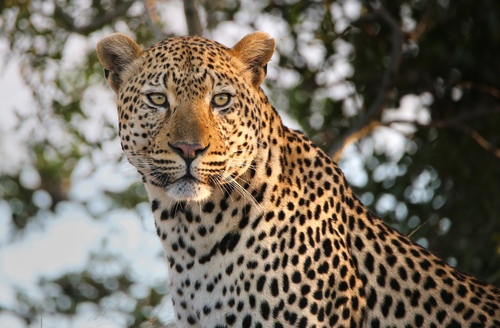
Coat color varies from pale yellow to deep gold or tawny, covered in dark rosette-shaped spots that are solid black on the head, limbs, and belly; a rare melanistic form (black panther) occurs frequently in dense rainforest populations.
Size
Body length ranges from 90 to 190 cm excluding tail, with shoulder height of 45-80 cm; tail length adds another 60-110 cm.
Weight
Males typically weigh 37-90 kg, while females are smaller at 21-60 kg, with significant regional variation based on prey availability.
Distinctive features
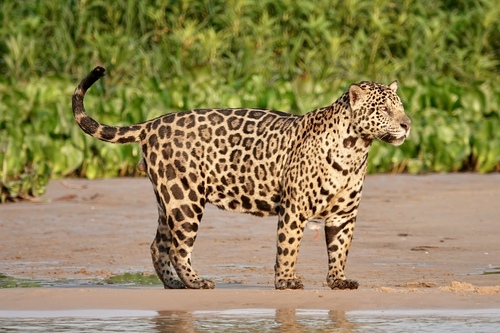
Leopards are distinguished from jaguars by smaller rosettes without central dots, from cheetahs by solid black spots rather than rosettes and non-tear-marked faces, and from other big cats by their stockier build adapted for climbing.
Differences between males and females
Males are notably larger and more heavily built than females, often 30-50% heavier, though coat pattern and coloration are similar between sexes.
Behaviour and diet of the Leopard
Predominantly solitary and territorial, with adults maintaining home ranges that may overlap between sexes but rarely between same-sex individuals; brief social interactions occur mainly during mating or between mothers and cubs.
When it is active
Primarily nocturnal and crepuscular, though activity patterns shift toward more diurnal behavior in areas with reduced human disturbance or competing predators.
Diet
Highly opportunistic carnivore preying on a huge range of species including antelopes, deer, wild boar, primates, rodents, birds, and reptiles; known to take prey as large as young giraffes or as small as insects when necessary.
How it feeds and hunts
Relies on stealth and short powerful bursts of speed, stalking prey to close range before ambushing; frequently caches kills in trees to protect them from scavengers and competing predators such as lions and hyenas.
Communication
Communicates through vocalizations including a distinctive rasping 'sawing' call, growls, and purrs, alongside scent marking via urine spraying, claw marks, and cheek rubbing to establish territory boundaries.
Interactions with other species
Faces competition and occasional predation risk from lions, tigers, and spotted hyenas, which can steal kills or kill cubs; leopards mitigate this through tree-caching behavior and avoiding direct confrontation with larger predators.
Role in its ecosystem
Functions as an apex or meso-predator depending on region, playing a critical role in regulating herbivore and mesopredator populations, which helps maintain ecosystem balance and biodiversity.
Reproduction and lifecycle
Breeding occurs year-round in most regions with no strict seasonality; gestation lasts about 90-105 days, producing litters of 2-4 cubs that are weaned around 3 months of age.
Raising the young
Females raise cubs alone without male involvement, hiding them in dense cover or rocky crevices for the first weeks of life; cubs remain with their mother for 18-24 months learning hunting skills before becoming independent.
Maturity and lifespan
Sexual maturity is reached around 2-3 years of age; wild lifespan averages 12-17 years, while captive individuals can live up to 21-23 years.
Taxonomy and naming of the Leopard
Classification
Mammalia > Carnivora > Felidae > Panthera > Panthera pardus
Subspecies
Recognized subspecies include P. p. pardus (African leopard, sub-Saharan Africa), P. p. fusca (Indian leopard), P. p. kotiya (Sri Lankan leopard), P. p. orientalis (Amur leopard, Russian Far East/China), P. p. nimr (Arabian leopard, critically endangered), P. p. saxicolor (Persian leopard), P. p. delacouri (Indochinese leopard), and P. p. melas (Javan leopard).
Scientific synonyms
Felis pardus (original Linnaean classification, 1758)
What research says
Recent studies
Recent camera-trap and genetic studies have revealed surprising leopard resilience and adaptability near urban areas such as Mumbai, alongside growing concern over genetic bottlenecks in isolated populations like the Arabian and Amur leopards.
Genome and DNA
Diploid chromosome number is 2n=38; genomic studies have revealed deep population structuring among subspecies, supporting distinct conservation management units, particularly for isolated populations like the Amur leopard.
Compared with similar species
Compared to jaguars, leopards are more slender with smaller rosettes lacking central spots; compared to cheetahs, they are stockier, better climbers, and lack the cheetah's specialized sprinting adaptations; compared to lions and tigers, leopards are smaller but more habitat-flexible.
The Leopard and people
Leopards can carry prey up to three times their own body weight up into trees; the melanistic 'black panther' form is simply a leopard with excess dark pigment, not a separate species; leopards are the most widely distributed of all wild cat species.
Where and how to see it
Best observed in reserves such as South Africa's Sabi Sands, Kenya's Maasai Mara, or Sri Lanka's Yala National Park, typically during early morning or late evening game drives when leopards are most active and visible near riverine or rocky habitats.
Risks to humans
Generally avoids humans but can become dangerous if wounded, cornered, or habituated to human presence; documented attacks occur mainly in regions of high human-leopard conflict near livestock or human settlements.
Human uses
Historically hunted for its pelt used in ceremonial and traditional dress, particularly in African and Asian cultures; illegal trade in skins, claws, and bones for traditional medicine continues to drive poaching pressure despite legal protections.
Myths and legends
Leopards feature prominently in African folklore as symbols of cunning and stealth, in Chinese culture representing courage and ferocity, and in various African royal traditions where leopard skins symbolized power and status among chiefs and kings.
Countries where the Leopard is recorded
The 3 countries named in the range description of its IUCN Red List assessment.
Questions about the Leopard
Where does the Leopard live?
The Leopard is recorded in China, India and Iran across Asia. These countries come from the range description of its IUCN Red List assessment, and they are what place the species on the interactive map.
Is the Leopard endangered?
Yes. The IUCN Red List assesses the Leopard as Vulnerable, one of the three threatened categories. The species faces a high risk of extinction in the wild. It is the first of the three threatened categories: numbers are falling, the range is shrinking, or the population is small enough that a single bad event could do lasting damage.
How many are left in the wild?
Global population is estimated at roughly 250,000 individuals, though this figure is uncertain due to the species' elusive nature; overall trend is declining, with some regional populations, especially in Asia, critically reduced. This figure comes from the species assessment on the IUCN Red List; population estimates for wild mammals are ranges, not counts, and are revised at each assessment.
What habitat does the Leopard live in?
Extremely adaptable, occupying tropical and subtropical forests, savanna woodlands, grasslands, semi-desert and desert fringes, mountainous terrain, and even areas near human settlements.
What is the scientific name of the Leopard?
The Leopard is Panthera pardus, in the family Felidae, order Carnivora.
Other species in the genus Panthera
Other species in the family Felidae
Species that share its range
Sources
Conservation status, range description and population estimate come from the IUCN Red List assessment for Panthera pardus. Countries are derived from that range description, not from a mapped country list. Last refreshed on .
The distribution map is drawn from the IUCN Red List spatial data compiled in 2025. Peter Gerngross