
Ladakh Dwarf Hamster
Urocricetus alticola
Red List assessment
Least Concernon the IUCN Red List
- EXExtinct
- EWExtinct in the Wild
- CRCritically Endangered
- ENEndangered
- VUVulnerable
- NTNear Threatened
- LCLeast Concern
The Ladakh Dwarf Hamster is recorded in 2 countries across Asia. The IUCN Red List assesses the Ladakh Dwarf Hamster as Least Concern. No precise population estimate exists; the species is considered locally common within suitable habitat patches, with an unknown but presumed stable trend.
- Family
- Cricetidae
- Order
- Rodentia
- Genus
- Urocricetus
- Countries recorded
- 2
- Continents
- Asia
- Red List category
- Least Concern
- Data updated
- August 9, 2026
What is the Ladakh Dwarf Hamster?
The Ladakh Dwarf Hamster is a small rodent endemic to the cold, arid high-altitude plateaus of the western Himalayas. It is remarkable for its ability to survive in one of the harshest terrestrial environments on Earth, characterized by extreme temperature swings, low oxygen, and sparse vegetation. Little studied due to its remote habitat, it represents a unique lineage adapted to Trans-Himalayan desert-steppe ecosystems.
Where does the Ladakh Dwarf Hamster live?
Trans-Himalayan region of Ladakh (India), parts of Kashmir, and adjacent high-altitude areas of western Tibet (China)
Restricted to the Ladakh region of northern India (Jammu and Kashmir Union Territory), with range extending into adjacent parts of western Tibet in China. This is a narrow endemic range confined to the Trans-Himalayan plateau.
Altitude and depth
Approximately 3000 to 5300 meters above sea level
Seasonal movements
Likely undergoes reduced activity or torpor during the harsh winter months (November to March) when temperatures drop drastically and food is scarce, though detailed hibernation studies are lacking.
Habitat of the Ladakh Dwarf Hamster
Cold desert steppe and alpine meadows above the tree line, typically featuring sparse xerophytic shrubs, grasses, and rocky or gravelly substrates. It favors areas near streams or seasonal water sources where vegetation is slightly denser.
Adaptations to its environment
Possesses dense, thick fur for insulation against extreme cold, small ears and compact body shape to minimize heat loss, and efficient kidneys adapted to arid conditions with minimal water availability. Behavioral adaptations include burrowing for thermal refuge and food caching to survive long winters.
Conservation status and numbers
Listed as Least Concern (LC) by the IUCN due to its relatively wide distribution across the Ladakh-Tibet plateau and presumed stable population, though data on population trends remain limited due to the remoteness of its habitat.
Estimated population
No precise population estimate exists; the species is considered locally common within suitable habitat patches, with an unknown but presumed stable trend.
What threatens the Ladakh Dwarf Hamster?
Potential threats include habitat degradation from overgrazing by livestock, climate change altering the fragile high-altitude ecosystem, and increased human infrastructure development in Ladakh linked to tourism and military presence.
What is being done to protect it?
No species-specific conservation programs are currently in place; general habitat protection occurs incidentally through protected areas in Ladakh such as Hemis National Park, which may overlap with parts of its range.
Recommended actions
Conduct systematic population surveys and habitat mapping, monitor effects of climate change on Trans-Himalayan ecosystems, and include the species in regional biodiversity monitoring programs to better assess long-term trends.
What the Ladakh Dwarf Hamster looks like
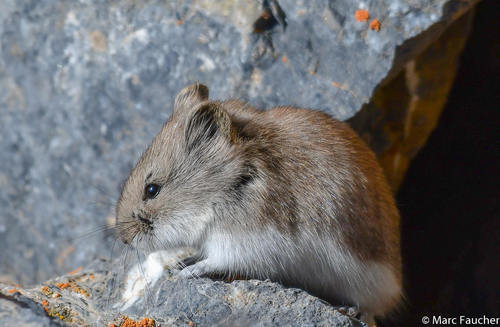
Small, compact rodent with grayish-brown to sandy dorsal fur that provides camouflage against rocky desert terrain, and paler, whitish-gray underparts. It has small rounded ears, short limbs, and a short, sparsely furred tail typical of dwarf hamsters.
Size
Body length approximately 8-11 cm, with a short tail of about 1.5-2.5 cm
Weight
Approximately 20-35 grams, with no significant difference reported between sexes
Distinctive features
Distinguished from other Cricetidae by its very short tail relative to body size, compact rounded body shape, and specific cranial features used in taxonomic identification; closely resembles other high-altitude hamsters but occupies a distinct, restricted geographic niche.
Behaviour and diet of the Ladakh Dwarf Hamster
Generally solitary and territorial, like most dwarf hamster species, with individuals occupying separate burrow systems and interacting primarily during the breeding season.
When it is active
Primarily nocturnal to crepuscular, likely an adaptation to avoid extreme daytime temperature fluctuations and predation in open habitats.
Diet
Herbivorous, feeding mainly on seeds, grasses, and other available vegetation typical of high-altitude steppe, with possible occasional consumption of small invertebrates for protein.
Communication
Likely relies on scent marking via specialized glands and short vocalizations for territorial signaling and mate attraction, similar to related Cricetidae species.
Interactions with other species
Potential predators include birds of prey (such as upland buzzards and eagles), foxes, and small mustelids native to the Ladakh region; may compete with other small rodents for limited food resources.
Role in its ecosystem
Plays a role in the high-altitude food web as prey for raptors and carnivores, and contributes to seed dispersal and soil aeration through burrowing activity in the fragile Trans-Himalayan ecosystem.
Reproduction and lifecycle
Breeding likely occurs during the brief warmer summer months (June-August) when food resources peak; gestation is estimated at around 18-20 days, typical for dwarf hamsters, with litter sizes probably ranging from 4-8 pups.
Raising the young
Presumed that females provide sole parental care, nursing and protecting young in burrow nests until weaning, consistent with typical hamster reproductive behavior, though specific data for this species is lacking.
Maturity and lifespan
Sexual maturity likely reached within 2-3 months, typical of small hamster species; lifespan in the wild is probably 1-2 years, though captive lifespan data is unavailable.
Taxonomy and naming of the Ladakh Dwarf Hamster
Classification
Class Mammalia > Order Rodentia > Family Cricetidae > Genus Urocricetus > Species U. alticola
Scientific synonyms
Cricetulus alticola (Thomas, 1917); formerly classified within genus Cricetulus before taxonomic revision placed it in Urocricetus
What research says
Recent studies
Recent taxonomic revisions have reclassified this species from genus Cricetulus to Urocricetus based on morphological and molecular phylogenetic analyses, though comprehensive ecological studies remain scarce.
Compared with similar species
Similar in size and ecology to other Trans-Himalayan hamsters such as the Tibetan Dwarf Hamster (Cricetulus kamensis), but distinguished by subtle cranial and dental characteristics and a more restricted range centered on Ladakh.
The Ladakh Dwarf Hamster and people
This hamster survives in one of the highest-altitude habitats of any rodent species worldwide, enduring oxygen levels and temperatures that would be lethal to most small mammals. It remains so poorly studied that basic aspects of its biology, such as exact lifespan and reproductive output, are still unknown to science.
Where and how to see it
Best observed during dusk or early morning in remote high-altitude valleys of Ladakh, such as areas near Hemis National Park, during the summer months (June-August) when activity is highest; patience and knowledge of burrow locations are essential due to its cryptic nocturnal habits.
Risks to humans
No notable risk to humans
Countries where the Ladakh Dwarf Hamster is recorded
The 2 countries named in the range description of its IUCN Red List assessment.
Questions about the Ladakh Dwarf Hamster
Where does the Ladakh Dwarf Hamster live?
The Ladakh Dwarf Hamster is recorded in China and India across Asia. These countries come from the range description of its IUCN Red List assessment, and they are what place the species on the interactive map.
Is the Ladakh Dwarf Hamster endangered?
The IUCN Red List assesses the Ladakh Dwarf Hamster as Least Concern. The species is widespread and abundant enough not to qualify for any threatened category. It does not mean the species is safe forever, only that nothing in the current data raises an alarm.
How many are left in the wild?
No precise population estimate exists; the species is considered locally common within suitable habitat patches, with an unknown but presumed stable trend. This figure comes from the species assessment on the IUCN Red List; population estimates for wild mammals are ranges, not counts, and are revised at each assessment.
What habitat does the Ladakh Dwarf Hamster live in?
Cold desert steppe and alpine meadows above the tree line, typically featuring sparse xerophytic shrubs, grasses, and rocky or gravelly substrates.
What is the scientific name of the Ladakh Dwarf Hamster?
The Ladakh Dwarf Hamster is Urocricetus alticola, in the family Cricetidae, order Rodentia.
Other species in the genus Urocricetus
Other species in the family Cricetidae

Species that share its range

Sources
Conservation status, range description and population estimate come from the IUCN Red List assessment for Urocricetus alticola. Countries are derived from that range description, not from a mapped country list. Last refreshed on .
The distribution map is drawn from the IUCN Red List spatial data compiled in 2008. IUCN (International Union for Conservation of Nature)