
Kinabalu Squirrel
Callosciurus baluensis
Red List assessment
Least Concernon the IUCN Red List
- EXExtinct
- EWExtinct in the Wild
- CRCritically Endangered
- ENEndangered
- VUVulnerable
- NTNear Threatened
- LCLeast Concern
The Kinabalu Squirrel is recorded in 2 countries across Asia. The IUCN Red List assesses the Kinabalu Squirrel as Least Concern. No precise global population estimate exists; considered locally common within suitable montane habitat, particularly within Kinabalu Park, with presumed stable trend.
- Family
- Sciuridae
- Order
- Rodentia
- Genus
- Callosciurus
- Countries recorded
- 2
- Continents
- Asia
- Red List category
- Least Concern
- Data updated
- August 9, 2026
What is the Kinabalu Squirrel?
The Kinabalu Squirrel is a medium-sized tree squirrel endemic to the island of Borneo, closely associated with the montane forests of Mount Kinabalu and surrounding highlands. It is a member of the diverse Callosciurus genus known as 'beautiful squirrels' due to their often vibrant fur patterns. This species is notable for its restricted range and adaptation to higher elevation forest ecosystems compared to many lowland Callosciurus relatives. It plays an important ecological role in seed dispersal within its forest habitat.
Where does the Kinabalu Squirrel live?
Borneo, primarily Sabah and Sarawak (Malaysia), with possible presence in adjacent Kalimantan (Indonesia)
Endemic to the island of Borneo, with core populations centered on Mount Kinabalu and the Crocker Range in Sabah, Malaysia. May extend into adjacent highland areas of northern Borneo.
Altitude and depth
Approximately 500-2500 meters above sea level, with highest densities typically observed in mid-to-upper montane forest zones.
Seasonal movements
No significant migration or hibernation; activity patterns may shift slightly with fruiting seasons of key food trees.
Habitat of the Kinabalu Squirrel
Primarily found in montane and submontane tropical rainforest, including primary and secondary forest with dense canopy cover. Also inhabits forest edges and areas with mixed vegetation at higher elevations.
Adaptations to its environment
Sharp curved claws and strong hind limbs allow agile arboreal locomotion through complex montane canopy structures. Dense fur provides insulation against cooler temperatures found at higher elevations compared to lowland Bornean forests.
Conservation status and numbers
Listed as Least Concern by IUCN due to relatively stable populations within protected areas like Kinabalu Park, though its restricted range makes it potentially vulnerable to habitat changes.
Estimated population
No precise global population estimate exists; considered locally common within suitable montane habitat, particularly within Kinabalu Park, with presumed stable trend.
What threatens the Kinabalu Squirrel?
Habitat loss from logging, agricultural expansion, and development pressure on montane forests outside protected zones. Climate change may also threaten montane specialists through habitat shifting.
What is being done to protect it?
Benefits significantly from protection within Kinabalu Park, a UNESCO World Heritage Site and one of the best-protected montane ecosystems in Borneo. Additional protection occurs in the Crocker Range National Park.
Recommended actions
Continued protection of montane forest corridors connecting fragmented habitat, monitoring of population trends outside protected areas, and further taxonomic research to clarify subspecies boundaries.
What the Kinabalu Squirrel looks like
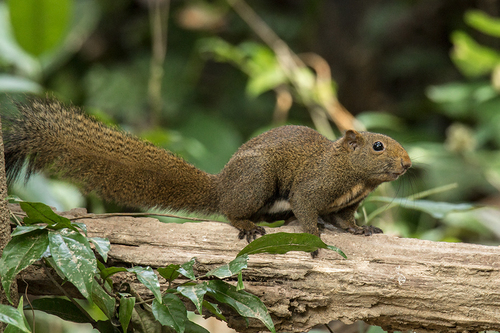
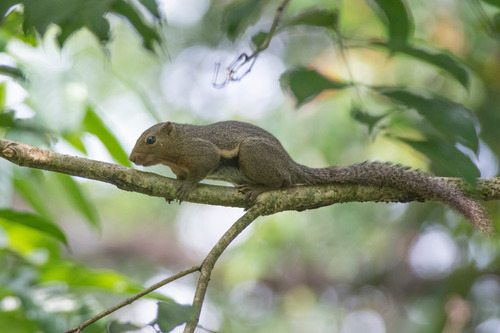
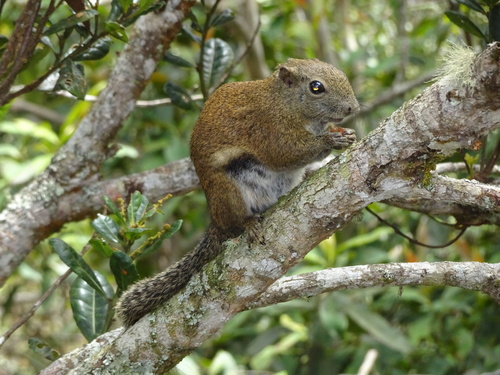
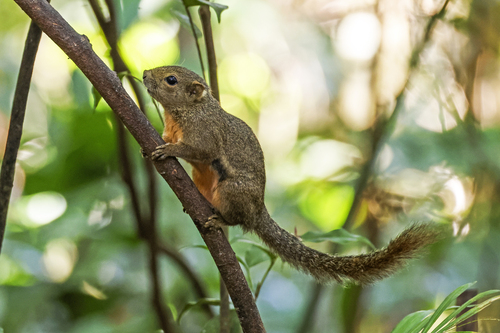
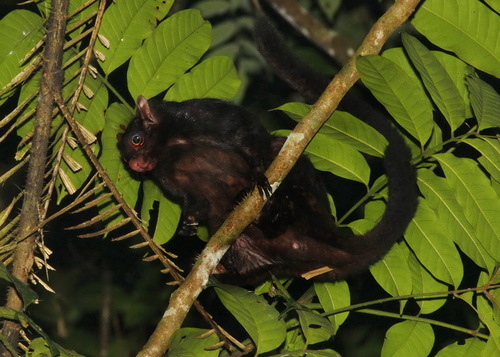
Displays a variable but often richly colored coat, typically featuring reddish-brown to olive tones on the back with paler, often creamy or grayish underparts. The tail is bushy and often shows banding or agouti patterning typical of Callosciurus species.
Size
Body length approximately 20-24 cm, with a tail of similar or slightly greater length (20-25 cm), giving a total length around 40-49 cm.
Weight
Typically weighs between 250-400 grams, with no marked difference between sexes.
Distinctive features
Distinguished from lowland Callosciurus relatives by its montane habitat preference and specific coloration patterns; precise identification often requires comparison of pelage details and range with other Bornean tree squirrels.
Behaviour and diet of the Kinabalu Squirrel
Generally solitary or seen in loose associations, with individuals maintaining home ranges that may overlap with conspecifics, particularly in food-rich areas.
When it is active
Diurnal, most active during daylight hours when foraging for food in the forest canopy and understory.
Diet
Omnivorous diet consisting mainly of fruits, seeds, nuts, and flowers, supplemented occasionally with insects and other small invertebrates.
Communication
Communicates through vocalizations including chattering and alarm calls, as well as scent marking and body postures typical of arboreal squirrels.
Interactions with other species
Predators likely include birds of prey, snakes, and small carnivorous mammals; the species may compete with other sympatric squirrel species for food resources in shared forest habitat.
Role in its ecosystem
Functions as an important seed disperser within montane forest ecosystems, contributing to forest regeneration and plant diversity through its foraging habits.
Reproduction and lifecycle
Breeding likely occurs opportunistically in relation to fruit availability, similar to related Callosciurus species; gestation is estimated around 40 days with litters typically of 1-3 young.
Raising the young
Females provide sole parental care, nursing and protecting young in a nest built within tree cavities or dense vegetation until they are weaned and capable of independent foraging.
Maturity and lifespan
Sexual maturity likely reached around 1 year of age, similar to related Callosciurus species; lifespan in the wild is estimated at 5-6 years, potentially longer in captivity.
Taxonomy and naming of the Kinabalu Squirrel
Classification
Mammalia > Rodentia > Sciuridae > Callosciurus > Callosciurus baluensis
Subspecies
Several subspecies recognized including C. b. baluensis (Mount Kinabalu region) and C. b. harrisoni, distributed across different montane areas of Borneo, though taxonomy remains somewhat unresolved.
Scientific synonyms
Sciurus baluensis (original combination)
What research says
Recent studies
Recent taxonomic studies continue to investigate the relationships between Callosciurus baluensis and other Bornean tree squirrels to clarify subspecies validity and evolutionary history.
Compared with similar species
Similar in general body plan to other Callosciurus species such as the Plantain Squirrel, but distinguished by its montane distribution and specific coloration; less colorful than some lowland relatives adapted to different forest strata.
The Kinabalu Squirrel and people
Named after Mount Kinabalu, the highest peak in Borneo, reflecting its strong association with this iconic mountain ecosystem. It is one of relatively few squirrel species specialized for higher elevation tropical forest in Southeast Asia.
Where and how to see it
Best observed in Kinabalu Park during early morning hours when squirrels are actively foraging; patient, quiet observation along forest trails increases chances of sighting.
Risks to humans
No notable risk to humans.
Countries where the Kinabalu Squirrel is recorded
The 2 countries named in the range description of its IUCN Red List assessment.
Questions about the Kinabalu Squirrel
Where does the Kinabalu Squirrel live?
The Kinabalu Squirrel is recorded in Indonesia and Malaysia across Asia. These countries come from the range description of its IUCN Red List assessment, and they are what place the species on the interactive map.
Is the Kinabalu Squirrel endangered?
The IUCN Red List assesses the Kinabalu Squirrel as Least Concern. The species is widespread and abundant enough not to qualify for any threatened category. It does not mean the species is safe forever, only that nothing in the current data raises an alarm.
How many are left in the wild?
No precise global population estimate exists; considered locally common within suitable montane habitat, particularly within Kinabalu Park, with presumed stable trend. This figure comes from the species assessment on the IUCN Red List; population estimates for wild mammals are ranges, not counts, and are revised at each assessment.
What habitat does the Kinabalu Squirrel live in?
Primarily found in montane and submontane tropical rainforest, including primary and secondary forest with dense canopy cover.
What is the scientific name of the Kinabalu Squirrel?
The Kinabalu Squirrel is Callosciurus baluensis, in the family Sciuridae, order Rodentia.
Other species in the genus Callosciurus
Other species in the family Sciuridae
Sources
Conservation status, range description and population estimate come from the IUCN Red List assessment for Callosciurus baluensis. Countries are derived from that range description, not from a mapped country list. Last refreshed on .
The distribution map is drawn from the IUCN Red List spatial data compiled in 2016. IUCN SSC Small Mammal Specialist Group