
Honduran Fruit-eating Bat
Artibeus inopinatus
Red List assessment
Data Deficienton the IUCN Red List
- EXExtinct
- EWExtinct in the Wild
- CRCritically Endangered
- ENEndangered
- VUVulnerable
- NTNear Threatened
- LCLeast Concern
Data Deficient has no position on the scale above — it records the absence of an assessment, not a degree of risk.
The Honduran Fruit-eating Bat is recorded in 2 countries across North America. The IUCN Red List records the Honduran Fruit-eating Bat as Data Deficient. Unknown; no reliable population estimate exists.
- Family
- Phyllostomidae
- Order
- Chiroptera
- Genus
- Artibeus
- Countries recorded
- 2
- Continents
- North America
- Red List category
- Data Deficient
- Data updated
- August 9, 2026
What is the Honduran Fruit-eating Bat?
Artibeus inopinatus, the Honduran Fruit-eating Bat, is a small leaf-nosed bat belonging to the family Phyllostomidae, endemic to the dry and moist forests of Honduras and El Salvador. Like other members of its genus, it is primarily frugivorous and plays an important ecological role as a seed disperser. It is one of the lesser-known Artibeus species due to the scarcity of specimens and field observations, which explains its Data Deficient IUCN listing. Its existence highlights the incompletely surveyed bat diversity of Central America.
Where does the Honduran Fruit-eating Bat live?
Honduras and El Salvador, Central America
Endemic to a restricted range in Central America, primarily recorded in Honduras and El Salvador. Records are concentrated in the interior valleys and Pacific slopes of Honduras, with limited documented occurrences in adjacent El Salvador.
Altitude and depth
Primarily found at low to moderate elevations, approximately 0–1200 m above sea level, with most records from lowland and foothill zones.
Seasonal movements
No well-documented seasonal migrations are known. Like most tropical bats, it likely adjusts foraging activity and roosting behavior in response to seasonal fruiting patterns and dry-season food scarcity.
Habitat of the Honduran Fruit-eating Bat
Occupies tropical dry forests and tropical moist lowland forests, as well as forest edges and second-growth vegetation. It is associated with areas where fruiting trees and shrubs are available year-round or seasonally, and may also use gallery forests along river systems.
Adaptations to its environment
Possesses a well-developed nose leaf characteristic of phyllostomid bats, which assists in the emission and fine-tuning of echolocation signals. Strong jaw musculature enables it to process tough fruits. Its relatively small body size may allow it to exploit microhabitats and fruit resources unavailable to larger Artibeus species.
Conservation status and numbers
Listed as Data Deficient (DD) by the IUCN, meaning insufficient information is available to assess its extinction risk accurately. The restricted range, limited number of documented specimens, and ongoing habitat loss in Honduras and El Salvador suggest the species may warrant a threatened category upon further study.
Estimated population
Unknown; no reliable population estimate exists. Given the paucity of records and ongoing habitat loss, the population is suspected to be small and potentially declining.
What threatens the Honduran Fruit-eating Bat?
Primary threats include deforestation and habitat degradation caused by agricultural expansion (especially cattle ranching and sugarcane cultivation), logging, and human settlement in its restricted range. The small geographic distribution makes it particularly vulnerable to localized habitat loss.
Diseases and parasites
No specific disease or parasite studies exist for this species. Like other phyllostomid bats, it likely harbors ectoparasites (mites, streblid flies) and endoparasites (helminths). Bats of the genus Artibeus can carry various coronaviruses and other viruses, though no specific data exist for A. inopinatus.
What is being done to protect it?
No species-specific conservation programs are currently in place. The species may benefit indirectly from protected areas in Honduras such as Cerro Azul Meámbar National Park and La Muralla National Park, as well as general bat conservation initiatives in Central America.
Recommended actions
Priority actions include targeted field surveys to clarify distribution and population size, ecological studies on roosting and foraging behavior, inclusion in national biodiversity monitoring programs, and strengthening protection of tropical dry and moist forests within its known range.
What the Honduran Fruit-eating Bat looks like
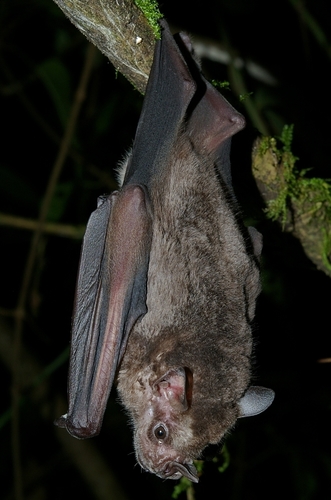
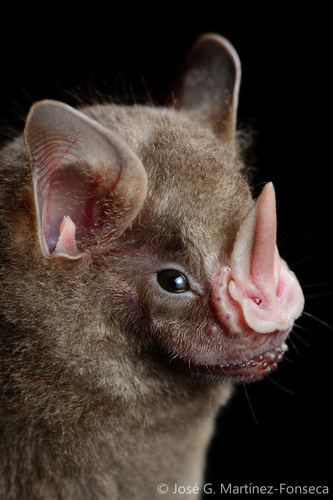
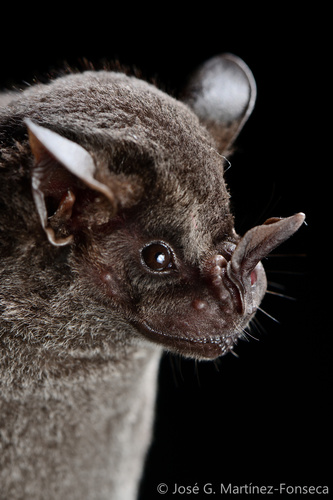
Fur is brownish-gray to dark brown dorsally and paler ventrally. It has a short, prominent triangular nose leaf, rounded ears, and a reduced or absent tail. Faint whitish facial stripes above and below the eyes are characteristic of the genus Artibeus, though less pronounced in smaller species.
Size
Small bat; body length approximately 60–75 mm; forearm length estimated at 40–46 mm; wingspan approximately 30–35 cm.
Weight
Estimated at approximately 18–30 g, typical for small Artibeus species; no sex-specific data published.
Distinctive features
Distinguished from other small Artibeus species (such as A. aztecus and A. toltecus) by subtle cranial and dental morphology, particularly aspects of the skull proportions and tooth dimensions. The combination of small size, reduced facial stripes, and geographic distribution helps separate it from sympatric congeners.
Differences between males and females
Minimal sexual dimorphism reported, as is typical for the genus; females may be slightly larger than males, a common pattern among phyllostomid bats, but data are insufficient for confident confirmation.
Behaviour and diet of the Honduran Fruit-eating Bat
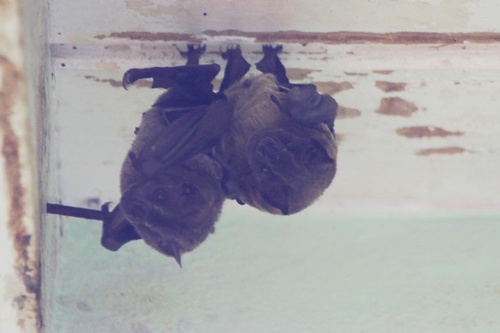
Presumed to roost in small to medium-sized groups, as is typical for Artibeus bats, often in tree hollows, dense foliage, or modified tent-like shelters constructed from large leaves. Social structure likely involves a dominant male with a small harem of females.
When it is active
Strictly nocturnal. Foraging activity typically begins shortly after dusk, with peak activity in the first few hours of the night when fruit is located by echolocation and olfaction.
Diet
Primarily frugivorous, feeding on a variety of soft, ripe tropical fruits including figs (Ficus spp.) and other fruiting trees common to Central American forests. May occasionally supplement diet with pollen, nectar, or insects, as is documented in related Artibeus species.
How it feeds and hunts
Locates fruit using low-intensity echolocation calls and olfaction. Individuals typically pluck fruit in flight or while hovering briefly, then carry it to a feeding roost where it is consumed, reducing predation risk while eating.
Communication
Uses ultrasonic echolocation for orientation and obstacle avoidance; social calls and audible vocalizations are used for intraspecific communication at the roost. Scent glands may play a role in harem-defense and individual recognition, as observed in related species.
Interactions with other species
As a fruit-eater and seed disperser, it interacts mutualistically with many fruiting plant species. Natural predators likely include owls and arboreal snakes. May compete with other sympatric frugivorous bats and birds for fruit resources.
Role in its ecosystem
Plays a significant ecological role as a seed disperser for tropical forest plants, contributing to forest regeneration and structure. As with other Artibeus, it may be a keystone mutualist in its ecosystem, particularly in disturbed habitats where other dispersers are absent.
Reproduction and lifecycle
Reproductive pattern likely bimodal polyestry (two birth peaks per year) as seen in most Central American phyllostomids, typically timed to coincide with fruit abundance. Gestation is estimated at approximately 3–4 months; litter size is typically one pup.
Raising the young
Maternal care is primary, with females nursing and carrying the pup for several weeks. Pups cling to the mother initially and are left at the roost during foraging once large enough. Weaning occurs at approximately 1–2 months of age.
Maturity and lifespan
Sexual maturity is likely reached within the first year, as typical for small phyllostomid bats. Lifespan in the wild is estimated at 5–10 years based on data from closely related species; captive longevity data are unavailable.
Taxonomy and naming of the Honduran Fruit-eating Bat
Classification
Mammalia > Chiroptera > Phyllostomidae > Artibeus > Artibeus inopinatus
Scientific synonyms
Historically considered by some authors as a possible subspecies or close relative of Artibeus aztecus; no widely accepted synonyms currently recognized.
What research says
Recent studies
The species remains among the least-studied bats in Central America. Recent regional bat inventories in Honduras and El Salvador have occasionally documented specimens, but no dedicated ecological or genetic studies have been published as of the early 2020s.
Genome and DNA
No published genome or chromosomal studies specific to A. inopinatus. Other Artibeus species typically have a diploid chromosome number of 2n = 30–31; similar numbers are expected but unconfirmed for this species.
Compared with similar species
Most closely related to other small members of the genus Artibeus, including Artibeus aztecus (Aztec Fruit-eating Bat) and Artibeus toltecus (Toltec Fruit-eating Bat), from which it differs primarily in cranial morphology and geographic range. It is considerably smaller than the well-known Artibeus jamaicensis and Artibeus lituratus.
The Honduran Fruit-eating Bat and people
Despite being named the 'Honduran' Fruit-eating Bat, it also occurs in El Salvador, making its common name slightly misleading. Like other Artibeus, it may construct 'tents' by biting the midribs of large leaves to create a waterproof roosting shelter. This species was formally described only in 1964, making it one of the more recently described bats in the region, and many aspects of its biology remain entirely unknown.
Where and how to see it
Best observed at night in tropical dry or moist forest edges and fruit-bearing trees in Honduras (particularly in valleys of the interior and Pacific slope regions) and El Salvador. Mist-netting surveys near fruiting fig trees or forest clearings are the most reliable method of encountering this species. Local bat researchers and universities in Tegucigalpa, Honduras occasionally conduct surveys where sightings are most likely.
Risks to humans
No notable risk to humans. As with all wild bats, direct handling should be avoided due to the theoretical possibility of rabies transmission; trained researchers should use appropriate protective equipment during capture and handling.
Countries where the Honduran Fruit-eating Bat is recorded
The 2 countries named in the range description of its IUCN Red List assessment.
Questions about the Honduran Fruit-eating Bat
Where does the Honduran Fruit-eating Bat live?
The Honduran Fruit-eating Bat is recorded in El Salvador and Honduras across North America. These countries come from the range description of its IUCN Red List assessment, and they are what place the species on the interactive map.
Is the Honduran Fruit-eating Bat endangered?
The IUCN Red List assesses the Honduran Fruit-eating Bat as Data Deficient. There is not enough information to judge the risk of extinction, usually because the species is rarely seen or has never been surveyed. It is not a reassuring category: several species were Data Deficient right up to the point they were found to be Critically Endangered.
How many are left in the wild?
Unknown; no reliable population estimate exists. This figure comes from the species assessment on the IUCN Red List; population estimates for wild mammals are ranges, not counts, and are revised at each assessment.
What habitat does the Honduran Fruit-eating Bat live in?
Occupies tropical dry forests and tropical moist lowland forests, as well as forest edges and second-growth vegetation.
What is the scientific name of the Honduran Fruit-eating Bat?
The Honduran Fruit-eating Bat is Artibeus inopinatus, in the family Phyllostomidae, order Chiroptera.
Other species in the genus Artibeus
Other species in the family Phyllostomidae
Sources
Conservation status, range description and population estimate come from the IUCN Red List assessment for Artibeus inopinatus. Countries are derived from that range description, not from a mapped country list. Last refreshed on .
The distribution map is drawn from the IUCN Red List spatial data compiled in 2016. IUCN (International Union for Conservation of Nature)