
Hinde's Rock Rat
Aethomys hindei
Red List assessment
Least Concernon the IUCN Red List
- EXExtinct
- EWExtinct in the Wild
- CRCritically Endangered
- ENEndangered
- VUVulnerable
- NTNear Threatened
- LCLeast Concern
The Hinde's Rock Rat is recorded in 4 countries across Africa. The IUCN Red List assesses the Hinde's Rock Rat as Least Concern. No reliable global population estimate exists.
- Family
- Muridae
- Order
- Rodentia
- Genus
- Aethomys
- Countries recorded
- 4
- Continents
- Africa
- Red List category
- Least Concern
- Data updated
- August 9, 2026
What is the Hinde's Rock Rat?
Hinde's Rock Rat is a medium-sized murid rodent endemic to East Africa, particularly associated with rocky outcrops and kopjes within savanna and woodland landscapes of Kenya and northern Tanzania. It belongs to the genus Aethomys, a group of African rats commonly referred to as rock rats or bush rats due to their strong affinity for rocky terrain. The species was named after Sidney Langford Hinde, a British colonial officer and naturalist active in East Africa in the late 19th century. It remains relatively poorly studied compared to more widespread Aethomys species.
Where does the Hinde's Rock Rat live?
Primarily Kenya and northern Tanzania in East Africa, with the core range centered on the central Kenyan highlands and surrounding rocky savanna zones.
The species' range is centered in Kenya, including the central highlands, the Rift Valley margins, and eastern regions. It extends into northern Tanzania. Some records suggest a range reaching parts of Uganda and possibly southern Ethiopia, but these require confirmation. Overall, its distribution is relatively restricted within East Africa.
Altitude and depth
Typically found from about 500 m to 2,000 m above sea level, with optimal occurrence in mid-elevation rocky savanna and woodland habitats.
Seasonal movements
No known seasonal migration or hibernation. Activity patterns may shift slightly with rainfall seasons, which influence food availability; during dry seasons the animals likely rely more heavily on stored food or cached seeds.
Habitat of the Hinde's Rock Rat
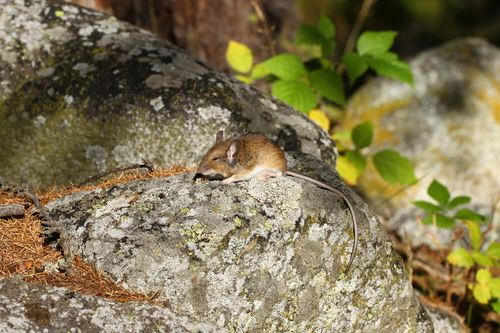
Hinde's Rock Rat favors rocky outcrops, boulder fields, kopjes, and escarpments embedded within savanna, dry woodland, and bushland ecosystems. It shelters in crevices and under large rocks, which provide protection from predators and thermal buffering. Surrounding vegetation including grasses, shrubs, and acacia woodland provides foraging opportunities near rocky refugia.
Adaptations to its environment
Its robust, compact body and strong claws are well adapted to navigating rocky terrain. Large eyes support nocturnal activity in low-light conditions. The fur coloration provides effective camouflage against rocky, sun-bleached substrates. Like other Aethomys, it likely has efficient water conservation mechanisms suited to semi-arid rocky environments.
Conservation status and numbers
Least Concern (LC) on the IUCN Red List. The species is considered stable with no evidence of major population declines meeting threshold criteria for a more threatened category. Its association with rocky habitats, which are less susceptible to agricultural conversion than plains habitats, affords it some natural protection.
Estimated population
No reliable global population estimate exists. The population trend is considered stable based on IUCN assessment, though detailed surveys are lacking.
What threatens the Hinde's Rock Rat?
Habitat degradation through overgrazing around rocky outcrops, which reduces vegetative cover needed for foraging, represents the most likely threat. Predation pressure from domestic cats and rats (invasive species) in areas near human settlement may be locally significant. Broader land-use changes in Kenya and Tanzania could incrementally reduce suitable habitat.
Diseases and parasites
No species-specific disease or parasite records are well documented. Like other African murids, it is likely host to various ectoparasites (fleas, ticks, mites) and endoparasites (nematodes, cestodes), and may act as a reservoir for rodent-borne pathogens common in East African small mammal communities.
What is being done to protect it?
The species is present within several protected areas in Kenya and Tanzania, including national parks and game reserves where rocky kopje habitats are preserved. No species-specific conservation program is known to exist for Hinde's Rock Rat.
Recommended actions
Comprehensive field surveys are needed to accurately map the current distribution and assess population size. Monitoring of rocky kopje habitats for degradation due to grazing and human encroachment is recommended. Control of invasive predators near rocky habitats in settled areas would be beneficial.
What the Hinde's Rock Rat looks like
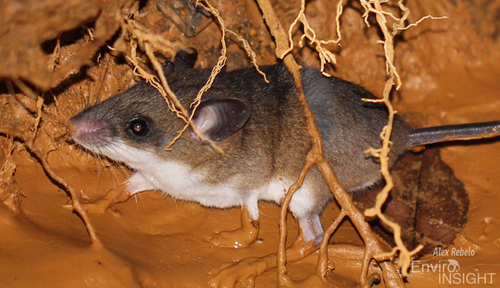
The dorsal fur is brownish-gray to tawny-brown, often with a slightly grizzled appearance due to mixed dark and pale guard hairs. The ventral surface is distinctly paler, typically whitish to cream. The tail is thinly haired and bicolored (darker above, paler below). Ears are moderately large and rounded; eyes are large and dark.
Size
Head-body length approximately 120–165 mm; tail length roughly 130–175 mm (approximately equal to or slightly longer than the body); hind foot length about 22–27 mm.
Weight
Typically 50–100 g; no strong evidence of significant sexual dimorphism in weight, though males may average slightly heavier.
Distinctive features
Distinguished from closely related Aethomys species such as A. kaiseri and A. nyikae by a combination of its geographic range (East Africa), body size, and subtle pelage coloration differences. Compared to A. thomasi, it tends to have a somewhat more robust skull. Definitive identification often requires examination of cranial and dental morphology.
Differences between males and females
Sexual dimorphism is minimal in this species. Males and females are similar in size, weight, and coloration, which is typical for the genus Aethomys.
Behaviour and diet of the Hinde's Rock Rat
Likely semi-social or loosely colonial as is typical of rock rats in the genus, with small family groups or pairs sharing rocky refuge sites. Precise social structure in the wild is not well documented for this species.
When it is active
Primarily nocturnal, foraging after dark and retreating to rock crevices or burrows beneath boulders during daylight hours. This pattern reduces exposure to diurnal predators such as raptors.
Diet
Omnivorous; diet consists primarily of seeds, grains, and plant material including grasses, fruits, and roots. Insects and other invertebrates are likely consumed opportunistically, providing protein especially during the breeding season.
How it feeds and hunts
Forages on the ground and among rocks, using its sensitive whiskers (vibrissae) and keen sense of smell to locate seeds and invertebrates. It may cache food items near its rocky shelter.
Communication
Communication likely involves ultrasonic vocalizations (as in most murid rodents), scent marking via urine and specialized glands to delineate territory and signal reproductive status, and tactile contact within social groups.
Interactions with other species
Natural predators include owls (particularly barn owls and eagle owls), small carnivores such as mongooses, genets, and servals, and snakes that hunt in rocky terrain. It may compete for rocky refuge sites with other small mammals. It likely plays a role in seed dispersal within its habitat.
Role in its ecosystem
As a granivore and seed hoarder, Hinde's Rock Rat likely contributes to seed dispersal and potentially to plant community structure in rocky savanna environments. It also serves as prey for a range of mesopredators, linking plant productivity to higher trophic levels.
Reproduction and lifecycle
Breeding appears to be seasonal, likely peaking during or shortly after the rainy seasons when food resources are most abundant. Gestation in Aethomys species is approximately 22–25 days. Litter size is typically 2–6 pups.
Raising the young
The female provides primary care for the altricial young within a nest constructed in a rock crevice or beneath boulders. Young are weaned at approximately 3–4 weeks of age, consistent with other small murids.
Maturity and lifespan
Sexual maturity is likely reached at approximately 6–10 weeks of age, consistent with related Aethomys species. Wild lifespan is estimated at 1–3 years; captive lifespan may extend to 4–5 years under optimal conditions.
Taxonomy and naming of the Hinde's Rock Rat
Classification
Mammalia > Rodentia > Muridae > Aethomys > Aethomys hindei
Scientific synonyms
Originally described by Oldfield Thomas in 1902; may appear in older literature under broader Aethomys or Rattus groupings, but no widely accepted synonyms are established.
What research says
Recent studies
No notable recent high-profile studies specifically targeting Aethomys hindei have been identified. Broader phylogenetic studies of the genus Aethomys using molecular markers have helped clarify species boundaries and relationships within the group, indirectly informing the taxonomy of this species.
Genome and DNA
The karyotype of Aethomys hindei has not been fully characterized in published literature. The broader genus Aethomys shows 2n ranging from 44 to 50 depending on species; the specific chromosome count for A. hindei is not confirmed.
Compared with similar species
Aethomys hindei is closely related to other East African rock rats in the genus, particularly A. kaiseri (Kaiser's Rock Rat) and A. nyikae (Nyika Rock Rat). It differs from A. kaiseri primarily by geographic range and minor morphological characters. The genus Aethomys as a whole is distinguished from the genus Rattus by dental morphology and its African distribution.
The Hinde's Rock Rat and people
Hinde's Rock Rat is named after a 19th-century British officer who also wrote extensively about the Maasai people of East Africa, making it one of the few rodents named after both a soldier and an ethnographer. Like many rock-dwelling rodents worldwide, it exploits the thermal stability of boulder crevices to survive hot African days and cold nights without true hibernation. Despite living in arid and semi-arid rocky terrain, it can obtain much of its water requirement from the seeds and plant matter it consumes.
Where and how to see it
The best chance of observing Hinde's Rock Rat is at rocky kopjes in central and eastern Kenya, particularly at dusk or with a red-filtered spotlight after dark. Sites within or near wildlife reserves such as Tsavo East National Park or Laikipia Plateau offer suitable habitat. Patience near boulder fields with surrounding grass and shrub cover is the most effective strategy.
Risks to humans
No notable risk to humans. Like all wild rodents, it may carry ectoparasites or pathogens if handled, so direct contact without protective gloves is inadvisable.
Countries where the Hinde's Rock Rat is recorded
The 4 countries named in the range description of its IUCN Red List assessment.
Questions about the Hinde's Rock Rat
Where does the Hinde's Rock Rat live?
The Hinde's Rock Rat is recorded in Ethiopia, Kenya, Tanzania and Uganda across Africa. These countries come from the range description of its IUCN Red List assessment, and they are what place the species on the interactive map.
Is the Hinde's Rock Rat endangered?
The IUCN Red List assesses the Hinde's Rock Rat as Least Concern. The species is widespread and abundant enough not to qualify for any threatened category. It does not mean the species is safe forever, only that nothing in the current data raises an alarm.
How many are left in the wild?
No reliable global population estimate exists. This figure comes from the species assessment on the IUCN Red List; population estimates for wild mammals are ranges, not counts, and are revised at each assessment.
What habitat does the Hinde's Rock Rat live in?
Hinde's Rock Rat favors rocky outcrops, boulder fields, kopjes, and escarpments embedded within savanna, dry woodland, and bushland ecosystems.
What is the scientific name of the Hinde's Rock Rat?
The Hinde's Rock Rat is Aethomys hindei, in the family Muridae, order Rodentia.
Other species in the genus Aethomys
Other species in the family Muridae
Sources
Conservation status, range description and population estimate come from the IUCN Red List assessment for Aethomys hindei. Countries are derived from that range description, not from a mapped country list. Last refreshed on .
The distribution map is drawn from the IUCN Red List spatial data compiled in 2008. IUCN (International Union for Conservation of Nature)