
Guereza
Colobus guereza
Red List assessment
Least Concernon the IUCN Red List
- EXExtinct
- EWExtinct in the Wild
- CRCritically Endangered
- ENEndangered
- VUVulnerable
- NTNear Threatened
- LCLeast Concern
The Guereza is recorded in 9 countries across Africa. The IUCN Red List assesses the Guereza as Least Concern. Exact global population numbers are not well quantified, but the species is considered numerous and widespread; overall trend is thought to be declining in some regions due to deforestation while stable in protected areas.
- Family
- Cercopithecidae
- Order
- Primates
- Genus
- Colobus
- Countries recorded
- 9
- Continents
- Africa
- Red List category
- Least Concern
- Data updated
- August 9, 2026
What is the Guereza?
The guereza, or mantled colobus, is a striking black-and-white monkey native to the forests of Central and East Africa. It is easily recognized by its long white mantle of fur draping over its shoulders and back, contrasting with its black body. This arboreal leaf-eating primate plays a key ecological role in forest regeneration through seed dispersal. It is one of the more widespread and adaptable colobus species, tolerating a range of forest habitats including some degraded areas.
Where does the Guereza live?
Central and East Africa, primarily Kenya, Uganda, Tanzania, Ethiopia, Democratic Republic of Congo, and Cameroon
Found across a broad swath of Central and East Africa, including Ethiopia, Kenya, Uganda, Tanzania, Rwanda, Democratic Republic of Congo, Central African Republic, Cameroon, and Nigeria. Populations are often fragmented due to forest clearing but the species has one of the widest ranges among colobus monkeys.
Altitude and depth
Ranges from lowland forests near sea level up to montane forests at elevations of 3,000 meters or more, particularly in East African highlands.
Seasonal movements
No true migration or hibernation; however, activity and feeding patterns may shift seasonally in response to fruit and leaf availability during wet and dry seasons.
Habitat of the Guereza
Primarily inhabits tropical and subtropical moist forests, including montane forest, riverine forest, and forest fragments. Also found in secondary forest and forest-savanna mosaics, showing some tolerance for habitat disturbance compared to other colobus species.
Adaptations to its environment
Possesses a specialized multi-chambered stomach with symbiotic bacteria to digest cellulose-rich mature leaves, an unusual diet among primates. Long limbs and a long tail aid in arboreal locomotion and balance while leaping between trees. Its striking mantle may serve in visual communication and species recognition within dense forest.
Conservation status and numbers
Listed as Least Concern by IUCN due to its wide distribution and relatively large population, though some local populations are declining due to habitat loss and hunting. Certain subspecies or isolated populations face greater regional pressure.
Estimated population
Exact global population numbers are not well quantified, but the species is considered numerous and widespread; overall trend is thought to be declining in some regions due to deforestation while stable in protected areas.
What threatens the Guereza?
Habitat destruction from logging and agricultural expansion, hunting for bushmeat and its distinctive pelt, and fragmentation of forest habitat limiting gene flow between populations.
Diseases and parasites
Susceptible to various gastrointestinal parasites and can be affected by outbreaks of disease in fragmented, stressed populations, though specific pathogens are not extensively documented.
What is being done to protect it?
Protected in numerous national parks and reserves across its range, including Kakamega Forest in Kenya and Kibale National Park in Uganda. Listed under CITES Appendix II regulating international trade.
Recommended actions
Strengthen protection of remaining forest habitat, reduce bushmeat hunting through community engagement, maintain forest corridors to prevent population fragmentation, and monitor subspecies-level population trends.
What the Guereza looks like
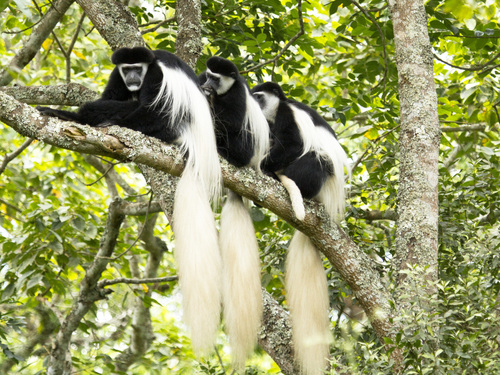
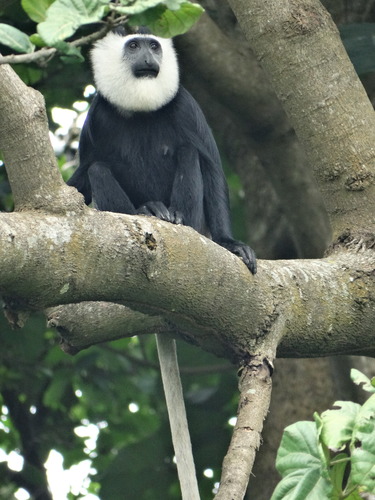
The guereza has a predominantly black body with a striking white mantle of long fur draping from the shoulders down the back and flanks, plus a white beard-like fringe around the face. The tail often has a white tuft at the tip, and the face is framed by black fur with a bare, dark skin visible around the eyes and muzzle.
Size
Body length (head to rump) typically ranges from 45-70 cm, with an additional tail length of 50-90 cm.
Weight
Adult males typically weigh 8-14 kg; females are slightly smaller, weighing around 7-10 kg.
Distinctive features
Distinguished from other colobus species by its prominent white mantle and facial fringe, combined with a generally more robust build. The white tail tuft and mantle pattern vary somewhat by subspecies and can help distinguish regional populations.
Differences between males and females
Males are generally larger and heavier than females, though coloration patterns are similar between sexes.
Behaviour and diet of the Guereza
Lives in social groups typically of 3-15 individuals, usually consisting of one adult male, several females, and their offspring, though multi-male groups also occur. Groups defend territories and interact through vocal displays rather than physical aggression in most encounters.
When it is active
Diurnal, with activity concentrated in morning and late afternoon; midday is often spent resting and digesting food due to their fibrous diet.
Diet
Primarily folivorous, feeding on young and mature leaves, but also consumes fruit, flowers, seeds, and occasionally bark, depending on availability. Their specialized digestive system allows efficient processing of cellulose-heavy vegetation.
Communication
Males produce loud roaring calls, especially at dawn, to communicate group location and deter rival males. Additional communication includes body postures, facial expressions, and physical contact such as grooming.
Interactions with other species
Predators include leopards, eagles (notably crowned eagles), and chimpanzees in some regions. Guerezas may share habitat and sometimes forage alongside other primate species with minimal direct competition due to differing dietary niches.
Role in its ecosystem
As a foliage specialist, the guereza plays a role in shaping forest vegetation structure through selective feeding and contributes to nutrient cycling; it also disperses seeds of some fruiting plants it consumes.
Reproduction and lifecycle
Breeding can occur year-round without a strict seasonal pattern, though some regional peaks correspond to periods of high food abundance. Gestation lasts approximately 5-6 months, and females typically give birth to a single offspring.
Raising the young
Infants are cared for primarily by the mother, though allomothering (care by other group females) is common and helps socialize infants. Infants are weaned by around 6-12 months of age and reach juvenile independence over the following year.
Maturity and lifespan
Females typically reach sexual maturity around 3-4 years, males slightly later. Lifespan in the wild is estimated at 20-25 years, while captive individuals can live slightly longer with veterinary care.
Taxonomy and naming of the Guereza
Classification
Mammalia > Primates > Cercopithecidae > Colobus > Colobus guereza
Subspecies
Several subspecies recognized including C. g. occidentalis (western populations), C. g. dodingae (Uganda), C. g. gallarum (Ethiopia/Kenya border), C. g. kikuyuensis (Kenya highlands), and C. g. matschiei (Uganda/DRC border region), differing mainly in tail length and mantle coloration.
Scientific synonyms
Colobus abyssinicus is sometimes used as a synonym or was historically applied to related populations; the species has also been referred to as the mantled guereza.
What research says
Recent studies
Recent research has focused on genetic diversity among guereza subspecies and the impact of forest fragmentation on gene flow, as well as studies on their digestive microbiome adaptations to a leaf-based diet.
Genome and DNA
Colobus guereza has a diploid chromosome number of 44, consistent with many Old World monkey species; genetic studies have been used to clarify subspecies boundaries and phylogenetic relationships within Colobus.
Compared with similar species
Compared to the black-and-white colobus species like Colobus polykomos, the guereza has a more extensive white mantle and different facial fringe patterns. It is generally more habitat-tolerant than the Angola colobus (Colobus angolensis), allowing it a wider geographic distribution.
The Guereza and people
Guerezas can leap distances of over 6 meters between trees despite their relatively large body size. Their loud male roaring calls can be heard echoing through the forest for over a kilometer at dawn.
Where and how to see it
Best observed in protected forest reserves such as Kakamega Forest in Kenya or Kibale National Park in Uganda, particularly in early morning when groups are most active and vocal. Guided forest walks increase chances of sightings due to knowledgeable trackers familiar with group locations.
Risks to humans
No notable risk to humans; guerezas are shy and typically avoid close contact with people.
Human uses
Historically hunted for their distinctive black-and-white pelts, which were used in traditional clothing and ceremonial items; today, the species is primarily valued for ecotourism and conservation education.
Myths and legends
In some East African cultures, colobus pelts have historically been used in traditional ceremonial garments and dances, symbolizing status or spiritual significance, though detailed mythological narratives specific to this species are limited.
Countries where the Guereza is recorded
The 9 countries named in the range description of its IUCN Red List assessment.
Questions about the Guereza
Where does the Guereza live?
The Guereza is recorded in Cameroon, Central African Republic, Democratic Republic of the Congo, Ethiopia and Kenya, among 9 countries in total across Africa. These countries come from the range description of its IUCN Red List assessment, and they are what place the species on the interactive map.
Is the Guereza endangered?
The IUCN Red List assesses the Guereza as Least Concern. The species is widespread and abundant enough not to qualify for any threatened category. It does not mean the species is safe forever, only that nothing in the current data raises an alarm.
How many are left in the wild?
Exact global population numbers are not well quantified, but the species is considered numerous and widespread; overall trend is thought to be declining in some regions due to deforestation while stable in protected areas. This figure comes from the species assessment on the IUCN Red List; population estimates for wild mammals are ranges, not counts, and are revised at each assessment.
What habitat does the Guereza live in?
Primarily inhabits tropical and subtropical moist forests, including montane forest, riverine forest, and forest fragments.
What is the scientific name of the Guereza?
The Guereza is Colobus guereza, in the family Cercopithecidae, order Primates.
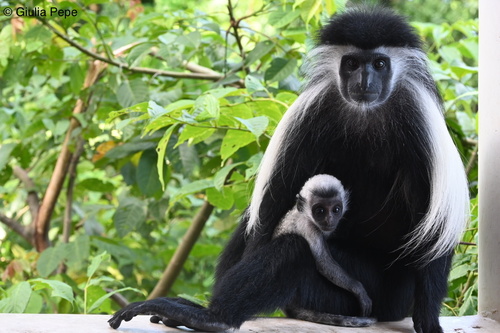
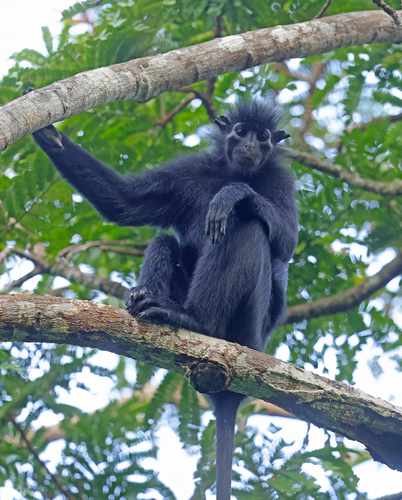
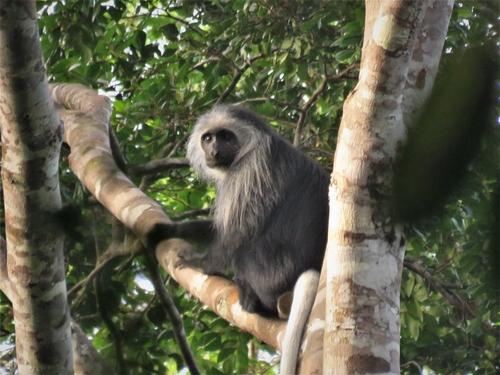
Other species in the genus Colobus
Other species in the family Cercopithecidae
Species that share its range
Sources
Conservation status, range description and population estimate come from the IUCN Red List assessment for Colobus guereza. Countries are derived from that range description, not from a mapped country list. Last refreshed on .
The distribution map is drawn from the IUCN Red List spatial data compiled in 2024. Yvonne de Jong, Tom Butynski and IUCN (International Union for Conservation of Nature)