
King Colobus
Colobus polykomos
Red List assessment
Endangeredon the IUCN Red List
- EXExtinct
- EWExtinct in the Wild
- CRCritically Endangered
- ENEndangered
- VUVulnerable
- NTNear Threatened
- LCLeast Concern
The King Colobus is recorded in 7 countries across Africa. The IUCN Red List assesses the King Colobus as Endangered. Exact population estimates are unavailable, but numbers are believed to be declining across its range, with fragmented and isolated populations in many areas.
- Family
- Cercopithecidae
- Order
- Primates
- Genus
- Colobus
- Countries recorded
- 7
- Continents
- Africa
- Red List category
- Endangered
- Data updated
- August 9, 2026
What is the King Colobus?
The King Colobus is a striking black-and-white leaf-eating monkey native to the lowland rainforests of West Africa. It is known for its long white 'mantle' of fur draping over its shoulders and its long tail, giving it a regal appearance that inspired its common name. As an arboreal specialist adapted to a leaf-based diet, it plays an important role in tropical forest ecology as a seed and leaf disperser. The species is increasingly threatened by habitat loss and hunting across its range.
Where does the King Colobus live?
West Africa, primarily Sierra Leone, Guinea, Liberia, Côte d'Ivoire, Ghana, and Senegal
Found in West Africa from Senegal and Guinea-Bissau through Guinea, Sierra Leone, Liberia, and Côte d'Ivoire to Ghana. Its range is fragmented due to deforestation, with the most stable populations in Sierra Leone and Liberia.
Altitude and depth
Typically found from sea level up to about 1500m, though most populations occur in lowland forests below 500m.
Seasonal movements
No true migration or hibernation; however, feeding behavior and ranging patterns shift somewhat with fruiting and leafing seasons of preferred tree species.
Habitat of the King Colobus
Primarily found in primary and secondary lowland tropical rainforests, including gallery forests and forest fragments near water sources. It also inhabits moist evergreen and semi-deciduous forests with dense canopy cover essential for arboreal locomotion.
Adaptations to its environment
Possesses a specialized multi-chambered stomach with symbiotic bacteria to digest cellulose-rich leaves, allowing it to thrive on a diet low in nutrients. Long limbs and a long tail aid in arboreal locomotion and balance while leaping between forest canopy branches.
Conservation status and numbers
Classified as Endangered by the IUCN due to significant population declines driven by habitat destruction and hunting pressure, with an estimated decline exceeding 50% over the past three generations.
Estimated population
Exact population estimates are unavailable, but numbers are believed to be declining across its range, with fragmented and isolated populations in many areas.
What threatens the King Colobus?
Major threats include deforestation for agriculture and logging, bushmeat hunting, and habitat fragmentation reducing viable forest corridors. Mining activities and infrastructure development further exacerbate habitat loss.
Diseases and parasites
Susceptible to various gastrointestinal parasites and occasionally viral infections common among forest primates, though specific studies on disease prevalence in wild populations are limited.
What is being done to protect it?
The species is protected under national wildlife laws in several West African countries and occurs in protected areas such as Tai National Park (Côte d'Ivoire) and Gola Rainforest National Park (Sierra Leone). It is also listed on CITES Appendix II to regulate international trade.
Recommended actions
Priority actions include strengthening enforcement of anti-poaching laws, expanding and connecting protected forest areas, and promoting community-based conservation and sustainable forest management to reduce habitat loss.
What the King Colobus looks like
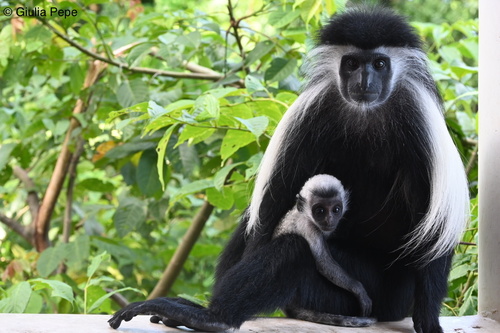
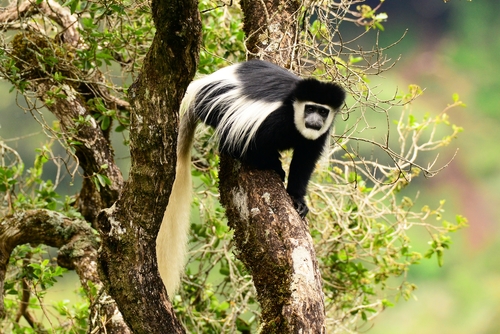
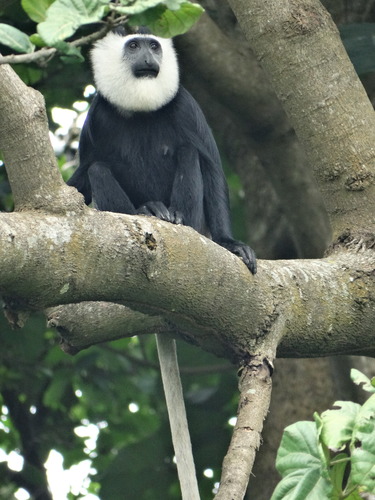
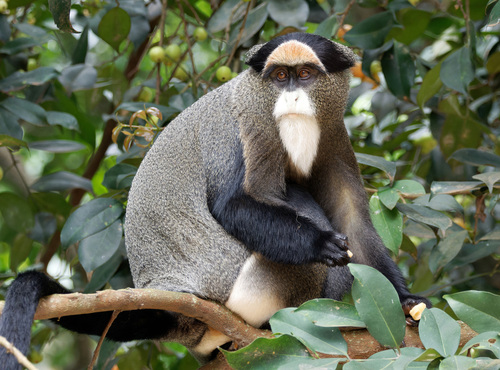
The King Colobus has predominantly black fur with a distinctive white mantle covering the shoulders, sides, and throat, along with white fur on the cheeks and a long white tail tuft. Its face is framed by a black crown and long white side-whiskers, giving it a regal, dignified look.
Size
Head-body length ranges from about 47-67 cm, with an additional tail length of 52-80 cm.
Weight
Adult males typically weigh 8.3-10 kg, while females are slightly lighter, weighing around 7-8.5 kg.
Distinctive features
Distinguished from other colobus species by its extensive white mantle and cheek fur combined with an all-black crown, differing from the more localized white markings seen in species like Colobus vellerosus.
Differences between males and females
Males are slightly larger and heavier than females, but coloration and general appearance are similar between sexes.
Behaviour and diet of the King Colobus
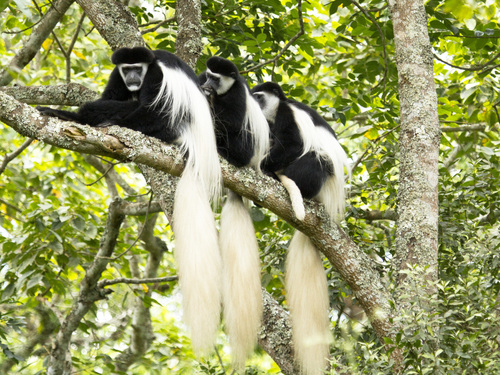
Lives in cohesive social groups of 3-20 individuals, typically consisting of one adult male, several females, and their offspring. Groups maintain loose hierarchies with occasional inter-group encounters involving vocal displays.
When it is active
Primarily diurnal, with peak activity during morning and late afternoon hours, resting during the hottest midday period.
Diet
Herbivorous, feeding mainly on young leaves, seeds, flowers, and unripe fruits from a variety of forest tree species. Its specialized digestive system allows it to process large amounts of fibrous plant material efficiently.
Communication
Communicates through a combination of vocalizations, including loud calls to signal alarm or territorial boundaries, along with body postures and facial expressions to convey social status and mood.
Interactions with other species
Natural predators include large raptors such as crowned eagles and occasionally leopards; humans through hunting represent the most significant predatory pressure. It may share habitat with other primate species with minimal direct competition due to differing dietary preferences.
Role in its ecosystem
Plays an important ecological role as a folivore and seed disperser, contributing to forest regeneration and nutrient cycling within tropical ecosystems.
Reproduction and lifecycle
Breeding is not strictly seasonal, though births may peak during certain months correlating with food abundance. Gestation lasts approximately 5-6 months, typically resulting in a single offspring.
Raising the young
Mothers provide the primary care, nursing and carrying infants for several months, with juveniles gradually becoming independent by around one year of age. Alloparental care by other females in the group is sometimes observed.
Maturity and lifespan
Sexual maturity is typically reached around 4-5 years of age; lifespan in the wild is estimated at 20-25 years, while captive individuals may live slightly longer under managed care.
Taxonomy and naming of the King Colobus
Classification
Mammalia > Primates > Cercopithecidae > Colobus > Colobus polykomos
Scientific synonyms
Colobus vellerosus was formerly considered a subspecies but is now recognized as a distinct species; historical synonyms include Colobus polykomos polykomos
What research says
Recent studies
Recent genetic and ecological studies have focused on population fragmentation effects and taxonomic clarifications separating Colobus polykomos from closely related species like Colobus vellerosus.
Compared with similar species
Similar to other black-and-white colobus species such as Colobus vellerosus and Colobus satanas, but distinguished by its more extensive white mantle and cheek fur, as well as geographic range differences.
The King Colobus and people
The King Colobus's stomach can hold nearly a quarter of its body weight in leaves at a time. Its striking white mantle inspired its 'royal' common name, evoking imagery of a king's ceremonial cape.
Where and how to see it
Best observed in protected reserves such as Tai National Park in Côte d'Ivoire or Gola Rainforest in Sierra Leone during early morning hours when groups are most active and vocal.
Risks to humans
No notable risk to humans; the species is shy and avoids human contact, though it may carry parasites transmissible through direct contact.
Human uses
Historically hunted for bushmeat and its fur, which was sometimes used in traditional ceremonial attire; currently, it holds ecotourism value in protected forest reserves.
Myths and legends
In some West African cultures, colobus monkeys are associated with forest spirits and are sometimes featured in local folklore as symbols of the forest's mystery and abundance.
Countries where the King Colobus is recorded
The 7 countries named in the range description of its IUCN Red List assessment.
Questions about the King Colobus
Where does the King Colobus live?
The King Colobus is recorded in Ghana, Guinea, Guinea-Bissau, Ivory Coast and Liberia, among 7 countries in total across Africa. These countries come from the range description of its IUCN Red List assessment, and they are what place the species on the interactive map.
Is the King Colobus endangered?
Yes. The IUCN Red List assesses the King Colobus as Endangered, one of the three threatened categories. The species faces a very high risk of extinction in the wild — a step below Critically Endangered, but still on a trajectory that ends badly without intervention.
How many are left in the wild?
Exact population estimates are unavailable, but numbers are believed to be declining across its range, with fragmented and isolated populations in many areas. This figure comes from the species assessment on the IUCN Red List; population estimates for wild mammals are ranges, not counts, and are revised at each assessment.
What habitat does the King Colobus live in?
Primarily found in primary and secondary lowland tropical rainforests, including gallery forests and forest fragments near water sources.
What is the scientific name of the King Colobus?
The King Colobus is Colobus polykomos, in the family Cercopithecidae, order Primates.
Other species in the genus Colobus
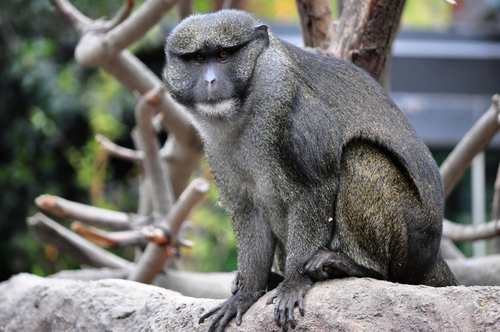
Other species in the family Cercopithecidae
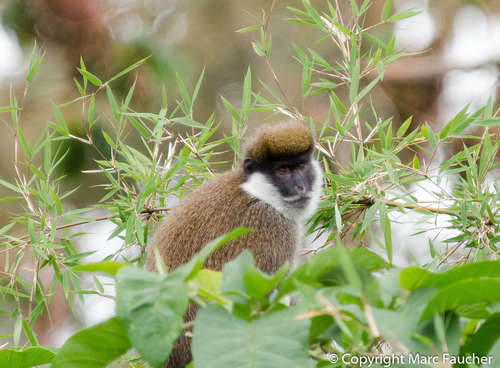
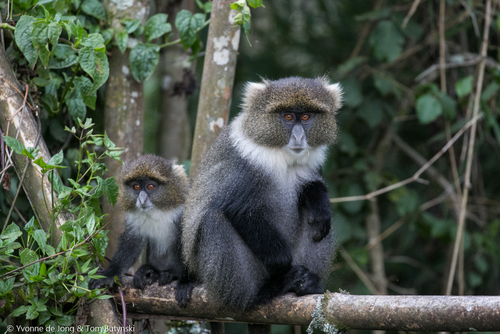
Species that share its range
Sources
Conservation status, range description and population estimate come from the IUCN Red List assessment for Colobus polykomos. Countries are derived from that range description, not from a mapped country list. Last refreshed on .
The distribution map is drawn from the IUCN Red List spatial data compiled in 2018. IUCN (International Union for Conservation of Nature)