
Black Colobus
Colobus satanas
Red List assessment
Vulnerableon the IUCN Red List
- EXExtinct
- EWExtinct in the Wild
- CRCritically Endangered
- ENEndangered
- VUVulnerable
- NTNear Threatened
- LCLeast Concern
The Black Colobus is recorded in 4 countries across Africa. The IUCN Red List assesses the Black Colobus as Vulnerable. Exact population numbers are unknown, but the species is experiencing a continuing declining trend across its range, with some local populations showing severe depletion or local extinction near human settlements.
- Family
- Cercopithecidae
- Order
- Primates
- Genus
- Colobus
- Countries recorded
- 4
- Continents
- Africa
- Red List category
- Vulnerable
- Data updated
- August 9, 2026
What is the Black Colobus?
The Black Colobus is a large, entirely black leaf-eating monkey endemic to the coastal forests of west-central Africa. It is notable for its striking all-black coat, long silky fur, and reduced thumb, an adaptation shared with other colobus monkeys for efficient arboreal locomotion. It lives in dense lowland tropical rainforests and plays an important ecological role as a folivore. This species is considered one of the most threatened colobus monkeys due to heavy hunting pressure and habitat loss.
Where does the Black Colobus live?
Central Africa: Cameroon, Equatorial Guinea, Gabon, and Republic of Congo
Restricted to a relatively narrow coastal band in west-central Africa, spanning southern Cameroon, mainland Equatorial Guinea (Rio Muni), Gabon, and the western Republic of Congo. Its range is largely bounded by major rivers and coastal forest belts.
Altitude and depth
Typically found from sea level up to around 900 meters elevation, though it is most common in lowland forests below 500 meters.
Seasonal movements
No true migration or hibernation; however, ranging patterns and feeding behavior can shift seasonally in response to fruiting and leafing cycles of key food trees.
Habitat of the Black Colobus
Primarily found in primary and secondary lowland tropical rainforest, including coastal forests, swamp forests, and semi-deciduous forests. It shows a preference for areas with dense canopy cover that provide both food and protection from predators.
Adaptations to its environment
Possesses a highly reduced or vestigial thumb, allowing for a hook-like grip ideal for swinging through branches (brachiation). Its multi-chambered stomach houses specialized bacteria that ferment cellulose, enabling digestion of mature leaves that are toxic or indigestible to many other primates.
Conservation status and numbers
Classified as Vulnerable (VU) by the IUCN due to significant population declines estimated at over 30% over the past three generations, primarily driven by hunting for bushmeat and habitat degradation.
Estimated population
Exact population numbers are unknown, but the species is experiencing a continuing declining trend across its range, with some local populations showing severe depletion or local extinction near human settlements.
What threatens the Black Colobus?
Major threats include intense hunting pressure for bushmeat (it is a preferred target due to its large body size and slow, predictable movement), logging and habitat fragmentation, and increasing human encroachment via roads and agricultural expansion.
Diseases and parasites
Known to host various gastrointestinal parasites typical of colobine primates, including nematodes and protozoa; specific disease research on this species remains limited.
What is being done to protect it?
The species occurs in several protected areas, including Lopé National Park and Moukalaba-Doudou National Park in Gabon, and various reserves in Cameroon and Equatorial Guinea. It is listed on CITES Appendix II, restricting international trade.
Recommended actions
Priority actions include strengthening anti-poaching enforcement, expanding protected area coverage and connectivity, reducing bushmeat demand through community education, and conducting further population surveys to monitor trends.
What the Black Colobus looks like
The Black Colobus has an entirely glossy black coat with no white markings, distinguishing it from most other colobus species. Its fur is long and silky, and its face is bare and dark, often with a slight bluish tinge around the muzzle.
Size
Head-body length ranges from approximately 55 to 70 cm, with a long tail of 65 to 90 cm that is often longer than the body.
Weight
Adults typically weigh between 8 and 10 kg for females and 9 to 12 kg for males.
Distinctive features
Unlike other colobus species such as the black-and-white colobus (Colobus guereza), the Black Colobus lacks any white fur, making it uniquely uniform in coloration. It also has a notably long tail relative to body size.
Differences between males and females
Males are moderately larger and heavier than females, though the coloration is identical between sexes with no distinguishing markings.
Behaviour and diet of the Black Colobus
Lives in social groups typically ranging from 8 to 20 individuals, usually consisting of one adult male and multiple females with offspring, though multi-male groups also occur. Groups exhibit a relatively stable social structure with strong bonds among females.
When it is active
Primarily diurnal, being most active during early morning and late afternoon, with rest periods during the heat of midday spent digesting fibrous food.
Diet
Primarily folivorous, feeding on young leaves, seeds, and unripe fruits from a variety of tree species; leaves make up the bulk of the diet, supplemented seasonally by seeds and flowers.
Communication
Communication includes loud vocalizations such as roaring or barking calls, especially by adult males to signal territory or alarm, along with visual displays and scent marking within the group's home range.
Interactions with other species
Natural predators include large raptors such as crowned eagles, and large carnivores like leopards; humans are the primary threat through hunting. It may share habitat with other primate species, occasionally forming loose polyspecific associations for predator detection.
Role in its ecosystem
As a folivore, the Black Colobus plays a role in shaping forest vegetation dynamics and nutrient cycling through leaf consumption; it also contributes to limited seed dispersal through consumption of seeds and fruits.
Reproduction and lifecycle
Breeding is not strictly seasonal, occurring year-round with possible peaks tied to food availability. Gestation lasts approximately 5 to 6 months, and females typically give birth to a single infant.
Raising the young
Infants are cared for primarily by the mother, who carries and nurses the young for several months, though allomothering (care by other females in the group) has been observed. Weaning generally occurs by around 6 months, with full independence achieved by 1 to 2 years.
Maturity and lifespan
Sexual maturity is typically reached around 4 to 5 years of age. Lifespan in the wild is estimated at 20 years, while individuals in captivity may live slightly longer under proper care.
Taxonomy and naming of the Black Colobus
Classification
Class Mammalia > Order Primates > Family Cercopithecidae > Genus Colobus > Species Colobus satanas
Scientific synonyms
Colobus satanas satanas (sometimes considered the sole taxon, with C. anthracinus previously treated as subspecies but now often elevated to full species status)
What research says
Recent studies
Recent studies have focused on population density assessments in Gabon and Cameroon using camera traps and line-transect surveys, revealing continued declines in unprotected areas and highlighting the effectiveness of protected zones.
Genome and DNA
Limited specific genomic studies exist for this species compared to more widely studied primates; general colobine chromosome numbers are around 2n=44, though species-specific confirmation is limited.
Compared with similar species
Compared to the black-and-white colobus (Colobus guereza) and the red colobus (Piliocolobus species), the Black Colobus is distinguished by its completely black coat lacking any contrasting markings, and it tends to occupy a more restricted coastal range.
The Black Colobus and people
The Black Colobus's genus name 'Colobus' derives from the Greek word for 'mutilated,' referencing its reduced thumb. Despite its name 'satanas' (relating to its all-black appearance), the species is a gentle, shy leaf-eater with no aggressive tendencies toward humans.
Where and how to see it
Best observed in protected reserves such as Lopé National Park in Gabon, particularly during early morning hours when groups are most active and vocal; patience and a knowledgeable local guide greatly increase chances of sighting.
Risks to humans
No notable risk to humans; the species is shy and avoids human contact, posing no threat of aggression or disease transmission under normal circumstances.
Human uses
Hunted extensively for bushmeat within its range, representing significant use for local subsistence and commercial trade, which unfortunately drives its population decline.
Myths and legends
In some local cultures within its range, black colobus monkeys have been associated with omens or spiritual significance due to their striking dark coloration, though specific documented folklore is limited.
Countries where the Black Colobus is recorded
The 4 countries named in the range description of its IUCN Red List assessment.
Questions about the Black Colobus
Where does the Black Colobus live?
The Black Colobus is recorded in Cameroon, Democratic Republic of the Congo, Equatorial Guinea and Gabon across Africa. These countries come from the range description of its IUCN Red List assessment, and they are what place the species on the interactive map.
Is the Black Colobus endangered?
Yes. The IUCN Red List assesses the Black Colobus as Vulnerable, one of the three threatened categories. The species faces a high risk of extinction in the wild. It is the first of the three threatened categories: numbers are falling, the range is shrinking, or the population is small enough that a single bad event could do lasting damage.
How many are left in the wild?
Exact population numbers are unknown, but the species is experiencing a continuing declining trend across its range, with some local populations showing severe depletion or local extinction near human settlements. This figure comes from the species assessment on the IUCN Red List; population estimates for wild mammals are ranges, not counts, and are revised at each assessment.
What habitat does the Black Colobus live in?
Primarily found in primary and secondary lowland tropical rainforest, including coastal forests, swamp forests, and semi-deciduous forests.
What is the scientific name of the Black Colobus?
The Black Colobus is Colobus satanas, in the family Cercopithecidae, order Primates.
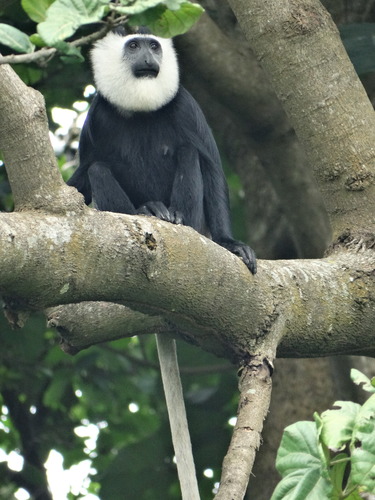
Other species in the genus Colobus
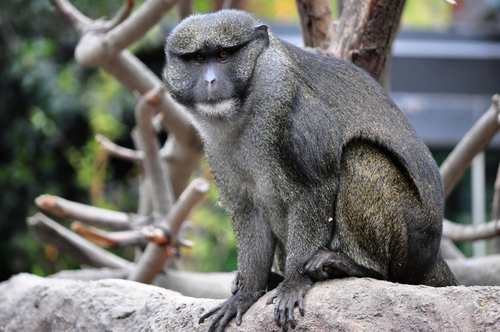
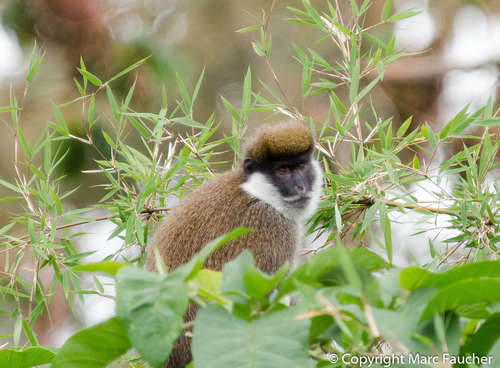
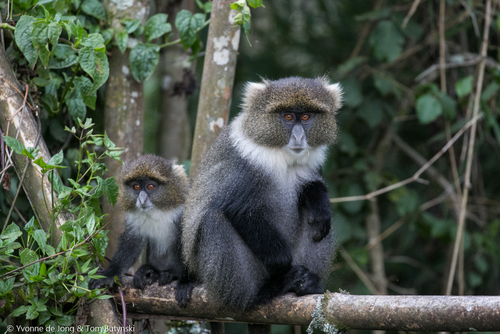
Other species in the family Cercopithecidae
Species that share its range

Sources
Conservation status, range description and population estimate come from the IUCN Red List assessment for Colobus satanas. Countries are derived from that range description, not from a mapped country list. Last refreshed on .
The distribution map is drawn from the IUCN Red List spatial data compiled in 2020. IUCN (International Union for Conservation of Nature)