
White-thighed Colobus
Colobus vellerosus
Red List assessment
Critically Endangeredon the IUCN Red List
- EXExtinct
- EWExtinct in the Wild
- CRCritically Endangered
- ENEndangered
- VUVulnerable
- NTNear Threatened
- LCLeast Concern
The White-thighed Colobus is recorded in 4 countries across Africa. The IUCN Red List assesses the White-thighed Colobus as Critically Endangered. Population estimated in the low thousands, with a continuing declining trend across its fragmented range.
- Family
- Cercopithecidae
- Order
- Primates
- Genus
- Colobus
- Countries recorded
- 4
- Continents
- Africa
- Red List category
- Critically Endangered
- Data updated
- August 9, 2026
What is the White-thighed Colobus?
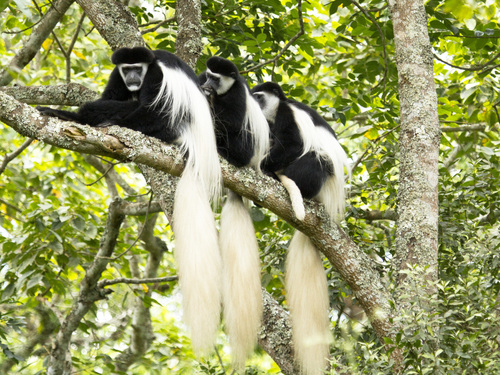
The White-thighed Colobus is a striking black-and-white leaf-eating monkey native to the forests of West Africa. It is easily recognized by its long white fur on the thighs and a white facial fringe contrasting with its black body. This species plays an important ecological role as a seed disperser and is critically endangered due to severe habitat loss and hunting pressure.
Where does the White-thighed Colobus live?
West Africa, primarily Ghana, Côte d'Ivoire, Togo, and Benin
Found in fragmented forest patches across Ghana, Côte d'Ivoire, Togo, and Benin in West Africa, with the largest remaining populations concentrated in Ghana's forest reserves.
Altitude and depth
Typically found at lowland elevations from near sea level up to approximately 500-800 meters.
Seasonal movements
No true migration or hibernation; activity patterns may shift slightly with wet and dry season fruiting and leafing cycles of forest trees.
Habitat of the White-thighed Colobus
Primarily inhabits primary and secondary tropical moist forests, including semi-deciduous and riparian forest fragments; also found in forest-savanna mosaic zones.
Adaptations to its environment
Possesses a specialized multi-chambered stomach with symbiotic bacteria to digest cellulose-rich leaves; long limbs and tail aid in arboreal locomotion and balance while leaping between forest canopy branches.
Conservation status and numbers
Critically Endangered (IUCN) due to an estimated population decline exceeding 80% over the past three generations, driven primarily by habitat destruction and hunting.
Estimated population
Population estimated in the low thousands, with a continuing declining trend across its fragmented range.
What threatens the White-thighed Colobus?
Severe deforestation for agriculture and logging, habitat fragmentation, and bushmeat hunting are the primary threats; illegal hunting is intensified by the accessibility of remaining small forest fragments.
Diseases and parasites
Susceptible to various gastrointestinal parasites and occasionally affected by disease outbreaks in fragmented, stressed populations.
What is being done to protect it?
Protected in several forest reserves in Ghana such as Boabeng-Fiema Monkey Sanctuary and parts of Kakum National Park; listed on CITES Appendix II and covered by national wildlife protection laws in range countries.
Recommended actions
Strengthen enforcement against illegal hunting, expand and connect protected forest fragments, promote community-based conservation initiatives, and conduct further population monitoring.
What the White-thighed Colobus looks like
Predominantly black fur with striking white thigh patches, a white facial ruff, and a long black tail; the fur has a somewhat shaggy texture.
Size
Body length approximately 45-65 cm, with a tail nearly as long or longer than the body (55-80 cm).
Weight
Adults typically weigh between 5-10 kg, with males generally slightly larger than females.
Distinctive features
Distinguished from other colobus species by the specific pattern of white fur restricted to the thighs and face, differing from the fuller white mantle seen in some related species like the King Colobus.
Differences between males and females
Males are moderately larger than females, though pelage coloration is similar between sexes.
Behaviour and diet of the White-thighed Colobus
Lives in social groups typically composed of 8-20 individuals, often with multiple adult females and one or a few adult males; groups exhibit territorial behavior.
When it is active
Diurnal, with activity concentrated during daylight hours, particularly in early morning and late afternoon for feeding.
Diet
Primarily herbivorous, feeding mainly on young leaves, but also consumes seeds, flowers, and unripe fruits from a variety of forest tree species.
Communication
Communicates through loud vocalizations including roars and barks by males, as well as visual displays and grooming behaviors for social bonding.
Interactions with other species
Natural predators include leopards, eagles, and occasionally chimpanzees; competes with other primate species for forest food resources.
Role in its ecosystem
Acts as an important seed disperser and contributes to forest regeneration through leaf consumption patterns that influence tree community structure.
Reproduction and lifecycle
Breeding is not strictly seasonal; gestation lasts approximately 5-6 months, with females typically giving birth to a single infant.
Raising the young
Infants are cared for primarily by the mother, though allomothering by other females in the group is common; infants are weaned at around 6-12 months of age.
Maturity and lifespan
Sexual maturity is reached around 4-5 years; lifespan in the wild is estimated at 20-25 years, potentially longer in captivity.
Taxonomy and naming of the White-thighed Colobus
Classification
Mammalia > Primates > Cercopithecidae > Colobus > Colobus vellerosus
Scientific synonyms
Colobus polykomos vellerosus (formerly considered a subspecies of Colobus polykomos)
What research says
Recent studies
Recent research has focused on population genetics and the effects of habitat fragmentation on group dynamics and long-term viability in Ghana's forest reserves.
Genome and DNA
Diploid chromosome number is 44, consistent with other colobus species; genetic studies have been used to clarify taxonomic boundaries within the Colobus genus.
Compared with similar species
Similar to the King Colobus (Colobus polykomos) but distinguished by the extent and pattern of white fur; historically classified as a subspecies before being recognized as distinct.
The White-thighed Colobus and people
This species can leap distances of over 6 meters between trees; males produce loud roaring calls that can be heard over a kilometer away in dense forest.
Where and how to see it
Best observed at dawn in protected areas such as Boabeng-Fiema Monkey Sanctuary in Ghana, where habituated groups can be seen relatively easily.
Risks to humans
No notable risk to humans.
Human uses
Historically hunted for bushmeat and its fur, though such use is now illegal in most range countries due to its critically endangered status.
Countries where the White-thighed Colobus is recorded
The 4 countries named in the range description of its IUCN Red List assessment.
Questions about the White-thighed Colobus
Where does the White-thighed Colobus live?
The White-thighed Colobus is recorded in Benin, Ghana, Ivory Coast and Togo across Africa. These countries come from the range description of its IUCN Red List assessment, and they are what place the species on the interactive map.
Is the White-thighed Colobus endangered?
Yes. The IUCN Red List assesses the White-thighed Colobus as Critically Endangered, one of the three threatened categories. The species faces an extremely high risk of extinction in the wild. This is the last category before extinction, and it is reached through a very small or steeply declining population, a tiny range, or both.
How many are left in the wild?
Population estimated in the low thousands, with a continuing declining trend across its fragmented range. This figure comes from the species assessment on the IUCN Red List; population estimates for wild mammals are ranges, not counts, and are revised at each assessment.
What habitat does the White-thighed Colobus live in?
Primarily inhabits primary and secondary tropical moist forests, including semi-deciduous and riparian forest fragments; also found in forest-savanna mosaic zones.
What is the scientific name of the White-thighed Colobus?
The White-thighed Colobus is Colobus vellerosus, in the family Cercopithecidae, order Primates.
Other species in the genus Colobus
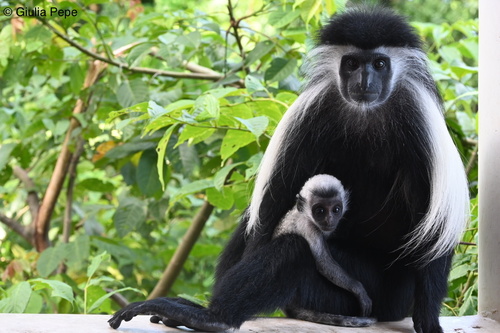
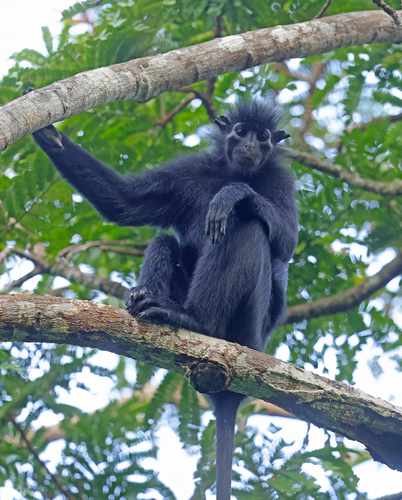
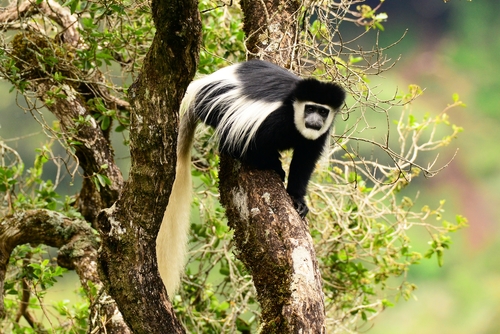
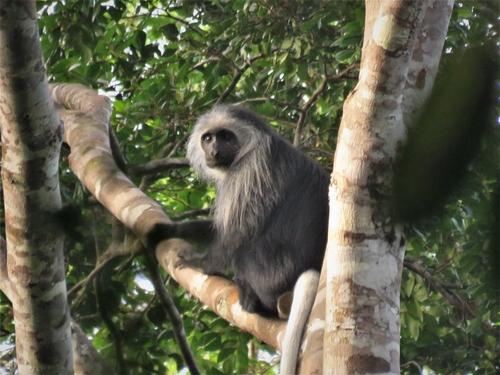
Other species in the family Cercopithecidae
Species that share its range

Sources
Conservation status, range description and population estimate come from the IUCN Red List assessment for Colobus vellerosus. Countries are derived from that range description, not from a mapped country list. Last refreshed on .
The distribution map is drawn from the IUCN Red List spatial data compiled in 2019. IUCN (International Union for Conservation of Nature)