
Angolan Colobus
Colobus angolensis
Red List assessment
Vulnerableon the IUCN Red List
- EXExtinct
- EWExtinct in the Wild
- CRCritically Endangered
- ENEndangered
- VUVulnerable
- NTNear Threatened
- LCLeast Concern
The Angolan Colobus is recorded in 9 countries across Africa. The IUCN Red List assesses the Angolan Colobus as Vulnerable. Exact global population figures are not well documented, but overall numbers are believed to be declining; some subspecies like C.
- Family
- Cercopithecidae
- Order
- Primates
- Genus
- Colobus
- Countries recorded
- 9
- Continents
- Africa
- Red List category
- Vulnerable
- Data updated
- August 9, 2026
What is the Angolan Colobus?
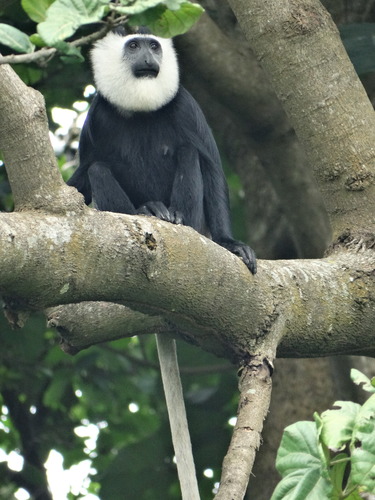
The Angolan Colobus is a striking black-and-white leaf-eating monkey native to the forests of central and eastern Africa. It is renowned for its long white mantle of fur that flows from its shoulders, dramatic white facial fringe, and long white tail tuft that create an almost angelic appearance against its jet-black body. This arboreal species lives in cohesive social groups high in the forest canopy and plays an important role in forest ecology as a folivore. It is one of the most widely distributed colobus species, though many populations are increasingly threatened by habitat loss.
Where does the Angolan Colobus live?
Central and East Africa, including the Democratic Republic of Congo, Rwanda, Burundi, Uganda, Kenya, Tanzania, and Angola
Distributed across a broad but patchy range in Central and East Africa, including the Democratic Republic of Congo, Rwanda, Burundi, Uganda, western Kenya, Tanzania, Zambia, Malawi, and parts of Angola. Populations are often isolated due to forest fragmentation.
Altitude and depth
Ranges from lowland forests near sea level up to montane forests at approximately 2,500-3,000 meters, particularly in the Albertine Rift region.
Seasonal movements
No true migration or hibernation; however, activity patterns and feeding behavior can shift seasonally in response to fruiting and leafing cycles of preferred tree species.
Habitat of the Angolan Colobus
Primarily found in lowland and montane tropical rainforest, including primary and secondary forest, riverine forest, and forest fragments; some subspecies inhabit coastal forests and forest-savanna mosaics.
Adaptations to its environment
Possesses a specialized multi-chambered stomach with symbiotic bacteria that allow digestion of cellulose-rich mature leaves, an adaptation shared with other colobines. Long limbs and a reduced thumb aid efficient brachiation and leaping through the forest canopy, while its long tail assists with balance during arboreal locomotion.
Conservation status and numbers
Listed as Vulnerable (VU) by the IUCN due to ongoing population declines driven by habitat destruction and hunting; some isolated subspecies face even greater risk of local extinction.
Estimated population
Exact global population figures are not well documented, but overall numbers are believed to be declining; some subspecies like C. a. prigoginei are considered extremely rare with populations possibly in the low hundreds.
What threatens the Angolan Colobus?
Major threats include deforestation for agriculture and logging, habitat fragmentation, bushmeat hunting, and in some regions civil conflict that limits conservation enforcement.
Diseases and parasites
Susceptible to various gastrointestinal parasites and occasionally to diseases transmissible from other primates; specific pathogen studies remain limited in wild populations.
What is being done to protect it?
Protected in several national parks and reserves such as Nyungwe National Park (Rwanda), Kahuzi-Biega National Park (DRC), and various forest reserves in Kenya and Tanzania; listed on CITES Appendix II to regulate international trade.
Recommended actions
Priority actions include strengthening protected area enforcement, restoring forest corridors between fragmented populations, community-based conservation and education programs, and further population surveys of poorly known subspecies.
What the Angolan Colobus looks like
The body is predominantly glossy black with a striking white U-shaped mantle of long fur across the shoulders and back, a white facial fringe framing a black face, and a long white-tufted tail. Fur texture is soft and silky, providing a dramatic visual contrast that is unique among colobus species.
Size
Head-body length typically ranges from 45-70 cm, with an additional tail length of 60-90 cm.
Weight
Adult males typically weigh 8-13 kg, while females are somewhat smaller at 7-10 kg.
Distinctive features
Distinguished from other colobus species by the specific pattern and length of its white mantle hair, the shape of its facial ruff, and regional variation in the extent of the white tail tuft among subspecies.
Differences between males and females
Males are moderately larger than females, but there is minimal difference in coloration between sexes.
Behaviour and diet of the Angolan Colobus
Lives in cohesive social groups typically of 3-15 individuals, sometimes forming larger aggregations of up to 300 in areas with high food density; groups usually consist of one or multiple adult males, several females, and their offspring.
When it is active
Diurnal, being most active during early morning and late afternoon with resting periods around midday spent digesting fibrous leaf matter.
Diet
Primarily folivorous, feeding on young and mature leaves, but also consumes fruit, seeds, flowers, and occasionally bark depending on seasonal availability.
Communication
Communicates through loud roaring calls (especially by adult males) used for territorial announcements, along with various grunts, screams, and visual displays such as branch shaking; scent marking plays a lesser role compared to vocal communication.
Interactions with other species
Natural predators include crowned eagles, leopards, and chimpanzees, which occasionally prey on young or unwary individuals; they may also share habitat and food resources with other primate species such as guenons and mangabeys with limited direct competition due to dietary specialization.
Role in its ecosystem
As a folivore, plays an important role in nutrient cycling and seed dispersal for certain plant species, and serves as a prey base supporting predator populations within its forest ecosystem.
Reproduction and lifecycle
Breeding can occur year-round without a strict seasonal pattern, though births may peak during periods of high food abundance; gestation lasts approximately 5-6 months, typically resulting in a single offspring.
Raising the young
Infants are cared for primarily by the mother, though allomothering by other females in the group is common; infants are weaned at around 6-12 months and reach independence gradually over the first two years.
Maturity and lifespan
Sexual maturity is typically reached around 4-6 years of age; lifespan in the wild is estimated at 20-25 years, while captive individuals may live slightly longer with proper care.
Taxonomy and naming of the Angolan Colobus
Classification
Class Mammalia > Order Primates > Family Cercopithecidae > Genus Colobus > Species Colobus angolensis
Subspecies
Several recognized subspecies including C. a. angolensis (Angola), C. a. ruwenzorii (Rwenzori Mountains region), C. a. palliatus (coastal Kenya/Tanzania), C. a. cottoni (DRC), C. a. cordieri (DRC), C. a. prigoginei (DRC), and C. a. sharpei (Malawi/Zambia/Tanzania)
Scientific synonyms
Colobus vellerosus angolensis (historical usage); occasionally classified within a broader Colobus polykomos species complex in older literature
What research says
Recent studies
Recent genetic and ecological studies have focused on clarifying subspecies taxonomy using mitochondrial DNA and assessing the impact of habitat fragmentation on population connectivity in the Albertine Rift region.
Genome and DNA
Chromosome number is reported as 2n=44; genetic studies have been used to clarify subspecies boundaries and phylogenetic relationships within the Colobus genus.
Compared with similar species
Compared to the closely related Colobus guereza (mantled guereza), C. angolensis has a generally less extensive white mantle and different tail tuft proportions; it is also generally found further south and east across the Central African forest belt.
The Angolan Colobus and people
Angolan Colobus monkeys lack a thumb, an adaptation that actually improves their grip and speed while swinging through trees. Their loud dawn calls can carry over a kilometer through dense forest, functioning as both territorial declarations and social bonding displays.
Where and how to see it
Best observed in protected reserves such as Nyungwe National Park in Rwanda or Kakamega Forest in Kenya during early morning hours when groups are most vocal and active in the canopy; a guided forest walk with local rangers greatly increases sighting success.
Risks to humans
No notable risk to humans; they are shy, arboreal, and avoid direct contact with people.
Human uses
Historically hunted for bushmeat and their striking pelts, which were used in traditional ceremonial garments in some regions; currently, ecotourism related to primate watching provides an important economic incentive for conservation.
Myths and legends
In some regional folklore across parts of Central and East Africa, colobus monkeys are associated with forest spirits or omens due to their striking appearance and eerie vocalizations, though specific documented legends about this species are limited.
Countries where the Angolan Colobus is recorded
The 9 countries named in the range description of its IUCN Red List assessment.
Questions about the Angolan Colobus
Where does the Angolan Colobus live?
The Angolan Colobus is recorded in Angola, Burundi, Democratic Republic of the Congo, Kenya and Malawi, among 9 countries in total across Africa. These countries come from the range description of its IUCN Red List assessment, and they are what place the species on the interactive map.
Is the Angolan Colobus endangered?
Yes. The IUCN Red List assesses the Angolan Colobus as Vulnerable, one of the three threatened categories. The species faces a high risk of extinction in the wild. It is the first of the three threatened categories: numbers are falling, the range is shrinking, or the population is small enough that a single bad event could do lasting damage.
How many are left in the wild?
Exact global population figures are not well documented, but overall numbers are believed to be declining; some subspecies like C. This figure comes from the species assessment on the IUCN Red List; population estimates for wild mammals are ranges, not counts, and are revised at each assessment.
What habitat does the Angolan Colobus live in?
Primarily found in lowland and montane tropical rainforest, including primary and secondary forest, riverine forest, and forest fragments; some subspecies inhabit coastal forests and forest-savanna mosaics.
What is the scientific name of the Angolan Colobus?
The Angolan Colobus is Colobus angolensis, in the family Cercopithecidae, order Primates.
Other species in the genus Colobus
Other species in the family Cercopithecidae
Species that share its range
Sources
Conservation status, range description and population estimate come from the IUCN Red List assessment for Colobus angolensis. Countries are derived from that range description, not from a mapped country list. Last refreshed on .
The distribution map is drawn from the IUCN Red List spatial data compiled in 2024. Yvonne de Jong, Tom Butynski and IUCN (International Union for Conservation of Nature)