
Bale Monkey
Chlorocebus djamdjamensis
Red List assessment
Vulnerableon the IUCN Red List
- EXExtinct
- EWExtinct in the Wild
- CRCritically Endangered
- ENEndangered
- VUVulnerable
- NTNear Threatened
- LCLeast Concern
The Bale Monkey is recorded in one country, Ethiopia across Africa. The IUCN Red List assesses the Bale Monkey as Vulnerable. Population size is not precisely known but is considered small and declining; total numbers are likely in the low thousands, restricted to fragmented forest patches.
- Family
- Cercopithecidae
- Order
- Primates
- Genus
- Chlorocebus
- Countries recorded
- 1
- Continents
- Africa
- Red List category
- Vulnerable
- Data updated
- August 9, 2026
What is the Bale Monkey?
The Bale Monkey is an endemic Ethiopian primate found only in the bamboo forests of the Bale Mountains and nearby highland areas. It is a specialized member of the vervet monkey genus, distinguished by its close dietary dependence on bamboo. Its restricted range and habitat specificity make it one of the more range-limited African primates. It is remarkable for being one of the few primates highly specialized on bamboo shoots as a primary food source.
Where does the Bale Monkey live?
Ethiopia (endemic), restricted to the Bale Mountains region and surrounding areas in the southeastern Ethiopian highlands
Endemic to Ethiopia, restricted to the Bale Mountains massif and adjacent areas in the southeastern highlands, including areas within and around Bale Mountains National Park and parts of the Sidamo region.
Altitude and depth
Approximately 2000-3600 meters above sea level
Seasonal movements
No long-distance migration; diet shifts seasonally depending on bamboo shoot availability, with greater reliance on alternative foods during periods of low bamboo productivity
Habitat of the Bale Monkey
Primarily found in highland bamboo forests (Arundinaria alpina), often in association with podocarpus and other montane forest types. Also occurs in forest edges, agricultural mosaics, and secondary growth near bamboo stands.
Adaptations to its environment
Adapted to cool highland climates with a thick fur coat, and has developed a specialized digestive tolerance for young bamboo shoots which are otherwise difficult to digest for many mammals. Behavioral flexibility allows switching to alternative plant foods when bamboo is scarce.
Conservation status and numbers
Classified as Vulnerable (VU) by the IUCN due to its small and fragmented range, ongoing habitat loss from agricultural expansion and deforestation, and dependency on a single specialized habitat type (bamboo forest).
Estimated population
Population size is not precisely known but is considered small and declining; total numbers are likely in the low thousands, restricted to fragmented forest patches.
What threatens the Bale Monkey?
Habitat destruction from agricultural encroachment, bamboo harvesting for construction and fuel, logging, human population growth in the region, and forest fragmentation limiting gene flow between populations.
Diseases and parasites
Specific data limited, though vervet-related species are known hosts to various gastrointestinal parasites and simian viruses
What is being done to protect it?
Partial protection within Bale Mountains National Park; some populations occur in unprotected forest fragments. Conservation research and monitoring programs have been conducted by international primatological researchers to assess distribution and threats.
Recommended actions
Expand protected area coverage to include more bamboo forest fragments, enforce anti-logging and anti-encroachment regulations, promote sustainable bamboo harvesting practices among local communities, and support long-term population monitoring.
What the Bale Monkey looks like
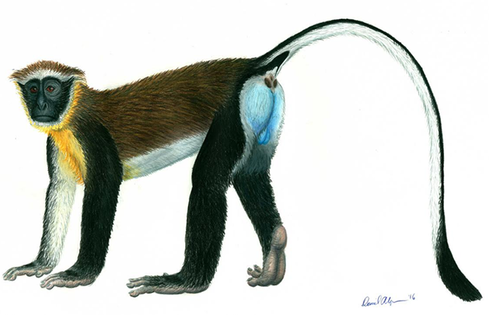
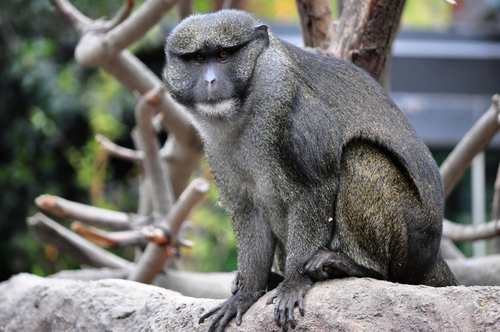
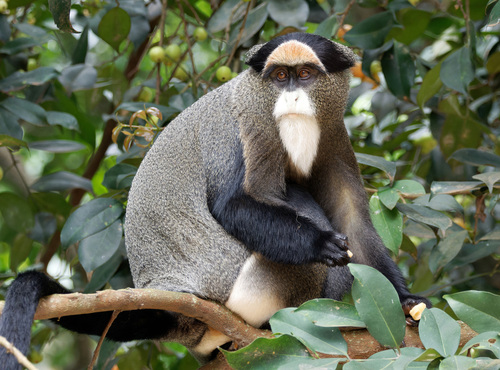
Grayish-olive to brownish fur on the back with lighter, pale underparts, dark face, and a long tail. It closely resembles other vervet monkeys but is generally slightly darker and has more subdued coloring adapted to the montane forest environment.
Size
Body length (head to body) approximately 40-55 cm, with a tail length similar to or slightly longer than the body
Weight
Approximately 3-5 kg, with males typically slightly larger than females
Distinctive features
Distinguished from other Chlorocebus species by its darker coat coloration, forest specialization, and restricted geographic range in Ethiopian highlands. It also has a diet more reliant on bamboo than typical vervet monkeys.
Differences between males and females
Males are somewhat larger than females and may show slightly more pronounced canine teeth, though sexual dimorphism is less extreme than in many other primate species
Behaviour and diet of the Bale Monkey
Lives in social groups typically ranging from a few individuals to about 10-30, generally organized around female kin groups with one or more adult males; exhibits hierarchical social structure typical of vervet monkeys.
When it is active
Diurnal, active during daylight hours, foraging and socializing in forest canopy and understory before resting at night
Diet
Primarily herbivorous, with a strong preference for young bamboo shoots and leaves; also consumes fruits, flowers, seeds, and occasionally invertebrates when available
Communication
Communicates via vocal calls (alarm calls, contact calls), facial expressions, and body postures; scent marking may play a role in social and territorial communication
Interactions with other species
Predators may include birds of prey, and possibly leopards or other carnivores in the region; competes with other herbivorous forest species for food resources, and its bamboo specialization reduces competition with generalist primates.
Role in its ecosystem
Plays a role in seed dispersal and vegetation dynamics within bamboo forest ecosystems, and its foraging on bamboo shoots may influence bamboo regeneration and forest structure.
Reproduction and lifecycle
Breeding is likely non-seasonal or loosely seasonal; gestation is estimated around 5-6 months based on related Chlorocebus species, typically resulting in a single offspring per birth
Raising the young
Mothers provide primary care, nursing and carrying infants; alloparental care by other group females (aunting behavior) may occur, similar to other vervet species
Maturity and lifespan
Sexual maturity likely reached around 3-4 years for females; lifespan estimated at 15-20 years in the wild, potentially longer in captivity
Taxonomy and naming of the Bale Monkey
Classification
Mammalia > Primates > Cercopithecidae > Chlorocebus > Chlorocebus djamdjamensis
Scientific synonyms
Cercopithecus djamdjamensis; formerly considered a subspecies of Chlorocebus aethiops (vervet monkey)
What research says
Recent studies
Recent ecological studies have focused on habitat fragmentation effects and dietary flexibility of Bale monkeys in degraded versus intact bamboo forest patches, highlighting their vulnerability to continued deforestation.
Compared with similar species
Closely related to the widespread vervet monkey (Chlorocebus pygerythrus) and other Chlorocebus species, but distinguished by its restricted highland forest habitat and specialized bamboo diet, contrasting with the more generalist savanna-dwelling vervets.
The Bale Monkey and people
The Bale Monkey is one of the only primates in Africa that relies so heavily on bamboo shoots, similar in dietary niche to giant pandas. It is also one of Ethiopia's rarest and most range-restricted primates, found nowhere else in the world.
Where and how to see it
Best observed within Bale Mountains National Park, particularly in bamboo forest zones such as the Harenna Forest area, during early morning hours when the monkeys are most active and foraging.
Risks to humans
No notable risk to humans; the species is shy and avoids direct contact
Countries where the Bale Monkey is recorded
The 1 countries named in the range description of its IUCN Red List assessment.
Questions about the Bale Monkey
Where does the Bale Monkey live?
The Bale Monkey is recorded in Ethiopia across Africa. These countries come from the range description of its IUCN Red List assessment, and they are what place the species on the interactive map.
Is the Bale Monkey endangered?
Yes. The IUCN Red List assesses the Bale Monkey as Vulnerable, one of the three threatened categories. The species faces a high risk of extinction in the wild. It is the first of the three threatened categories: numbers are falling, the range is shrinking, or the population is small enough that a single bad event could do lasting damage.
How many are left in the wild?
Population size is not precisely known but is considered small and declining; total numbers are likely in the low thousands, restricted to fragmented forest patches. This figure comes from the species assessment on the IUCN Red List; population estimates for wild mammals are ranges, not counts, and are revised at each assessment.
What habitat does the Bale Monkey live in?
Primarily found in highland bamboo forests (Arundinaria alpina), often in association with podocarpus and other montane forest types.
What is the scientific name of the Bale Monkey?
The Bale Monkey is Chlorocebus djamdjamensis, in the family Cercopithecidae, order Primates.
Other species in the genus Chlorocebus

Other species in the family Cercopithecidae
Sources
Conservation status, range description and population estimate come from the IUCN Red List assessment for Chlorocebus djamdjamensis. Countries are derived from that range description, not from a mapped country list. Last refreshed on .
The distribution map is drawn from the IUCN Red List spatial data compiled in 2022. IUCN (International Union for Conservation of Nature)