
Chacma Baboon
Papio ursinus
Red List assessment
Least Concernon the IUCN Red List
- EXExtinct
- EWExtinct in the Wild
- CRCritically Endangered
- ENEndangered
- VUVulnerable
- NTNear Threatened
- LCLeast Concern
The Chacma Baboon is recorded in 7 countries across Africa. The IUCN Red List assesses the Chacma Baboon as Least Concern. No precise global population estimate exists, but the species is considered common and widespread across its range; population trend is generally stable with some local declines near urban areas.
- Family
- Cercopithecidae
- Order
- Primates
- Genus
- Papio
- Countries recorded
- 7
- Continents
- Africa
- Red List category
- Least Concern
- Data updated
- August 9, 2026
What is the Chacma Baboon?
The Chacma baboon is one of the largest monkey species and the largest of the baboons, native to southern Africa. It is a highly adaptable, terrestrial primate found across a wide range of habitats from savanna to semi-desert and mountains. Known for its complex social structures and intelligence, it is remarkable for its ability to thrive alongside human settlements, sometimes raiding crops and homes for food.
Where does the Chacma Baboon live?
Southern Africa, including South Africa, Namibia, Botswana, Zimbabwe, Mozambique, Angola, and Zambia
Found throughout southern Africa south of the Zambezi River, including South Africa, Namibia, Botswana, Zimbabwe, southern Zambia, southern Mozambique, and southern Angola.
Altitude and depth
Sea level to approximately 3,000 meters, including mountainous regions such as the Drakensberg and Cape Fold Mountains
Seasonal movements
No true migration or hibernation; troops may shift ranging patterns seasonally based on food and water availability, with increased foraging effort during dry seasons.
Habitat of the Chacma Baboon
Highly adaptable, occupying savanna, woodland, grassland, semi-desert, fynbos, and montane habitats; often found near rocky outcrops, cliffs, or riverine areas that provide sleeping sites and water access.
Adaptations to its environment
Highly opportunistic and flexible diet allows survival in arid and resource-scarce environments; strong limbs and dexterous hands aid in digging for roots and tubers; complex social systems help coordinate predator vigilance and resource sharing.
Conservation status and numbers
Listed as Least Concern by IUCN due to a wide distribution and generally stable to locally abundant populations, though some localized declines occur from human conflict and habitat loss.
Estimated population
No precise global population estimate exists, but the species is considered common and widespread across its range; population trend is generally stable with some local declines near urban areas.
What threatens the Chacma Baboon?
Human-wildlife conflict from crop raiding and urban encounters, persecution and culling, habitat fragmentation, road mortality, and occasional hunting for bushmeat or traditional medicine.
Diseases and parasites
Susceptible to intestinal parasites, tuberculosis, and various zoonotic diseases; can also carry ectoparasites such as ticks and mites.
What is being done to protect it?
Protected within numerous national parks and reserves across southern Africa (e.g., Kruger National Park, Cape Peninsula reserves); some regions implement baboon management programs to reduce human-wildlife conflict through monitoring and deterrence rather than lethal control.
Recommended actions
Improve human-baboon conflict mitigation through better waste management and education, maintain habitat connectivity, and monitor localized population trends in urbanized areas like Cape Town.
What the Chacma Baboon looks like
Robust build with dark brown to grayish-black fur, a dog-like elongated muzzle, and a distinctive downward-curving tail base followed by an arched tip. The face is hairless and dark, with prominent brow ridges especially in males.
Size
Head-body length approximately 50-115 cm, with males significantly larger than females; tail length around 45-84 cm.
Weight
Males typically weigh 25-40 kg, while females weigh 12-20 kg, reflecting strong sexual dimorphism.
Distinctive features
Distinguished from other baboon species by its darker coat color, larger body size, and more pronounced sexual dimorphism; the tail shape (kinked near the base) is also characteristic.
Differences between males and females
Pronounced dimorphism: males are much larger and heavier with larger canine teeth and a more muscular build, while females are smaller with less pronounced facial features.
Behaviour and diet of the Chacma Baboon
Highly social, living in multi-male, multi-female troops of 20-100 individuals with strict dominance hierarchies among both males and females; alliances and grooming play key roles in maintaining social bonds.
When it is active
Diurnal, active during the day for foraging and social activities, retreating to cliffs, trees, or rocky areas at night for safety from predators.
Diet
Omnivorous and highly opportunistic, feeding on fruits, seeds, roots, tubers, insects, small vertebrates, birds' eggs, and occasionally young ungulates; also raids crops and human food sources.
How it feeds and hunts
Forages mainly by digging and searching but also hunts small prey opportunistically, including young antelope, hares, and birds, using cooperative or opportunistic ambush tactics.
Communication
Complex vocal repertoire including barks, grunts, and screams, combined with facial expressions, body postures, and grooming for social communication and bond reinforcement.
Interactions with other species
Predators include leopards, lions, and occasionally large birds of prey targeting infants; baboons often forage near ungulates like impala, benefiting from mutual predator vigilance.
Role in its ecosystem
Plays an important ecological role as a seed disperser and occasional predator, helping shape vegetation dynamics and prey population balance in their ecosystems.
Reproduction and lifecycle
Breeding occurs year-round with peaks linked to resource availability; gestation lasts about 6 months, typically resulting in a single offspring; weaning occurs around 6-12 months.
Raising the young
Mothers provide most direct care, carrying infants on their belly and later on their back, while other troop members (especially related females) may assist in alloparental care; males sometimes protect or carry infants during conflicts.
Maturity and lifespan
Females reach sexual maturity around 4-5 years, males around 5-8 years; lifespan is typically 20-30 years in the wild and up to 45 years in captivity.
Taxonomy and naming of the Chacma Baboon
Classification
Class Mammalia > Order Primates > Family Cercopithecidae > Genus Papio > Species Papio ursinus
Subspecies
Three commonly recognized subspecies: Papio ursinus ursinus (Cape chacma, southern South Africa), Papio ursinus griseipes (grey-footed chacma, Zimbabwe/Botswana/Zambia), and Papio ursinus ruacana (Ruacana chacma, Namibia/Angola border region), though taxonomy remains debated.
Scientific synonyms
Papio comatus, Papio porcarius, sometimes classified as a subspecies of Papio cynocephalus (Papio cynocephalus ursinus)
What research says
Recent studies
Recent research has focused on baboon cognition, social decision-making, and human-wildlife conflict management in urban areas like Cape Town, revealing sophisticated problem-solving and social learning abilities.
Genome and DNA
Diploid chromosome number of 42; genetic studies indicate hybridization zones with other Papio species such as Papio cynocephalus in areas of range overlap.
Compared with similar species
Compared to the yellow baboon (Papio cynocephalus), the chacma baboon is larger, darker in coloration, and found further south, with a more robust build and different tail carriage.
The Chacma Baboon and people
Chacma baboons in Cape Town have famously learned to open car doors and raid homes for food; they also exhibit complex social strategies akin to primate 'politics' involving alliances and reconciliation after conflicts.
Where and how to see it
Best observed in protected reserves such as Cape Point Nature Reserve, Kruger National Park, or the Drakensberg foothills, typically in early morning or late afternoon when troops are most active and visible.
Risks to humans
Can be aggressive when habituated to humans, sometimes biting or attacking to obtain food; caution advised in urban interface areas due to potential injury and disease transmission.
Human uses
Historically hunted for bushmeat and used in some traditional medicine practices; increasingly significant in ecotourism due to their visibility and complex behavior.
Myths and legends
In some southern African folklore, baboons are seen as clever tricksters or omens, often featured in traditional stories reflecting their intelligence and cunning nature.
Countries where the Chacma Baboon is recorded
The 7 countries named in the range description of its IUCN Red List assessment.
Questions about the Chacma Baboon
Where does the Chacma Baboon live?
The Chacma Baboon is recorded in Angola, Botswana, Mozambique, Namibia and South Africa, among 7 countries in total across Africa. These countries come from the range description of its IUCN Red List assessment, and they are what place the species on the interactive map.
Is the Chacma Baboon endangered?
The IUCN Red List assesses the Chacma Baboon as Least Concern. The species is widespread and abundant enough not to qualify for any threatened category. It does not mean the species is safe forever, only that nothing in the current data raises an alarm.
How many are left in the wild?
No precise global population estimate exists, but the species is considered common and widespread across its range; population trend is generally stable with some local declines near urban areas. This figure comes from the species assessment on the IUCN Red List; population estimates for wild mammals are ranges, not counts, and are revised at each assessment.
What habitat does the Chacma Baboon live in?
Highly adaptable, occupying savanna, woodland, grassland, semi-desert, fynbos, and montane habitats; often found near rocky outcrops, cliffs, or riverine areas that provide sleeping sites and water access.
What is the scientific name of the Chacma Baboon?
The Chacma Baboon is Papio ursinus, in the family Cercopithecidae, order Primates.
Other species in the genus Papio
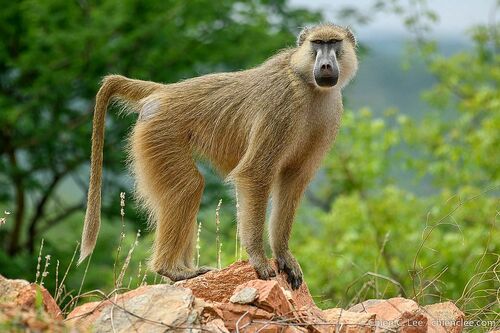
Other species in the family Cercopithecidae
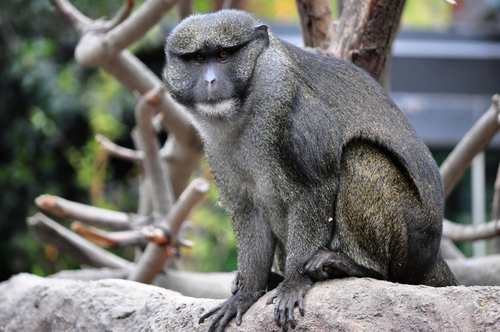
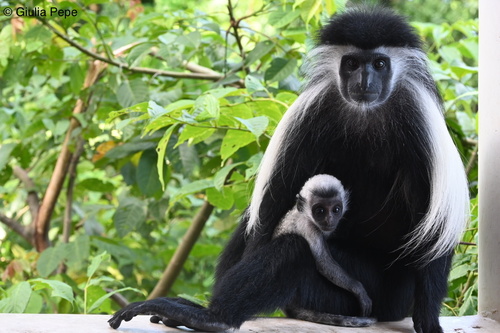
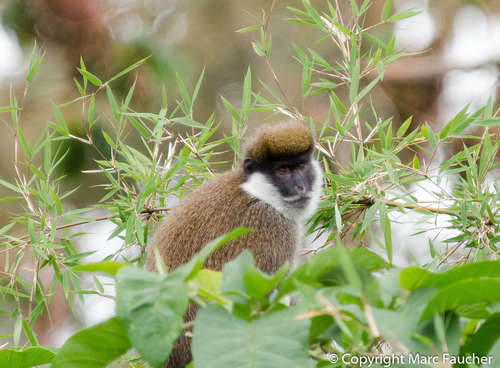
Species that share its range
Sources
Conservation status, range description and population estimate come from the IUCN Red List assessment for Papio ursinus. Countries are derived from that range description, not from a mapped country list. Last refreshed on .
The distribution map is drawn from the IUCN Red List spatial data compiled in 2019. IUCN (International Union for Conservation of Nature)