
Greater Naked Bat
Cheiromeles torquatus
Red List assessment
Least Concernon the IUCN Red List
- EXExtinct
- EWExtinct in the Wild
- CRCritically Endangered
- ENEndangered
- VUVulnerable
- NTNear Threatened
- LCLeast Concern
The Greater Naked Bat is recorded in 5 countries across Asia. The IUCN Red List assesses the Greater Naked Bat as Least Concern. Population size is not precisely quantified but considered locally abundant in suitable cave habitats; overall trend is believed to be stable to slightly declining due to habitat degradation.
- Family
- Molossidae
- Order
- Chiroptera
- Genus
- Cheiromeles
- Countries recorded
- 5
- Continents
- Asia
- Red List category
- Least Concern
- Data updated
- August 9, 2026
What is the Greater Naked Bat?
The Greater Naked Bat is one of the largest and most distinctive bats in Southeast Asia, notable for its almost entirely hairless body. It roosts in massive colonies within limestone caves and tree hollows across Borneo and neighboring islands. This species is remarkable for its unique wing-folding mechanism that allows wings to be tucked into lateral pouches, and for using its feet to walk on all fours when foraging.
Where does the Greater Naked Bat live?
Southeast Asia, primarily Borneo, Sumatra, Java, Philippines, and Malay Peninsula
Distributed across the Sundaland region including Borneo (Malaysia, Indonesia, Brunei), Sumatra, Java, the Philippines, and parts of the Malay Peninsula and Thailand.
Altitude and depth
Typically found from sea level up to about 1000 meters elevation, though most populations occur in lowland areas below 500m.
Seasonal movements
No significant migratory behavior documented; activity patterns remain relatively consistent year-round in tropical climate, though breeding may show some seasonal peaks.
Habitat of the Greater Naked Bat
Primarily found in lowland tropical rainforests, limestone karst caves, and occasionally in hollow trees; often roosts in large caves near forested areas that provide foraging grounds.
Adaptations to its environment
Its near-hairless skin reduces drag during flight and may aid thermoregulation in humid tropical climates. Unique skin pouches on the sides of the body allow the wings to be folded away when not flying, facilitating crawling and climbing within cave environments.
Conservation status and numbers
Listed as Least Concern by IUCN due to wide distribution and presumed large population, though some regional populations face localized pressure from cave disturbance and habitat loss.
Estimated population
Population size is not precisely quantified but considered locally abundant in suitable cave habitats; overall trend is believed to be stable to slightly declining due to habitat degradation.
What threatens the Greater Naked Bat?
Main threats include deforestation for palm oil plantations and logging, disturbance of roosting caves by tourism or guano harvesting, and hunting for food or traditional medicine in some regions.
Diseases and parasites
Known to host various ectoparasites including bat flies and mites; may also carry certain coronaviruses as documented in regional bat virome studies.
What is being done to protect it?
Protected within various national parks and cave systems across Malaysia and Indonesia; some caves are managed as protected areas due to their significance for bat colonies and guano resources.
Recommended actions
Recommended actions include protecting critical cave roosts from disturbance, regulating guano harvesting, preventing deforestation near foraging habitats, and conducting further population monitoring studies.
What the Greater Naked Bat looks like
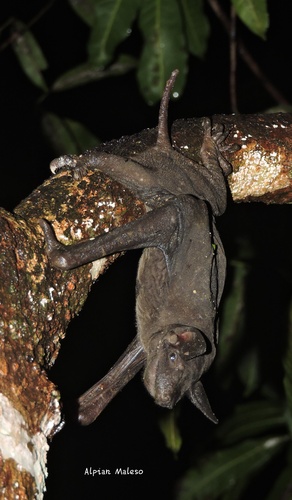
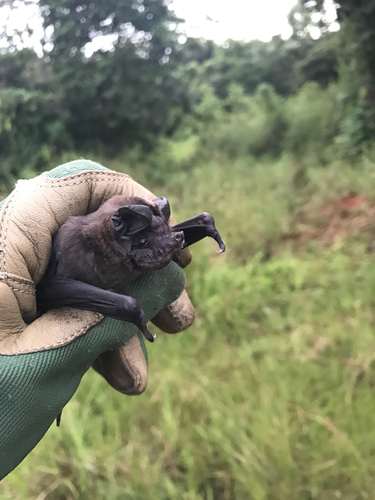
The body is almost entirely naked with only sparse fine hairs, giving it a wrinkled, leathery, dark grayish-brown to blackish skin appearance. It has large ears, a robust muzzle, and distinctive pouches on the sides of its body used to store folded wings.
Size
Body length approximately 8-9 cm; forearm length ranges from 66-84 mm; wingspan can reach up to 40 cm.
Weight
Adults typically weigh between 80-196 grams, making it one of the heaviest microbats in the world.
Distinctive features
Distinguished from related bats by its near-total lack of fur, larger body size compared to most microbats, and unique lateral skin pouches for wing storage that facilitate quadrupedal movement.
Differences between males and females
Minimal sexual dimorphism; males and females are similar in size and appearance with only slight variation in body mass.
Behaviour and diet of the Greater Naked Bat
Highly social and colonial, roosting in large aggregations that can number in the thousands within cave systems, often alongside other bat species.
When it is active
Strictly nocturnal, emerging from caves at dusk to forage and returning before dawn.
Diet
Primarily insectivorous, feeding on a variety of flying insects including beetles, moths, and other nocturnal insects captured in flight.
How it feeds and hunts
Uses echolocation to detect and capture insect prey while in flight; forages typically above the forest canopy or over open areas near roosting caves.
Communication
Communicates through ultrasonic echolocation calls for navigation and prey detection, as well as social vocalizations within roosting colonies for maintaining group cohesion.
Interactions with other species
Predators include birds of prey and snakes at cave entrances; the species often coexists with other bat species in shared cave systems, contributing to complex cave ecosystems.
Role in its ecosystem
Plays an important ecological role as an insectivore, helping control insect populations in tropical forest ecosystems; guano production also supports unique cave invertebrate communities.
Reproduction and lifecycle
Breeding details are not fully documented, but females typically give birth to a single pup per breeding cycle after a gestation period estimated around 3-4 months.
Raising the young
Females carry and nurse a single pup, with the young clinging to the mother initially before being left in creches within the roost while she forages.
Maturity and lifespan
Sexual maturity is reached at approximately 1-2 years of age; lifespan in the wild is estimated at 10-15 years, though specific data is limited.
Taxonomy and naming of the Greater Naked Bat
Classification
Class Mammalia > Order Chiroptera > Family Molossidae > Genus Cheiromeles > Species Cheiromeles torquatus
Scientific synonyms
Cheiromeles pusillus (sometimes considered synonym or separate species)
What research says
Recent studies
Recent research has focused on its role as a potential reservoir for coronaviruses and other zoonotic pathogens, as well as studies on its unique wing-folding morphology and cave ecosystem dynamics.
Genome and DNA
Genomic studies are limited, though the species has been included in broader molossid bat phylogenetic and virome research due to its unique morphology.
Compared with similar species
Compared to other molossid bats, C. torquatus is notably larger and almost completely hairless, whereas most related free-tailed bats retain dense fur; it is often compared with the smaller, less-studied Cheiromeles parvidens.
The Greater Naked Bat and people
This bat is sometimes called the 'naked bulldog bat' due to its wrinkled, hairless skin and pug-like face. It can store its folded wings in special skin pouches, allowing it to crawl on all fours like a small mammal rather than just fly. Its guano has historically been harvested as fertilizer in parts of Southeast Asia.
Where and how to see it
Best observed at dusk near known cave systems in Borneo, such as those in Gunung Mulu National Park, where mass emergences can be witnessed; a red-light flashlight and patience are recommended to avoid disturbing colonies.
Risks to humans
No notable risk to humans in terms of aggression, though as with many bat species, there is a potential zoonotic disease transmission risk if directly handled without precautions.
Human uses
Historically hunted for food in some rural communities and its guano collected for use as agricultural fertilizer; also of interest for scientific research on bat virology and unique morphology.
Myths and legends
In some local Bornean folklore, cave-dwelling bats including this species are associated with spirits or omens due to their eerie nocturnal emergence from dark caves in massive numbers.
Countries where the Greater Naked Bat is recorded
The 5 countries named in the range description of its IUCN Red List assessment.
Questions about the Greater Naked Bat
Where does the Greater Naked Bat live?
The Greater Naked Bat is recorded in Brunei, Indonesia, Malaysia, Philippines and Thailand across Asia. These countries come from the range description of its IUCN Red List assessment, and they are what place the species on the interactive map.
Is the Greater Naked Bat endangered?
The IUCN Red List assesses the Greater Naked Bat as Least Concern. The species is widespread and abundant enough not to qualify for any threatened category. It does not mean the species is safe forever, only that nothing in the current data raises an alarm.
How many are left in the wild?
Population size is not precisely quantified but considered locally abundant in suitable cave habitats; overall trend is believed to be stable to slightly declining due to habitat degradation. This figure comes from the species assessment on the IUCN Red List; population estimates for wild mammals are ranges, not counts, and are revised at each assessment.
What habitat does the Greater Naked Bat live in?
Primarily found in lowland tropical rainforests, limestone karst caves, and occasionally in hollow trees; often roosts in large caves near forested areas that provide foraging grounds.
What is the scientific name of the Greater Naked Bat?
The Greater Naked Bat is Cheiromeles torquatus, in the family Molossidae, order Chiroptera.
Other species in the genus Cheiromeles
Other species in the family Molossidae

Species that share its range
Sources
Conservation status, range description and population estimate come from the IUCN Red List assessment for Cheiromeles torquatus. Countries are derived from that range description, not from a mapped country list. Last refreshed on .
The distribution map is drawn from the IUCN Red List spatial data compiled in 2019. IUCN (International Union for Conservation of Nature)