
Duke of Abruzzi's Wrinkle-lipped Bat
Mops aloysiisabaudiae
Red List assessment
Least Concernon the IUCN Red List
- EXExtinct
- EWExtinct in the Wild
- CRCritically Endangered
- ENEndangered
- VUVulnerable
- NTNear Threatened
- LCLeast Concern
The Duke of Abruzzi's Wrinkle-lipped Bat is recorded in 4 countries across Africa. The IUCN Red List assesses the Duke of Abruzzi's Wrinkle-lipped Bat as Least Concern. No reliable population estimate exists; the species is considered rare in collections, and its population trend is presumed stable due to lack of evidence of decline.
- Family
- Molossidae
- Order
- Chiroptera
- Genus
- Mops
- Countries recorded
- 4
- Continents
- Africa
- Red List category
- Least Concern
- Data updated
- August 9, 2026
What is the Duke of Abruzzi's Wrinkle-lipped Bat?
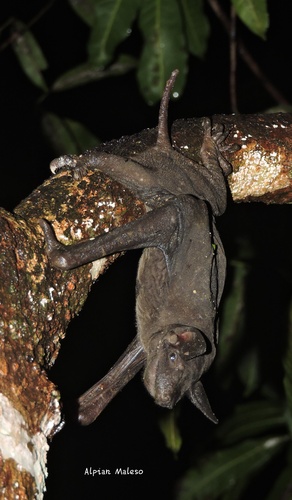
The Duke of Abruzzi's Wrinkle-lipped Bat is a small, poorly-studied free-tailed bat native to the lowland rainforests of Central Africa. It belongs to the Molossidae family, characterized by wrinkled lips and a tail extending beyond the tail membrane, aiding fast aerial flight. Named in honor of Prince Luigi Amedeo, Duke of the Abruzzi, an Italian explorer, this species remains one of the least documented bats in its genus. Its rarity in museum collections and field surveys makes it a species of scientific curiosity despite its non-threatened status.
Where does the Duke of Abruzzi's Wrinkle-lipped Bat live?
Central Africa, primarily the Democratic Republic of the Congo, with records also suggesting presence in the Republic of the Congo and possibly Cameroon and the Central African Republic.
Restricted to Central Africa, with confirmed records from the Democratic Republic of the Congo and possible occurrence in neighboring countries such as the Republic of the Congo, Cameroon, and the Central African Republic. Its exact range remains poorly mapped due to limited survey data.
Altitude and depth
Generally found in lowland areas below 1000 meters elevation, consistent with the tropical rainforest habitats it occupies.
Seasonal movements
No documented seasonal migration; likely maintains stable local populations with possible minor seasonal shifts in activity linked to insect abundance during wet and dry seasons.
Habitat of the Duke of Abruzzi's Wrinkle-lipped Bat
Primarily found in lowland tropical rainforest and forest-edge habitats, often roosting in tree hollows, foliage, or possibly caves and rock crevices within forested landscapes.
Adaptations to its environment
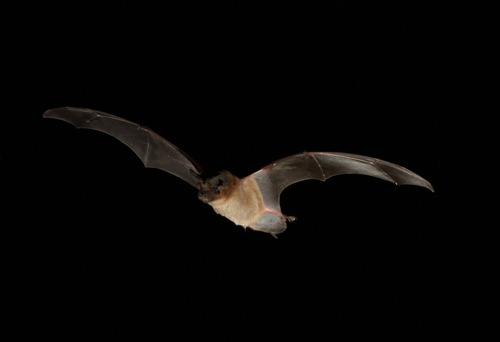
Possesses long narrow wings typical of molossid bats, enabling fast, sustained flight for catching insects in open or semi-open forest airspace. Wrinkled lips may assist in funneling insects into the mouth during flight, and its robust jaw structure suits an insectivorous diet.
Conservation status and numbers
Listed as Least Concern (LC) by the IUCN, primarily because no major population declines have been documented, though this may partly reflect a lack of comprehensive survey data across its Central African range.
Estimated population
No reliable population estimate exists; the species is considered rare in collections, and its population trend is presumed stable due to lack of evidence of decline.
What threatens the Duke of Abruzzi's Wrinkle-lipped Bat?
Potential threats include deforestation and habitat degradation from logging and agricultural expansion in Central African rainforests, though no specific major threats have been documented for this species.
What is being done to protect it?
No species-specific conservation programs are known; general protection stems from Central African forest reserves and national parks that preserve its rainforest habitat, such as protected areas in the DRC.
Recommended actions
Increased field surveys and taxonomic studies are recommended to clarify distribution, population size, and habitat requirements. Habitat protection within its known range would also help safeguard the species from indirect deforestation pressures.
What the Duke of Abruzzi's Wrinkle-lipped Bat looks like
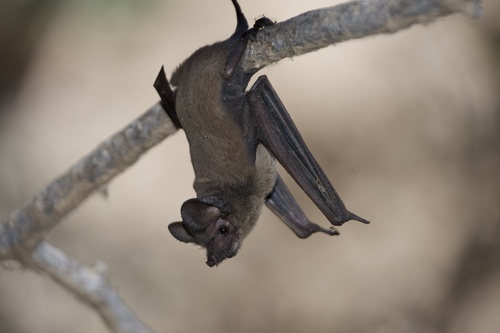
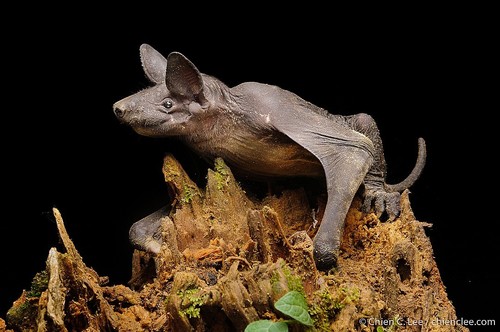
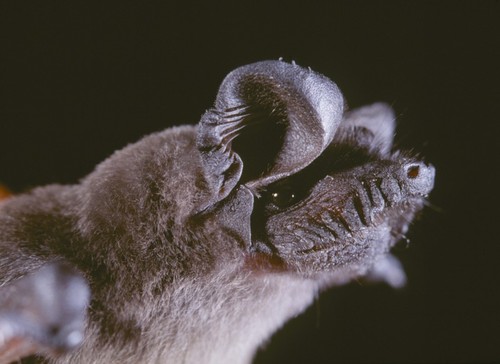
Small bat with dark brown to blackish fur, a broad wrinkled upper lip characteristic of the genus Mops, and narrow, elongated wings suited for fast flight. The tail extends notably beyond the interfemoral membrane, a defining trait of free-tailed bats.
Size
Forearm length approximately 35-40 mm; total body length estimated around 7-9 cm, typical of small molossid bats.
Weight
Estimated body weight of approximately 8-12 grams, based on comparable Mops species.
Distinctive features
Distinguished from closely related Mops species by subtle differences in skull morphology, dental structure, and forearm measurements, though field identification is challenging due to similarity with congeners.
Behaviour and diet of the Duke of Abruzzi's Wrinkle-lipped Bat
Likely roosts in small to moderate colonies, consistent with social behavior observed in related Mops species, though specific group sizes for this species are undocumented.
When it is active
Nocturnal, emerging at dusk to hunt flying insects, similar to other molossid bats.
Diet
Insectivorous, feeding on small flying insects such as moths, beetles, and other nocturnal insects captured during flight.
How it feeds and hunts
Employs aerial hawking, using echolocation to detect and capture insects mid-flight over forest canopies and clearings.
Communication
Likely uses echolocation calls for navigation and prey detection, along with social vocalizations for roost mate interactions, as observed in related molossid bats.
Interactions with other species
May share roosting habitats with other insectivorous bat species and face predation from nocturnal birds of prey, snakes, or small carnivorous mammals near roost sites.
Role in its ecosystem
Functions as an insectivorous predator within Central African rainforest ecosystems, contributing to natural pest control by consuming large quantities of nocturnal flying insects.
Reproduction and lifecycle
Reproductive biology is not well documented, but likely follows patterns similar to related Mops species, with possible seasonal breeding tied to insect abundance and a single offspring per breeding cycle.
Raising the young
Presumed maternal care typical of bats, with females nursing and roosting with a single pup until it becomes independent, though specific data for this species is lacking.
Maturity and lifespan
Specific data unavailable, but likely reaches sexual maturity within the first year of life, with a lifespan possibly ranging from 5-10 years based on similar-sized molossid bats.
Taxonomy and naming of the Duke of Abruzzi's Wrinkle-lipped Bat
Classification
Class Mammalia > Order Chiroptera > Family Molossidae > Genus Mops > Species Mops aloysiisabaudiae
Scientific synonyms
Xiphonycteris aloysiisabaudiae (original genus placement, Trouessart 1906); also historically referred to as Tadarida aloysiisabaudiae in some older classifications.
What research says
Compared with similar species
Closely resembles other Mops species such as Mops condylurus and Mops thersites in size and general morphology, but differs in specific craniodental measurements used for species-level identification.
The Duke of Abruzzi's Wrinkle-lipped Bat and people
This bat is named after Prince Luigi Amedeo, Duke of the Abruzzi, a famous Italian explorer and mountaineer, linking a small rainforest bat to a legacy of exploration. It remains one of the rarest and least-documented bats in museum collections worldwide, highlighting how much remains unknown about Central African bat diversity.
Where and how to see it
Best observed at dusk near forest edges or clearings in the Democratic Republic of the Congo using bat detectors to capture echolocation calls, as visual sightings are rare due to its nocturnal and elusive nature.
Risks to humans
No notable risk to humans; like most bats, it poses minimal direct threat but could theoretically carry zoonotic pathogens common to bat populations.
Countries where the Duke of Abruzzi's Wrinkle-lipped Bat is recorded
The 4 countries named in the range description of its IUCN Red List assessment.
Questions about the Duke of Abruzzi's Wrinkle-lipped Bat
Where does the Duke of Abruzzi's Wrinkle-lipped Bat live?
The Duke of Abruzzi's Wrinkle-lipped Bat is recorded in Cameroon, Central African Republic, Democratic Republic of the Congo and Republic of the Congo across Africa. These countries come from the range description of its IUCN Red List assessment, and they are what place the species on the interactive map.
Is the Duke of Abruzzi's Wrinkle-lipped Bat endangered?
The IUCN Red List assesses the Duke of Abruzzi's Wrinkle-lipped Bat as Least Concern. The species is widespread and abundant enough not to qualify for any threatened category. It does not mean the species is safe forever, only that nothing in the current data raises an alarm.
How many are left in the wild?
No reliable population estimate exists; the species is considered rare in collections, and its population trend is presumed stable due to lack of evidence of decline. This figure comes from the species assessment on the IUCN Red List; population estimates for wild mammals are ranges, not counts, and are revised at each assessment.
What habitat does the Duke of Abruzzi's Wrinkle-lipped Bat live in?
Primarily found in lowland tropical rainforest and forest-edge habitats, often roosting in tree hollows, foliage, or possibly caves and rock crevices within forested landscapes.
What is the scientific name of the Duke of Abruzzi's Wrinkle-lipped Bat?
The Duke of Abruzzi's Wrinkle-lipped Bat is Mops aloysiisabaudiae, in the family Molossidae, order Chiroptera.
Other species in the genus Mops


Other species in the family Molossidae
Sources
Conservation status, range description and population estimate come from the IUCN Red List assessment for Mops aloysiisabaudiae. Countries are derived from that range description, not from a mapped country list. Last refreshed on .
The distribution map is drawn from the IUCN Red List spatial data compiled in 2008. IUCN (International Union for Conservation of Nature)