
Brazilian Free-tailed Bat
Tadarida brasiliensis
Red List assessment
Least Concernon the IUCN Red List
- EXExtinct
- EWExtinct in the Wild
- CRCritically Endangered
- ENEndangered
- VUVulnerable
- NTNear Threatened
- LCLeast Concern
The Brazilian Free-tailed Bat is recorded in 4 countries across North America and South America. The IUCN Red List assesses the Brazilian Free-tailed Bat as Least Concern. Estimated in the tens of millions globally, with some individual colonies (e.g., Bracken Cave, Texas) containing up to 20 million bats; overall trend considered stable, though some local populations are declining.
- Family
- Molossidae
- Order
- Chiroptera
- Genus
- Tadarida
- Countries recorded
- 4
- Continents
- North America and South America
- Red List category
- Least Concern
- Data updated
- August 9, 2026
What is the Brazilian Free-tailed Bat?
The Brazilian free-tailed bat is a small, migratory insectivorous bat famous for forming some of the largest mammalian aggregations on Earth, with colonies numbering in the millions. It ranges from the southern United States through Mexico, Central America, and much of South America. This species is renowned for its high-speed, high-altitude flight and its critical ecological role as a natural pest controller. Its distinctive free tail extending beyond the tail membrane gives the species its common name.
Where does the Brazilian Free-tailed Bat live?
Southern United States, Mexico, Central America, and much of South America
Found from the southern United States (California to North Carolina) through Mexico, Central America, and into South America as far south as Chile and Argentina; also present in the Caribbean.
Altitude and depth
Roosts from sea level to over 2000m; known to forage at altitudes exceeding 3000m above ground, among the highest recorded for bats.
Seasonal movements
Populations in the southern US undertake seasonal migrations, traveling south to Mexico in winter and returning north in spring; southern populations may be non-migratory and resident year-round.
Habitat of the Brazilian Free-tailed Bat
Roosts in caves, bridges, buildings, tunnels, and hollow trees; forages over a wide variety of habitats including deserts, grasslands, agricultural fields, and urban areas.
Adaptations to its environment
Long, narrow wings adapted for fast, sustained flight at high altitudes; echolocation calls tuned for open-air hunting; ability to exploit tailwinds during migration to conserve energy.
Conservation status and numbers
Listed as Least Concern by the IUCN due to its wide distribution and large overall population, though some regional colonies have experienced significant declines.
Estimated population
Estimated in the tens of millions globally, with some individual colonies (e.g., Bracken Cave, Texas) containing up to 20 million bats; overall trend considered stable, though some local populations are declining.
What threatens the Brazilian Free-tailed Bat?
Habitat disturbance and destruction of roost sites (caves, bridges), pesticide use reducing insect prey, white-nose syndrome (less common in this species but a concern), wind turbine collisions, and human disturbance of maternity colonies.
Diseases and parasites
Susceptible to rabies (though transmission to humans is rare), various ectoparasites like mites and bat bugs, and occasionally affected by fungal infections, though less impacted by white-nose syndrome than some other species.
What is being done to protect it?
Protection of major roost sites such as Bracken Cave and Carlsbad Caverns; monitoring programs tracking colony sizes; legal protections against roost disturbance in some regions; public education on the ecological benefits of bats.
Recommended actions
Preserve and protect key roosting caves and bridges from disturbance, reduce pesticide use near foraging grounds, monitor for emerging diseases, and mitigate wind turbine impacts through improved siting and operational curtailment.
What the Brazilian Free-tailed Bat looks like
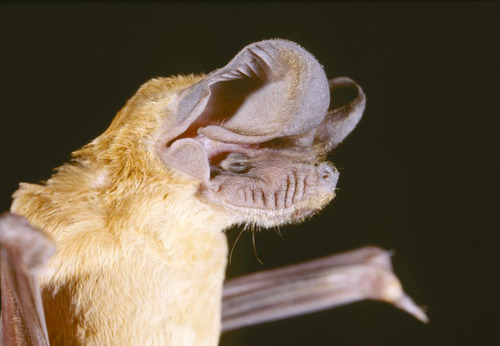
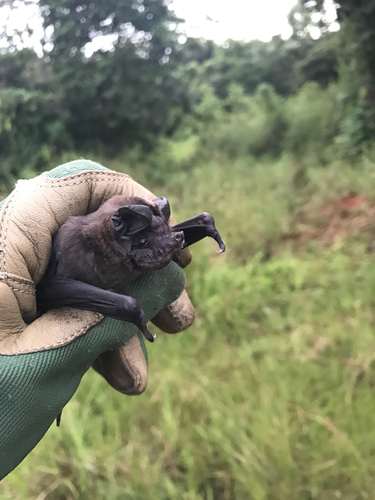
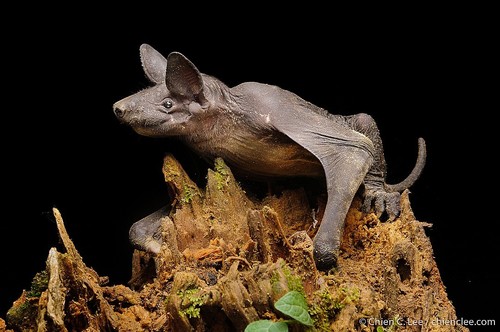
Fur is short and dark brown to grayish, with a velvety texture; large, forward-pointing ears and wrinkled lips characteristic of free-tailed bats.
Size
Body length approximately 9-11 cm; wingspan around 30-35 cm.
Weight
Typically weighs 11-14 grams, with little difference between sexes.
Distinctive features
Distinguished by its long tail extending well beyond the uropatagium (tail membrane), a trait giving the family its name; narrow, pointed wings adapted for fast flight distinguish it from broader-winged bat species.
Differences between males and females
Minimal sexual dimorphism; males and females are similar in size and coloration.
Behaviour and diet of the Brazilian Free-tailed Bat
Highly gregarious, forming some of the densest and largest colonies of any mammal, with densities reaching hundreds of bats per square foot in maternity caves.
When it is active
Nocturnal, emerging at dusk in large swirling columns to forage, often flying long distances and at high altitudes overnight.
Diet
Insectivorous, feeding primarily on moths, beetles, and other flying insects, including significant numbers of agricultural pest species like corn earworm moths.
How it feeds and hunts
Uses echolocation to detect and capture insects in open-air pursuit at high speed and altitude, often intercepting migrating insect swarms far above the ground.
Communication
Communicates through a wide range of ultrasonic and audible vocalizations for echolocation, mother-pup recognition, and social interaction within crowded roosts.
Interactions with other species
Preyed upon by owls, hawks, snakes, and raccoons near roost entrances; competes with other insectivorous bat species for prey; guano supports specialized cave ecosystems including invertebrates.
Role in its ecosystem
Plays a major ecological role as a natural pest control agent, consuming vast quantities of agricultural insect pests each night, providing significant economic benefits to farming regions.
Reproduction and lifecycle
Mating occurs in late winter to early spring; gestation lasts around 11-12 weeks, with females giving birth to a single pup in large maternity colonies in early summer.
Raising the young
Mothers form dense maternity colonies and are able to locate and nurse their own pup among millions of others using vocal and olfactory cues; pups are weaned at around 5-7 weeks old.
Maturity and lifespan
Reaches sexual maturity at around 9 months to 2 years; typical lifespan in the wild is 8-10 years, with some individuals recorded living over 15 years.
Taxonomy and naming of the Brazilian Free-tailed Bat
Classification
Class Mammalia > Order Chiroptera > Family Molossidae > Genus Tadarida > Species T. brasiliensis
Subspecies
Several subspecies recognized including T. b. brasiliensis (South America), T. b. mexicana (Mexico and southern USA), T. b. intermedia (Texas/Mexico border), and T. b. constanzae, differing slightly in size and range.
Scientific synonyms
Nyctinomus brasiliensis, Tadarida mexicana
What research says
Recent studies
Recent radar and GPS tracking studies have revealed record-breaking flight altitudes and speeds, with some individuals reaching over 3000m altitude and horizontal speeds exceeding 100 km/h.
Genome and DNA
Diploid chromosome number of 2n=48; genome studies have been used to explore population genetics and migratory connectivity between colonies.
Compared with similar species
Similar to other molossid bats like the European free-tailed bat (Tadarida teniotis) but generally smaller; distinguished from vesper bats (Vespertilionidae) by its longer tail and narrower wings suited for fast flight.
The Brazilian Free-tailed Bat and people
Bracken Cave in Texas hosts the largest known bat colony in the world, with up to 20 million individuals; this species has been recorded flying at altitudes over 3000 meters, among the highest of any bat; a single colony can consume tens of tons of insects in one night.
Where and how to see it
Best observed at dusk near well-known colonies such as Bracken Cave or the Congress Avenue Bridge in Austin, Texas, particularly from late spring through summer during peak colony activity.
Risks to humans
Low direct risk to humans, though bats can carry rabies; direct contact should be avoided, and guano exposure in caves can pose respiratory risks from histoplasmosis fungus.
Human uses
Valued for natural pest control services in agriculture; guano has historically been harvested as fertilizer; colonies attract significant eco-tourism revenue in places like Austin, Texas.
Myths and legends
In some Mexican and Texan folklore, the emergence of millions of bats at dusk has inspired local legends and is celebrated in cultural festivals like the Austin Bat Fest.
Countries where the Brazilian Free-tailed Bat is recorded
The 4 countries named in the range description of its IUCN Red List assessment.
Questions about the Brazilian Free-tailed Bat
Where does the Brazilian Free-tailed Bat live?
The Brazilian Free-tailed Bat is recorded in Argentina, Chile, Mexico and United States across North America and South America. These countries come from the range description of its IUCN Red List assessment, and they are what place the species on the interactive map.
Is the Brazilian Free-tailed Bat endangered?
The IUCN Red List assesses the Brazilian Free-tailed Bat as Least Concern. The species is widespread and abundant enough not to qualify for any threatened category. It does not mean the species is safe forever, only that nothing in the current data raises an alarm.
How many are left in the wild?
Estimated in the tens of millions globally, with some individual colonies (e.g., Bracken Cave, Texas) containing up to 20 million bats; overall trend considered stable, though some local populations are declining. This figure comes from the species assessment on the IUCN Red List; population estimates for wild mammals are ranges, not counts, and are revised at each assessment.
What habitat does the Brazilian Free-tailed Bat live in?
Roosts in caves, bridges, buildings, tunnels, and hollow trees; forages over a wide variety of habitats including deserts, grasslands, agricultural fields, and urban areas.
What is the scientific name of the Brazilian Free-tailed Bat?
The Brazilian Free-tailed Bat is Tadarida brasiliensis, in the family Molossidae, order Chiroptera.
Other species in the genus Tadarida
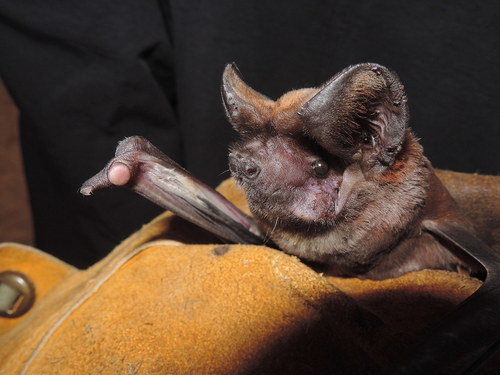
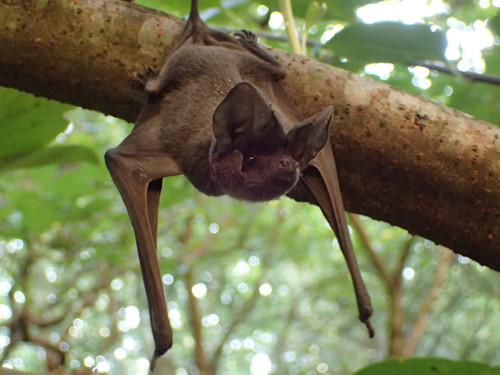
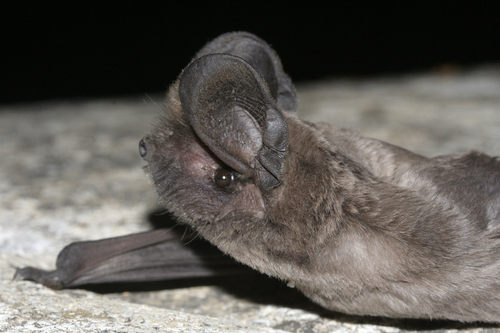

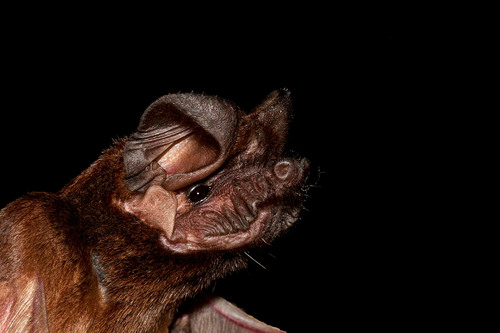
Other species in the family Molossidae

Sources
Conservation status, range description and population estimate come from the IUCN Red List assessment for Tadarida brasiliensis. Countries are derived from that range description, not from a mapped country list. Last refreshed on .
The distribution map is drawn from the IUCN Red List spatial data compiled in 2008. IUCN (International Union for Conservation of Nature)