
Lesser Naked Bat
Cheiromeles parvidens
Red List assessment
Least Concernon the IUCN Red List
- EXExtinct
- EWExtinct in the Wild
- CRCritically Endangered
- ENEndangered
- VUVulnerable
- NTNear Threatened
- LCLeast Concern
The Lesser Naked Bat is recorded in 2 countries across Asia. The IUCN Red List assesses the Lesser Naked Bat as Least Concern. No precise global population estimate exists; the population is presumed stable but likely under-monitored due to the species' cryptic cave-roosting habits.
- Family
- Molossidae
- Order
- Chiroptera
- Genus
- Cheiromeles
- Countries recorded
- 2
- Continents
- Asia
- Red List category
- Least Concern
- Data updated
- August 9, 2026
What is the Lesser Naked Bat?
The Lesser Naked Bat is a striking, nearly hairless molossid bat native to Sulawesi and parts of the Philippines. It is one of only two species in the genus Cheiromeles, both remarkable for their almost complete lack of fur, giving them a wrinkled, leathery appearance. This species is smaller than its close relative, the Naked Bulldog Bat (C. torquatus), and roosts colonially in caves and hollow trees. It is a specialized insectivore that plays an important role in controlling nocturnal insect populations.
Where does the Lesser Naked Bat live?
Sulawesi (Indonesia) and the Philippines
Endemic to the island of Sulawesi in Indonesia, with records also from parts of the Philippines. Its range is patchy and tied closely to the availability of cave and hollow-tree roosts.
Altitude and depth
Typically found from sea level up to around 1000 meters elevation, favoring lowland to mid-elevation forested areas.
Seasonal movements
No long-distance migration is known; the species shows relatively stable year-round activity, though breeding may be linked to seasonal insect abundance patterns.
Habitat of the Lesser Naked Bat
Found in lowland and hill tropical rainforests, often near caves, rock crevices, and hollow trees that serve as roosting sites. It can also be found in disturbed or secondary forest areas as long as suitable roosting structures remain.
Adaptations to its environment
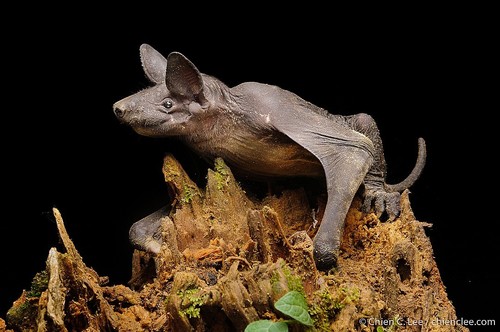
Its near-total lack of fur is thought to reduce parasite load and aid thermoregulation in the humid tropical climate. It has powerful, muscular limbs and unique pouches on its body used to store folded wings while crawling, an adaptation for its unusual quadrupedal locomotion on the ground and cave surfaces.
Conservation status and numbers
Listed as Least Concern by the IUCN due to a relatively wide distribution and presumed stable population, although data on population trends remain limited.
Estimated population
No precise global population estimate exists; the population is presumed stable but likely under-monitored due to the species' cryptic cave-roosting habits.
What threatens the Lesser Naked Bat?
Main threats include deforestation, cave disturbance from guano mining and tourism, and habitat degradation from agricultural expansion in Sulawesi and the Philippines.
Diseases and parasites
Like other bats, it may host various ectoparasites such as bat flies and mites, as well as being a potential reservoir for certain viruses, though specific studies on this species are limited.
What is being done to protect it?
Some populations occur within protected areas and national parks in Sulawesi, but targeted conservation programs specifically for this species are limited. General cave and forest protection laws in Indonesia and the Philippines provide indirect benefits.
Recommended actions
Recommended actions include better population surveys, protection of key cave roosts from disturbance, and inclusion of the species in regional bat conservation and habitat management plans.
What the Lesser Naked Bat looks like
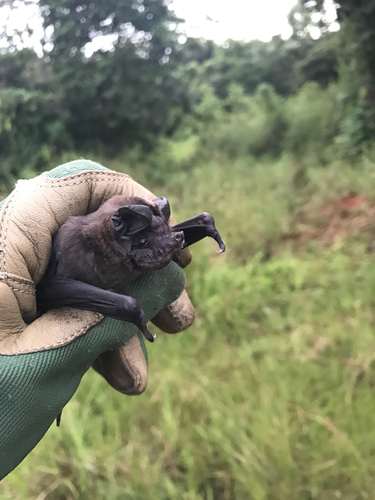
The body is almost entirely devoid of fur, appearing dark grayish-brown to blackish and wrinkled, resembling bare skin more than typical bat fur coverage. It has a robust, thickset body, large ears, and a distinctive throat pouch region.
Size
Body length approximately 8-9 cm, with a wingspan estimated around 30-35 cm, smaller than the related Cheiromeles torquatus.
Weight
Adults typically weigh between 60-80 grams, lighter than the larger naked bulldog bat.
Distinctive features
Distinguished from Cheiromeles torquatus mainly by its smaller overall size and subtle skull and dental differences; both species share the unusual hairless, wrinkled skin unique among bats.
Differences between males and females
Sexual dimorphism is minimal, with males and females showing similar size and coloration, though males may be marginally larger.
Behaviour and diet of the Lesser Naked Bat
Highly colonial, roosting in large groups within caves or hollow trees, sometimes numbering in the hundreds to thousands of individuals.
When it is active
Strictly nocturnal, emerging at dusk to forage for flying insects and returning to communal roosts before dawn.
Diet
Insectivorous, feeding primarily on flying insects such as moths, beetles, and other night-flying arthropods captured in flight.
How it feeds and hunts
Uses echolocation to detect and capture insect prey in open airspace above forest canopy and near cave entrances, employing fast, agile flight typical of molossid bats.
Communication
Communicates through high-frequency echolocation calls for navigation and prey detection, along with social vocalizations within roosting colonies.
Interactions with other species
Preyed upon occasionally by snakes, birds of prey, and other cave-dwelling predators; may share roosting caves with other bat species and contribute to guano-based cave ecosystems.
Role in its ecosystem
Plays an important ecological role as an insectivorous predator, helping regulate populations of nocturnal flying insects in tropical forest ecosystems.
Reproduction and lifecycle
Breeding biology is not fully documented but is presumed to follow typical molossid patterns with a single offspring per breeding cycle and a gestation period of a few months.
Raising the young
Females likely give birth to a single pup which is nursed and cared for in the maternity roost until capable of independent flight, similar to related bat species.
Maturity and lifespan
Specific data are lacking, but related molossid bats typically reach sexual maturity within one year and can live up to 10 years or more in the wild.
Taxonomy and naming of the Lesser Naked Bat
Classification
Class Mammalia > Order Chiroptera > Family Molossidae > Genus Cheiromeles > Species Cheiromeles parvidens
Scientific synonyms
Sometimes historically considered conspecific with or closely allied to Cheiromeles torquatus before being recognized as a distinct species based on smaller size and morphological differences.
What research says
Recent studies
Recent taxonomic and morphological studies have helped clarify the distinction between Cheiromeles parvidens and Cheiromeles torquatus, confirming their status as separate species.
Compared with similar species
Compared to Cheiromeles torquatus, the Lesser Naked Bat is smaller in body size and wingspan, though both share the rare hairless trait among bats and similar ecological niches.
The Lesser Naked Bat and people
This bat is one of only two naked (hairless) bat species in the world. It has skin pouches on its sides where it tucks its folded wings while crawling on all fours like a small mammal. Its bare, wrinkled skin gives it an almost alien appearance among bats.
Where and how to see it
Best observed at dusk near cave entrances in Sulawesi's forested regions, particularly around known bat cave systems; patience and knowledge of local cave roosts greatly increase chances of sighting.
Risks to humans
No notable risk to humans; however, as with all bats, caution should be taken to avoid direct contact due to potential zoonotic disease transmission.
Human uses
Not commonly used by humans, though in some areas guano from bat caves, including those hosting this species, may be collected as fertilizer.
Countries where the Lesser Naked Bat is recorded
The 2 countries named in the range description of its IUCN Red List assessment.
Questions about the Lesser Naked Bat
Where does the Lesser Naked Bat live?
The Lesser Naked Bat is recorded in Indonesia and Philippines across Asia. These countries come from the range description of its IUCN Red List assessment, and they are what place the species on the interactive map.
Is the Lesser Naked Bat endangered?
The IUCN Red List assesses the Lesser Naked Bat as Least Concern. The species is widespread and abundant enough not to qualify for any threatened category. It does not mean the species is safe forever, only that nothing in the current data raises an alarm.
How many are left in the wild?
No precise global population estimate exists; the population is presumed stable but likely under-monitored due to the species' cryptic cave-roosting habits. This figure comes from the species assessment on the IUCN Red List; population estimates for wild mammals are ranges, not counts, and are revised at each assessment.
What habitat does the Lesser Naked Bat live in?
Found in lowland and hill tropical rainforests, often near caves, rock crevices, and hollow trees that serve as roosting sites.
What is the scientific name of the Lesser Naked Bat?
The Lesser Naked Bat is Cheiromeles parvidens, in the family Molossidae, order Chiroptera.
Other species in the genus Cheiromeles
Other species in the family Molossidae

Species that share its range
Sources
Conservation status, range description and population estimate come from the IUCN Red List assessment for Cheiromeles parvidens. Countries are derived from that range description, not from a mapped country list. Last refreshed on .
The distribution map is drawn from the IUCN Red List spatial data compiled in 2019. IUCN (International Union for Conservation of Nature)