
Fijian Free-tailed Bat
Mops bregullae
Red List assessment
Endangeredon the IUCN Red List
- EXExtinct
- EWExtinct in the Wild
- CRCritically Endangered
- ENEndangered
- VUVulnerable
- NTNear Threatened
- LCLeast Concern
The Fijian Free-tailed Bat is recorded in one country, Fiji across Oceania. The IUCN Red List assesses the Fijian Free-tailed Bat as Endangered. Population size is poorly known but believed to be very small, likely only a few thousand individuals or fewer, with a declining trend due to roost disturbance.
- Family
- Molossidae
- Order
- Chiroptera
- Genus
- Mops
- Countries recorded
- 1
- Continents
- Oceania
- Red List category
- Endangered
- Data updated
- August 9, 2026
What is the Fijian Free-tailed Bat?
The Fijian Free-tailed Bat is a small insectivorous bat endemic to Fiji, known from only a few cave roosts on the islands of Vanua Levu and Viti Levu. It belongs to the free-tailed bat family Molossidae, characterized by a tail extending beyond the tail membrane. It is remarkable for its extremely restricted range and reliance on a very small number of cave roosting sites, making it one of the rarest bats in the South Pacific.
Where does the Fijian Free-tailed Bat live?
Fiji (Vanua Levu, Viti Levu, and nearby islands)
Endemic to the Fiji Islands, with confirmed records restricted to Vanua Levu and Viti Levu; the species has an extremely limited known distribution within these islands.
Altitude and depth
Lowland areas, generally below 500 m elevation, associated with cave systems near sea level to mid-elevation forest.
Seasonal movements
No long-distance migration documented; some seasonal shifts in roost use possibly linked to breeding and food availability, but data are limited.
Habitat of the Fijian Free-tailed Bat
Roosts in caves, often limestone caverns, within lowland tropical forest and disturbed agricultural landscapes; forages over forest, forest edge, and open areas near roosts.
Adaptations to its environment
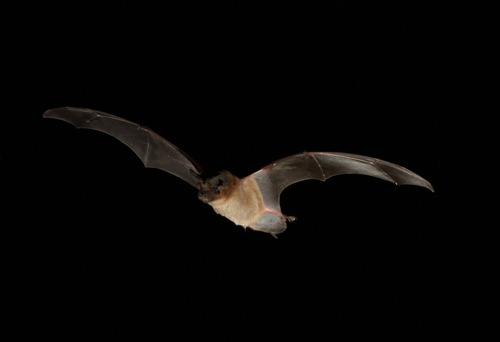
Long narrow wings and free tail adapted for fast, agile flight in open airspace typical of molossid bats; echolocation calls tuned for hunting flying insects in open or semi-open habitats; reliance on cave microclimates for roosting and thermoregulation.
Conservation status and numbers
Endangered (EN) according to IUCN, due to its extremely small range, small number of known roosting sites, and ongoing threats to those sites; population is inferred to be declining.
Estimated population
Population size is poorly known but believed to be very small, likely only a few thousand individuals or fewer, with a declining trend due to roost disturbance.
What threatens the Fijian Free-tailed Bat?
Disturbance and destruction of cave roosts (including guano mining, tourism, and human intrusion), deforestation reducing foraging habitat, and potential predation by introduced species such as rats and cats.
Diseases and parasites
Specific data on diseases or parasites for this species are limited, though bats in general can host ectoparasites such as mites and endoparasites; no major disease outbreaks documented.
What is being done to protect it?
Some cave roosts are located within areas of conservation interest in Fiji, and there is growing awareness of the need to protect key roost sites; formal habitat protection specific to this species remains limited.
Recommended actions
Protect and monitor known roost caves from disturbance, conduct surveys to identify additional roosts and estimate population size more accurately, implement community-based conservation programs, and control invasive predators near roost sites.
What the Fijian Free-tailed Bat looks like
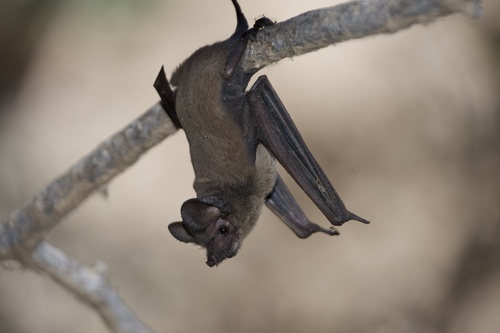
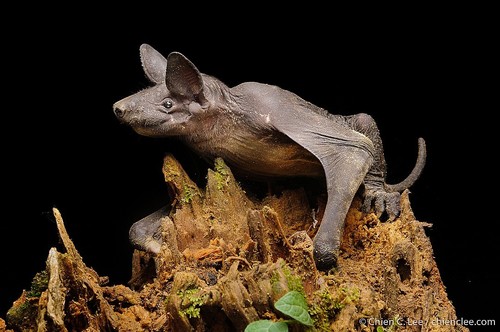
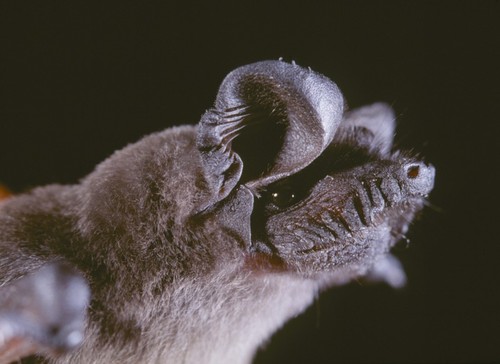
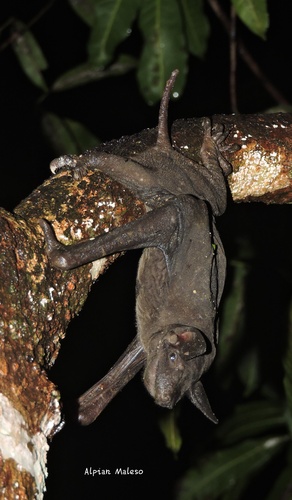
Small brownish-grey bat with a robust body, short dense fur, broad rounded ears, and a tail that protrudes freely beyond the interfemoral membrane, typical of free-tailed bats.
Size
Forearm length approximately 40-45 mm; overall body length around 8-10 cm excluding tail.
Weight
Approximately 10-15 grams.
Distinctive features
Distinguished from related Mops and Chaerephon species by subtle differences in skull morphology, dental characteristics, and echolocation call structure, as well as its restricted endemic range in Fiji.
Differences between males and females
Minimal sexual dimorphism; males and females are similar in size and coloration.
Behaviour and diet of the Fijian Free-tailed Bat
Roosts in colonies within caves, sometimes numbering from dozens to a few hundred individuals, showing gregarious behavior typical of molossid bats.
When it is active
Nocturnal, emerging at dusk to forage and returning to roost caves before dawn.
Diet
Insectivorous, feeding on a variety of flying insects such as moths, beetles, and other nocturnal insects captured in flight.
How it feeds and hunts
Uses echolocation to detect and capture insects in open airspace, employing fast, direct flight typical of free-tailed bats that forage above canopy level or in open areas.
Communication
Communicates primarily through echolocation calls for navigation and hunting, as well as social vocalizations within roosting colonies for contact and coordination.
Interactions with other species
Preyed upon by owls and possibly introduced predators such as rats and cats near roost entrances; may compete with other insectivorous bat species for food resources.
Role in its ecosystem
Plays an important ecological role as an insect predator, helping control populations of night-flying insects including agricultural pests.
Reproduction and lifecycle
Breeding biology is poorly documented, but likely follows the general molossid pattern with a single pup born per year after a gestation of about 2-3 months.
Raising the young
Females roost together in maternity colonies and nurse their single pup until it is capable of flight and independent foraging, typically over several weeks.
Maturity and lifespan
Sexual maturity likely reached within the first year, as in related molossid species; lifespan in the wild is estimated at several years, though exact data for this species are lacking.
Taxonomy and naming of the Fijian Free-tailed Bat
Classification
Mammalia > Chiroptera > Molossidae > Mops > Mops bregullae
Scientific synonyms
Chaerephon bregullae; Tadarida bregullae
What research says
Recent studies
Recent bat surveys in Fiji have focused on identifying remaining roost sites and assessing population status, contributing to updated IUCN threat assessments, though comprehensive genetic or ecological studies remain scarce.
Compared with similar species
Similar in general appearance to other Mops and Chaerephon species found in the Pacific and Southeast Asia, but distinguished by its unique endemic distribution restricted to Fiji and subtle morphological differences.
The Fijian Free-tailed Bat and people
This bat is one of only a handful of mammal species entirely endemic to Fiji; its entire known population may depend on just a few cave systems, making it extraordinarily vulnerable to localized disturbances.
Where and how to see it
Best observed at dusk near known cave roost entrances on Vanua Levu, with guided visits arranged through local conservation groups to minimize disturbance to the colony.
Risks to humans
No notable risk to humans.
Countries where the Fijian Free-tailed Bat is recorded
The 1 countries named in the range description of its IUCN Red List assessment.
Questions about the Fijian Free-tailed Bat
Where does the Fijian Free-tailed Bat live?
The Fijian Free-tailed Bat is recorded in Fiji across Oceania. These countries come from the range description of its IUCN Red List assessment, and they are what place the species on the interactive map.
Is the Fijian Free-tailed Bat endangered?
Yes. The IUCN Red List assesses the Fijian Free-tailed Bat as Endangered, one of the three threatened categories. The species faces a very high risk of extinction in the wild — a step below Critically Endangered, but still on a trajectory that ends badly without intervention.
How many are left in the wild?
Population size is poorly known but believed to be very small, likely only a few thousand individuals or fewer, with a declining trend due to roost disturbance. This figure comes from the species assessment on the IUCN Red List; population estimates for wild mammals are ranges, not counts, and are revised at each assessment.
What habitat does the Fijian Free-tailed Bat live in?
Roosts in caves, often limestone caverns, within lowland tropical forest and disturbed agricultural landscapes; forages over forest, forest edge, and open areas near roosts.
What is the scientific name of the Fijian Free-tailed Bat?
The Fijian Free-tailed Bat is Mops bregullae, in the family Molossidae, order Chiroptera.
Other species in the genus Mops


Other species in the family Molossidae
Sources
Conservation status, range description and population estimate come from the IUCN Red List assessment for Mops bregullae. Countries are derived from that range description, not from a mapped country list. Last refreshed on .
The distribution map is drawn from the IUCN Red List spatial data compiled in 2019. IUCN (International Union for Conservation of Nature)