
Ansorge's Free-tailed Bat
Mops ansorgei
Red List assessment
Least Concernon the IUCN Red List
- EXExtinct
- EWExtinct in the Wild
- CRCritically Endangered
- ENEndangered
- VUVulnerable
- NTNear Threatened
- LCLeast Concern
The Ansorge's Free-tailed Bat is recorded in 5 countries across Africa. The IUCN Red List assesses the Ansorge's Free-tailed Bat as Least Concern. Population size is not precisely quantified but is presumed stable across its range given its adaptability and broad distribution.
- Family
- Molossidae
- Order
- Chiroptera
- Genus
- Mops
- Countries recorded
- 5
- Continents
- Africa
- Red List category
- Least Concern
- Data updated
- August 9, 2026
What is the Ansorge's Free-tailed Bat?
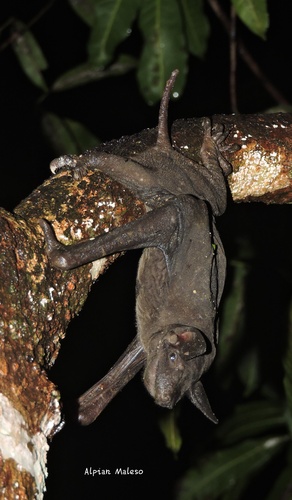
Ansorge's Free-tailed Bat is a small insectivorous bat belonging to the free-tailed bat family (Molossidae), distinguished by its characteristic tail extending beyond the interfemoral membrane. It inhabits woodland and savanna regions of central-southern Africa, roosting in tree hollows, rock crevices, and occasionally buildings. This species is remarkable for its fast, agile flight adapted to open-air insect hunting and its role in natural pest control.
Where does the Ansorge's Free-tailed Bat live?
Central and Southern Africa, primarily Angola, Democratic Republic of Congo, Zambia, and surrounding woodland regions
Distributed across parts of Angola, southern Democratic Republic of Congo, Zambia, and possibly extending into neighboring Malawi and Tanzania. Its range is centered on the Central African plateau region.
Altitude and depth
Typically found at elevations between 500-1500 meters above sea level
Seasonal movements
No long-distance migration documented; may show localized seasonal movements tracking insect abundance, particularly during wet and dry season transitions
Habitat of the Ansorge's Free-tailed Bat
Found in miombo woodland, savanna, and dry forest habitats, often near water sources. Roosts in tree cavities, rock crevices, caves, and sometimes human structures such as roofs.
Adaptations to its environment
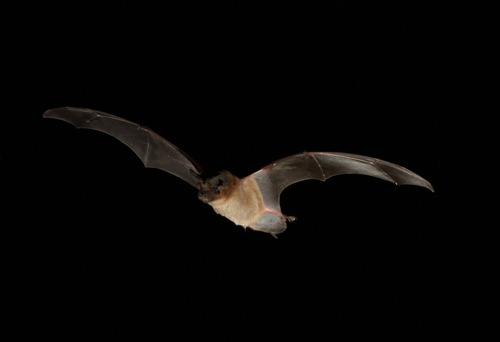
Possesses long, narrow wings adapted for fast, sustained flight in open habitats, enabling efficient aerial insect capture. Echolocation calls are tailored for detecting prey in open or semi-open woodland environments.
Conservation status and numbers
Listed as Least Concern (LC) by IUCN due to a wide distribution range and presumed large population without significant evidence of rapid decline.
Estimated population
Population size is not precisely quantified but is presumed stable across its range given its adaptability and broad distribution.
What threatens the Ansorge's Free-tailed Bat?
Habitat loss from deforestation and agricultural expansion, disturbance of roosting sites, and potential pesticide use reducing insect prey availability.
Diseases and parasites
Susceptible to common bat ectoparasites such as mites and bat flies; specific disease studies for this species are limited but bats broadly can carry various viruses.
What is being done to protect it?
No species-specific conservation programs are known; general protection occurs through habitat conservation in national parks and reserves within its range countries.
Recommended actions
Continued monitoring of population trends, protection of woodland habitats, and further taxonomic and ecological research to better understand this poorly studied species.
What the Ansorge's Free-tailed Bat looks like
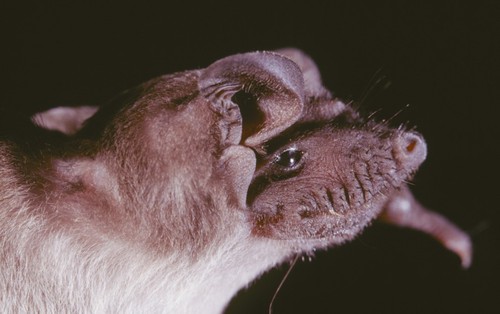
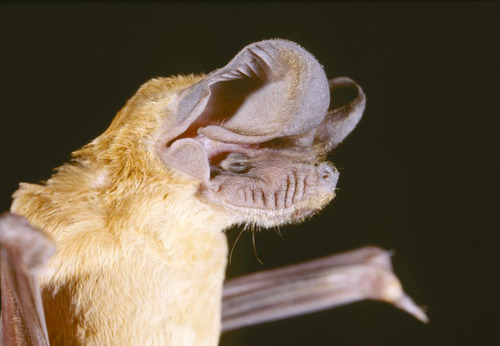
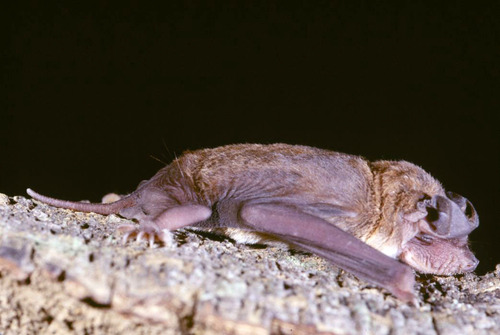
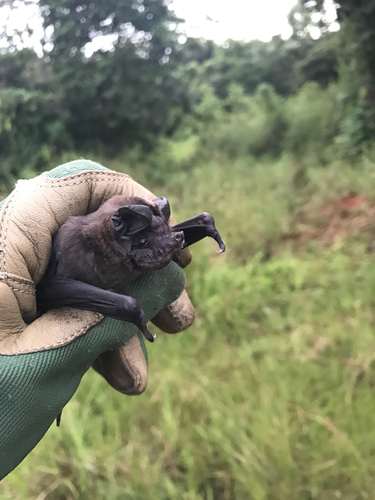
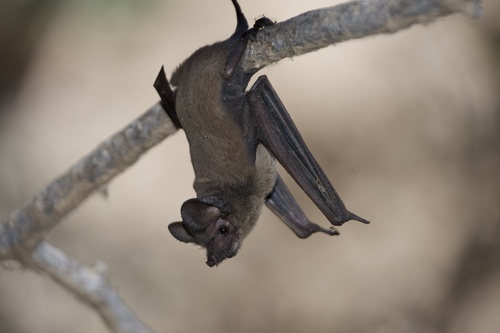
Dark brown to blackish fur covering the body, with a short muzzle and prominent free tail extending beyond the tail membrane. Ears are broad and rounded, typical of molossid bats.
Size
Body length approximately 5-6 cm, with forearm length around 35-40 mm; wingspan estimated at 25-30 cm
Weight
Approximately 8-12 grams
Distinctive features
Distinguished from related Mops species by subtle differences in skull morphology, tooth structure, and echolocation call frequency; requires careful examination for accurate field identification.
Differences between males and females
Minimal sexual dimorphism reported, with males and females similar in size and coloration
Behaviour and diet of the Ansorge's Free-tailed Bat
Likely roosts in small to moderate colonies, as is typical for many Mops species, though specific group size data for this species is limited.
When it is active
Strictly nocturnal, emerging after dusk to forage for flying insects
Diet
Insectivorous, feeding primarily on small flying insects such as moths, beetles, and flies captured in flight
How it feeds and hunts
Uses echolocation to detect and track flying insects in open airspace, employing fast aerial pursuit typical of molossid bats with narrow, pointed wings.
Communication
Communicates through high-frequency echolocation calls used for navigation and prey detection, as well as social vocalizations within roosting groups.
Interactions with other species
Preyed upon by owls, snakes, and small carnivorous mammals; may share roosting sites with other bat species, leading to interspecific competition for roosting space and food resources.
Role in its ecosystem
Plays an important ecological role as a natural insect population controller, helping regulate nocturnal flying insect numbers in its woodland habitat.
Reproduction and lifecycle
Breeding details are not well documented, but likely follows a pattern similar to other tropical Molossidae with births timed to coincide with insect abundance during wet seasons; typically produces a single pup per litter.
Raising the young
Females likely provide sole parental care, nursing and roosting with pups until they are capable of independent flight, a common pattern in molossid bats.
Maturity and lifespan
Sexual maturity likely reached within the first year of life; lifespan estimated at 5-10 years in the wild, consistent with similarly sized molossid bats.
Taxonomy and naming of the Ansorge's Free-tailed Bat
Classification
Class Mammalia > Order Chiroptera > Family Molossidae > Genus Mops > Species Mops ansorgei
Scientific synonyms
Xiphonycteris ansorgei
What research says
Recent studies
Limited recent species-specific research exists; most studies on this species focus on taxonomic classification and distribution records within broader Molossidae surveys.
Compared with similar species
Similar to other Mops species such as Mops condylurus, but distinguishable through minor cranial and dental differences as well as slight variations in body size and coloration.
The Ansorge's Free-tailed Bat and people
This bat can fly at considerable speeds thanks to its narrow wings, a common trait among free-tailed bats. Its free tail, which extends beyond the tail membrane, is a distinctive family trait that aids in flight maneuverability.
Where and how to see it
Best observed at dusk near woodland edges or water sources in Zambia or Angola during the wet season when insect activity is high; bat detectors can help identify their presence through echolocation calls.
Risks to humans
No notable risk; like most bats, it may carry pathogens but poses minimal direct threat to humans if left undisturbed.
Countries where the Ansorge's Free-tailed Bat is recorded
The 5 countries named in the range description of its IUCN Red List assessment.
Questions about the Ansorge's Free-tailed Bat
Where does the Ansorge's Free-tailed Bat live?
The Ansorge's Free-tailed Bat is recorded in Angola, Democratic Republic of the Congo, Malawi, Tanzania and Zambia across Africa. These countries come from the range description of its IUCN Red List assessment, and they are what place the species on the interactive map.
Is the Ansorge's Free-tailed Bat endangered?
The IUCN Red List assesses the Ansorge's Free-tailed Bat as Least Concern. The species is widespread and abundant enough not to qualify for any threatened category. It does not mean the species is safe forever, only that nothing in the current data raises an alarm.
How many are left in the wild?
Population size is not precisely quantified but is presumed stable across its range given its adaptability and broad distribution. This figure comes from the species assessment on the IUCN Red List; population estimates for wild mammals are ranges, not counts, and are revised at each assessment.
What habitat does the Ansorge's Free-tailed Bat live in?
Found in miombo woodland, savanna, and dry forest habitats, often near water sources.
What is the scientific name of the Ansorge's Free-tailed Bat?
The Ansorge's Free-tailed Bat is Mops ansorgei, in the family Molossidae, order Chiroptera.
Other species in the genus Mops


Other species in the family Molossidae
Sources
Conservation status, range description and population estimate come from the IUCN Red List assessment for Mops ansorgei. Countries are derived from that range description, not from a mapped country list. Last refreshed on .
The distribution map is drawn from the IUCN Red List spatial data compiled in 2008. IUCN (International Union for Conservation of Nature)