
Gallagher's Wrinkle-lipped Bat
Mops gallagheri
Red List assessment
Data Deficienton the IUCN Red List
- EXExtinct
- EWExtinct in the Wild
- CRCritically Endangered
- ENEndangered
- VUVulnerable
- NTNear Threatened
- LCLeast Concern
Data Deficient has no position on the scale above — it records the absence of an assessment, not a degree of risk.
The Gallagher's Wrinkle-lipped Bat is recorded in one country, Democratic Republic of the Congo across Africa. The IUCN Red List records the Gallagher's Wrinkle-lipped Bat as Data Deficient. No reliable population estimate exists due to the extreme rarity of records and lack of systematic surveys.
- Family
- Molossidae
- Order
- Chiroptera
- Genus
- Mops
- Countries recorded
- 1
- Continents
- Africa
- Red List category
- Data Deficient
- Data updated
- August 9, 2026
What is the Gallagher's Wrinkle-lipped Bat?
Mops gallagheri, known as Gallagher's Wrinkle-lipped Bat or Molosse du Zaïre in French, is a small free-tailed bat endemic to the forests of the Democratic Republic of Congo. It belongs to the diverse Molossidae family characterized by their distinctive wrinkled lips and fast, agile flight. Due to limited research and few specimen records, this species remains poorly understood, earning it a Data Deficient status from the IUCN. Its remarkable rarity in scientific collections makes it one of the more mysterious African bat species.
Where does the Gallagher's Wrinkle-lipped Bat live?
Democratic Republic of Congo (formerly Zaire), with the species known primarily from lowland forest regions in the Congo Basin.
Endemic to the Democratic Republic of Congo, with historical records concentrated in the central African rainforest zone. The species' range is not fully mapped due to limited survey effort and specimen collection in the region.
Altitude and depth
Likely found in lowland areas, roughly 300-1000m elevation, consistent with typical Congo Basin forest habitats, though precise altitudinal range is undocumented.
Habitat of the Gallagher's Wrinkle-lipped Bat
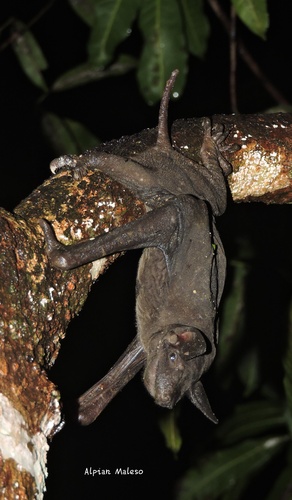
Believed to inhabit lowland tropical and subtropical moist forests typical of the Congo Basin. Like other Molossid bats, it likely roosts in tree hollows, crevices, or under bark in forested areas. Specific habitat preferences remain poorly documented due to scarcity of field observations.
Adaptations to its environment
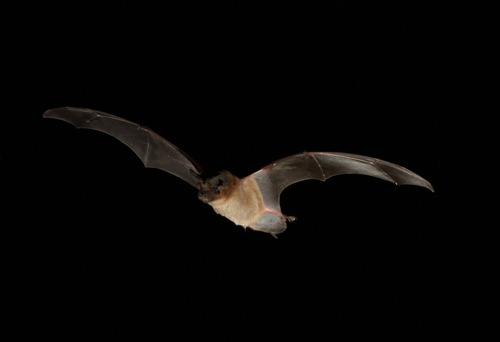
As a molossid bat, it possesses long narrow wings adapted for fast, sustained flight in open spaces above the forest canopy. The wrinkled lips characteristic of the genus may aid in echolocation call production or food handling. Free-tailed bats also have robust jaws suited for crushing hard-bodied insects.
Conservation status and numbers
Listed as Data Deficient (DD) by the IUCN due to insufficient information on population size, distribution, ecology, and threats. Very few specimens have been collected or studied since its description, preventing accurate assessment of conservation status.
Estimated population
No reliable population estimate exists due to the extreme rarity of records and lack of systematic surveys. Population trend is unknown.
What threatens the Gallagher's Wrinkle-lipped Bat?
Potential threats include deforestation and habitat degradation across the Congo Basin due to logging, agricultural expansion, and mining activities. Political instability in the DRC has also historically limited conservation research and enforcement in the region.
What is being done to protect it?
No specific conservation programs target this species directly, though it may benefit incidentally from protected areas within its presumed range, such as national parks in the DRC. Broader Congo Basin forest conservation initiatives could indirectly support its habitat.
Recommended actions
Priority actions include dedicated field surveys to clarify distribution, abundance, and habitat requirements. Genetic and taxonomic studies are needed to confirm species boundaries, along with habitat protection measures within known or suspected range areas.
What the Gallagher's Wrinkle-lipped Bat looks like
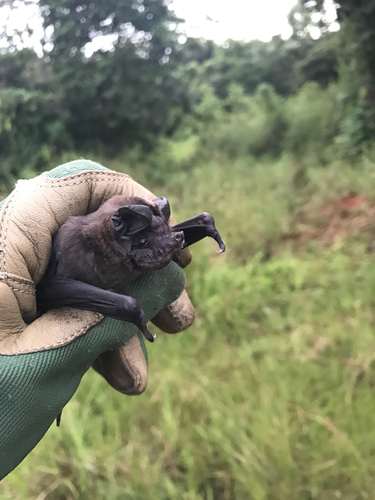
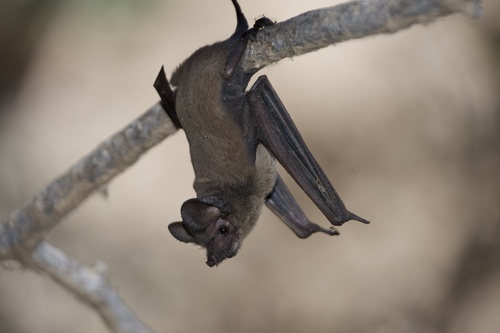
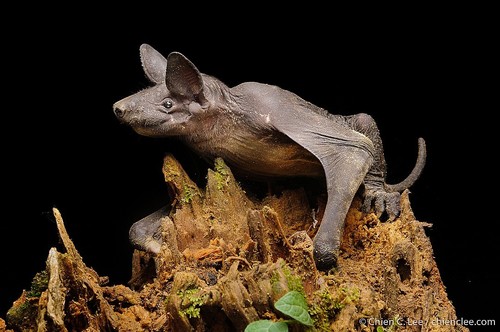
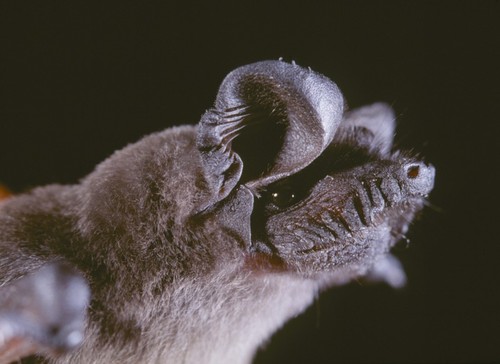
Likely displays typical molossid features: dark brown to blackish short fur, a robust body, and a long tail extending well beyond the tail membrane. The characteristic wrinkled upper lip gives the genus its common name.
Size
Forearm length is estimated at approximately 35-40mm, consistent with other small Mops species; total body length likely ranges from 8-10cm.
Weight
Estimated body weight of approximately 8-15 grams, typical for small molossid bats of similar size.
Distinctive features
Distinguished from closely related Mops species by subtle differences in skull morphology, dental characteristics, and forearm measurements, though these distinctions require expert examination. Field identification is extremely difficult without genetic or detailed morphological analysis.
Behaviour and diet of the Gallagher's Wrinkle-lipped Bat
Presumed to be colonial like most molossid bats, potentially roosting in small to moderate-sized groups in tree cavities or crevices. Specific social structure and group dynamics remain unstudied.
When it is active
Nocturnal, consistent with all bat species, likely emerging at dusk to forage for flying insects above the forest canopy or in clearings.
Diet
Insectivorous, likely feeding on a variety of flying insects such as moths, beetles, and other nocturnal insects typical of molossid bat diets in tropical forest ecosystems.
How it feeds and hunts
Presumably uses echolocation to detect and capture flying insects during fast, agile flight in open airspace above or within forest gaps, consistent with molossid foraging strategies.
Communication
Likely uses echolocation calls for navigation and prey detection, along with social vocalizations for roost communication, similar to related molossid species, though acoustic studies are lacking.
Interactions with other species
Likely predated upon by nocturnal raptors and possibly snakes at roost sites. May compete with other insectivorous bat species for aerial insect prey within its habitat.
Role in its ecosystem
Plays a role as an insectivorous predator, contributing to natural pest control within Congo Basin forest ecosystems by consuming large quantities of flying insects nightly.
Reproduction and lifecycle
Reproductive biology is undocumented for this species; related Mops species typically show seasonal breeding with single pups born after a gestation period of approximately 2-3 months.
Raising the young
Presumed maternal care typical of bats, with females roosting together in maternity colonies and nursing single offspring until weaning, though specific behaviors are unrecorded for this species.
Maturity and lifespan
Age of sexual maturity and lifespan are undocumented, but related molossid bats typically reach maturity within 1 year and can live 5-10 years in the wild.
Taxonomy and naming of the Gallagher's Wrinkle-lipped Bat
Classification
Class Mammalia > Order Chiroptera > Family Molossidae > Genus Mops > Species Mops gallagheri
Scientific synonyms
Previously classified under the genus Chaerephon in some older taxonomic treatments; also referenced as Xiphonycteris gallagheri in historical literature.
What research says
Recent studies
Very few recent studies have focused specifically on this species due to its rarity and the challenges of conducting fieldwork in its range. Molecular phylogenetic studies of the genus Mops may eventually help clarify its taxonomic status and relationships.
Compared with similar species
Closely resembles other small Central African Mops species such as Mops condylurus and Mops thersites, differing primarily in subtle cranial and dental characteristics that require careful comparative analysis to distinguish reliably.
The Gallagher's Wrinkle-lipped Bat and people
This species is named after a researcher named Gallagher and remains one of the least-documented bat species in Africa. Its 'wrinkle-lipped' common name refers to the distinctive folded skin on the upper lip shared by many molossid bats.
Where and how to see it
Due to its rarity and poorly known distribution, dedicated observation is extremely difficult; any sightings would likely require specialized bat surveys in DRC forest regions using mist nets and acoustic monitoring equipment during nocturnal fieldwork.
Risks to humans
No notable risk to humans; like most insectivorous bats, it poses minimal direct threat, though general precautions regarding bat handling and disease transmission (e.g., rabies) should always be observed.
Countries where the Gallagher's Wrinkle-lipped Bat is recorded
The 1 countries named in the range description of its IUCN Red List assessment.
Questions about the Gallagher's Wrinkle-lipped Bat
Where does the Gallagher's Wrinkle-lipped Bat live?
The Gallagher's Wrinkle-lipped Bat is recorded in Democratic Republic of the Congo across Africa. These countries come from the range description of its IUCN Red List assessment, and they are what place the species on the interactive map.
Is the Gallagher's Wrinkle-lipped Bat endangered?
The IUCN Red List assesses the Gallagher's Wrinkle-lipped Bat as Data Deficient. There is not enough information to judge the risk of extinction, usually because the species is rarely seen or has never been surveyed. It is not a reassuring category: several species were Data Deficient right up to the point they were found to be Critically Endangered.
How many are left in the wild?
No reliable population estimate exists due to the extreme rarity of records and lack of systematic surveys. This figure comes from the species assessment on the IUCN Red List; population estimates for wild mammals are ranges, not counts, and are revised at each assessment.
What habitat does the Gallagher's Wrinkle-lipped Bat live in?
Believed to inhabit lowland tropical and subtropical moist forests typical of the Congo Basin.
What is the scientific name of the Gallagher's Wrinkle-lipped Bat?
The Gallagher's Wrinkle-lipped Bat is Mops gallagheri, in the family Molossidae, order Chiroptera.
Other species in the genus Mops

Other species in the family Molossidae
Sources
Conservation status, range description and population estimate come from the IUCN Red List assessment for Mops gallagheri. Countries are derived from that range description, not from a mapped country list. Last refreshed on .
The distribution map is drawn from the IUCN Red List spatial data compiled in 2019. IUCN (International Union for Conservation of Nature)