
Golden Jackal
Canis aureus
Red List assessment
Least Concernon the IUCN Red List
- EXExtinct
- EWExtinct in the Wild
- CRCritically Endangered
- ENEndangered
- VUVulnerable
- NTNear Threatened
- LCLeast Concern
The Golden Jackal is recorded in 12 countries across Africa, Asia and Europe. The IUCN Red List assesses the Golden Jackal as Least Concern. Global population is not precisely quantified but considered large and stable to increasing, with expanding range in Europe; regional estimates in countries like India suggest tens of thousands of individuals.
- Family
- Canidae
- Order
- Carnivora
- Genus
- Canis
- Countries recorded
- 12
- Continents
- Africa, Asia and Europe
- Red List category
- Least Concern
- Data updated
- August 9, 2026
What is the Golden Jackal?
The golden jackal is a medium-sized canid native to Southeast Europe, the Middle East, and South Asia, known for its remarkable adaptability to diverse habitats including agricultural land and human settlements. It has rapidly expanded its range across Europe in recent decades, colonizing new countries. This opportunistic omnivore plays an important ecological role as both predator and scavenger.
Where does the Golden Jackal live?
Southeastern Europe, the Middle East, South Asia, and parts of North and Northeast Africa
Ranges from Southeast Europe (Balkans, Hungary, Italy) through the Middle East (Israel, Turkey, Iran) to South Asia (India, Pakistan, Bangladesh, Myanmar); also found in Egypt and parts of North Africa. Recent range expansion has been documented across Central Europe including Germany, Austria, and Poland.
Altitude and depth
Typically found from sea level up to 2,700 meters, though most populations occur below 1,500 meters elevation.
Seasonal movements
No true hibernation or long-distance migration; however, some populations show seasonal movements related to food availability and breeding season concentrated in winter months.
Habitat of the Golden Jackal
Highly adaptable species found in grasslands, savannas, scrublands, agricultural areas, wetlands, and forest edges; also thrives near human settlements including villages and urban outskirts. Prefers areas with access to water and dense vegetation for cover.
Adaptations to its environment
Highly generalized diet and behavioral flexibility allow exploitation of diverse food sources from small mammals to human refuse. Strong swimming ability and tolerance of extreme temperatures enable survival in both arid and wetland habitats.
Conservation status and numbers
Least Concern (LC) according to IUCN, reflecting a stable to increasing population trend and wide geographic range with no major immediate threats. The species has demonstrated significant range expansion in Europe over the past few decades.
Estimated population
Global population is not precisely quantified but considered large and stable to increasing, with expanding range in Europe; regional estimates in countries like India suggest tens of thousands of individuals.
What threatens the Golden Jackal?
Persecution due to conflict with livestock farmers, habitat loss in some regions, vehicle collisions, and disease transmission from domestic dogs (rabies, canine distemper). Hybridization with domestic dogs is also a concern in some areas.
Diseases and parasites
Susceptible to rabies, canine distemper virus, and various endoparasites including tapeworms and roundworms; can serve as a reservoir host for diseases transmissible to domestic dogs and livestock.
What is being done to protect it?
Protected under various national wildlife laws in range countries; included in CITES Appendix III in some regions. Research and monitoring programs track range expansion in Europe, particularly in Hungary, Serbia, and Bulgaria.
Recommended actions
Continued monitoring of range expansion in Europe, mitigation of human-wildlife conflict through education programs, and management of disease transmission risks from domestic dogs are recommended priorities.
What the Golden Jackal looks like
Golden-yellow to pale gold fur with variations depending on season and habitat, often with darker guard hairs along the back forming a subtle saddle pattern. Bushy tail is typically darker at the tip, and ears are relatively large and pointed.
Size
Body length 70-105 cm (head and body), with tail length 20-30 cm; shoulder height approximately 38-50 cm.
Weight
Adults typically weigh 6-14 kg, with males slightly larger than females on average.
Distinctive features
Distinguished from wolves by smaller size and more pointed muzzle; distinguished from foxes by longer legs and less bushy tail. Golden coloration and habitat preference for open country differentiate it from many sympatric canids.
Differences between males and females
Minimal sexual dimorphism; males are slightly larger and heavier than females but coloration and markings are similar between sexes.
Behaviour and diet of the Golden Jackal
Typically forms monogamous pairs that may be joined by offspring from previous litters, occasionally forming small family groups; less social than wolves with looser pack structures. Territory is defended cooperatively by mated pairs.
When it is active
Primarily nocturnal and crepuscular, though can be active during daylight hours in areas with low human disturbance or abundant food resources.
Diet
Omnivorous diet including small mammals, birds, reptiles, insects, fruits, and carrion; readily scavenges human refuse and agricultural crops. Diet composition varies significantly by season and habitat availability.
How it feeds and hunts
Hunts alone or in pairs using stalking and pouncing techniques for small prey; scavenges opportunistically and may follow larger predators to feed on kill remains. Cooperative hunting in pairs can allow capture of larger prey like young ungulates.
Communication
Communicates through a range of vocalizations including howls, barks, and yips used for territorial announcement and pair bonding; scent marking via urine and feces is important for territory demarcation. Body language including tail position and facial expressions conveys social status and intent.
Interactions with other species
Competes with foxes and smaller carnivores for food resources; may be preyed upon by wolves and large birds of prey in some regions. Often scavenges from larger predator kills and can benefit from human agricultural activities.
Role in its ecosystem
Functions as both predator and scavenger, helping control rodent and insect populations while also playing a role in nutrient cycling through scavenging behavior. Contributes to seed dispersal through fruit consumption.
Reproduction and lifecycle
Breeding season typically occurs in winter (December-March) with gestation lasting approximately 60-63 days; litter size ranges from 2-8 pups, with average of 4. Pups are born in dens dug by the parents or in natural cavities.
Raising the young
Both parents participate in raising young, with the male provisioning food to the female and pups; older siblings from previous litters may assist in pup rearing (helper behavior). Pups are weaned around 8 weeks but remain with parents for several months to learn hunting skills.
Maturity and lifespan
Sexual maturity is typically reached at 10-11 months of age; lifespan in the wild averages 8-9 years, while captive individuals may live up to 14-16 years.
Taxonomy and naming of the Golden Jackal
Classification
Class Mammalia > Order Carnivora > Family Canidae > Genus Canis > Species Canis aureus
Subspecies
Several subspecies recognized including C. a. aureus (Middle East), C. a. indicus (South Asia), C. a. moreotica (Balkans), and C. a. syriacus (Levant), though taxonomy is still debated and some populations previously classified as golden jackal have been reclassified as African golden wolf (Canis anthus).
Scientific synonyms
Canis anthus was formerly considered a subspecies or synonym; some African populations previously called 'golden jackal' are now classified as a separate species.
What research says
Recent studies
Recent genetic research (2015 onward) revealed that African 'golden jackal' populations are actually a distinct species (Canis anthus, African golden wolf), leading to taxonomic revision. Ongoing studies track the species' notable range expansion across Central and Western Europe.
Genome and DNA
Diploid chromosome number is 78 (2n=78), same as other Canis species, facilitating potential hybridization; genetic studies have revealed significant phylogenetic distinction between Eurasian golden jackals and African golden wolves.
Compared with similar species
Similar in general appearance to the African golden wolf but genetically distinct; smaller and less socially complex than the grey wolf, with a more solitary or pair-based social structure compared to wolf packs.
The Golden Jackal and people
Golden jackals have rapidly expanded their range across Europe in the last 50 years, now found as far west as Germany and as far north as Estonia. They are excellent swimmers and have been observed crossing rivers and even swimming in coastal waters to reach islands.
Where and how to see it
Best observed at dawn or dusk in open grasslands or agricultural edges in regions like the Balkans, Israel, or India; using camera traps or joining guided wildlife tours in protected areas increases sighting chances. Listening for their distinctive howling choruses at night can help locate territories.
Risks to humans
Generally low risk to humans; however, as a potential rabies vector in endemic regions, caution should be exercised around unfamiliar or sick-looking animals. Attacks on humans are extremely rare.
Human uses
Historically hunted for fur in some regions, though this is not widespread today; occasionally studied for pest control benefits due to their consumption of agricultural pest species like rodents and insects.
Myths and legends
In South Asian folklore, particularly Indian mythology, the jackal is often portrayed as a clever, cunning trickster figure similar to the fox in Western tales, appearing in numerous fables including the Panchatantra.
Countries where the Golden Jackal is recorded
The 12 countries named in the range description of its IUCN Red List assessment.
Questions about the Golden Jackal
Where does the Golden Jackal live?
The Golden Jackal is recorded in Austria, Bangladesh, Egypt, Germany and Hungary, among 12 countries in total across Africa, Asia and Europe. These countries come from the range description of its IUCN Red List assessment, and they are what place the species on the interactive map.
Is the Golden Jackal endangered?
The IUCN Red List assesses the Golden Jackal as Least Concern. The species is widespread and abundant enough not to qualify for any threatened category. It does not mean the species is safe forever, only that nothing in the current data raises an alarm.
How many are left in the wild?
Global population is not precisely quantified but considered large and stable to increasing, with expanding range in Europe; regional estimates in countries like India suggest tens of thousands of individuals. This figure comes from the species assessment on the IUCN Red List; population estimates for wild mammals are ranges, not counts, and are revised at each assessment.
What habitat does the Golden Jackal live in?
Highly adaptable species found in grasslands, savannas, scrublands, agricultural areas, wetlands, and forest edges; also thrives near human settlements including villages and urban outskirts.
What is the scientific name of the Golden Jackal?
The Golden Jackal is Canis aureus, in the family Canidae, order Carnivora.
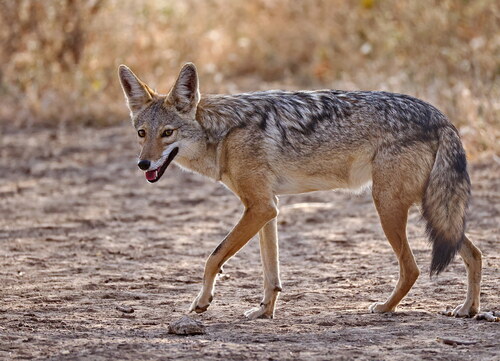
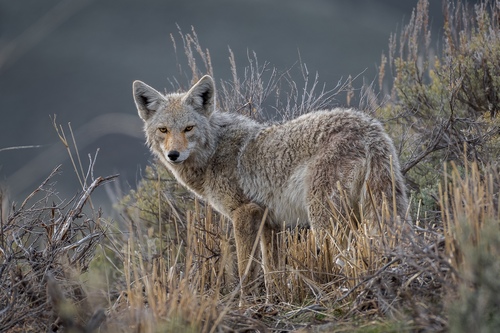
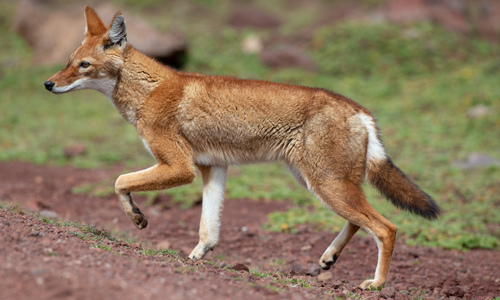
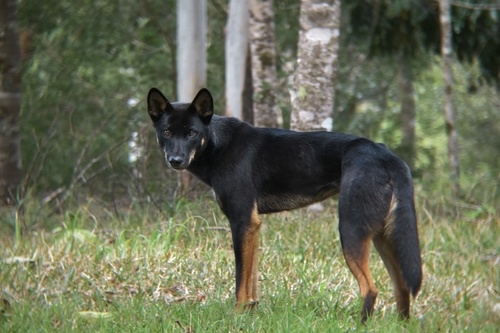
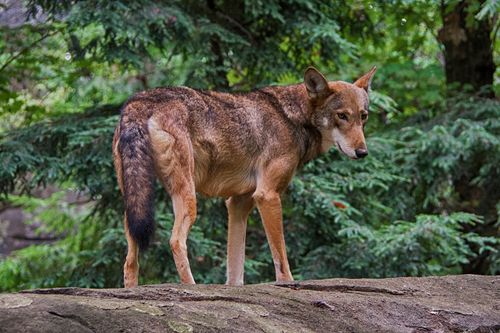
Other species in the genus Canis
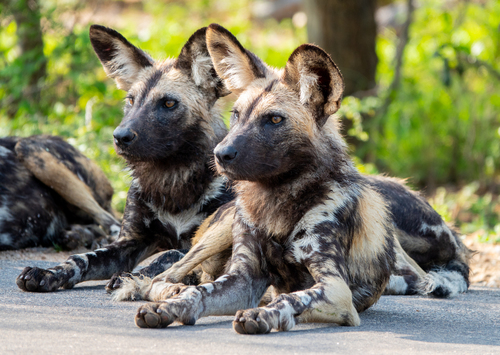
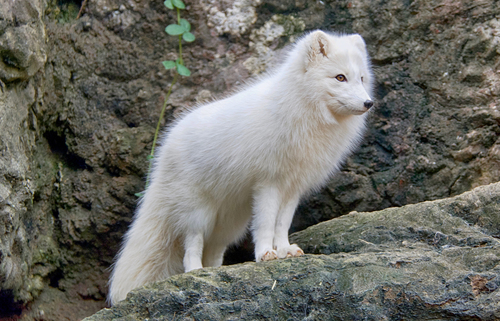
Other species in the family Canidae
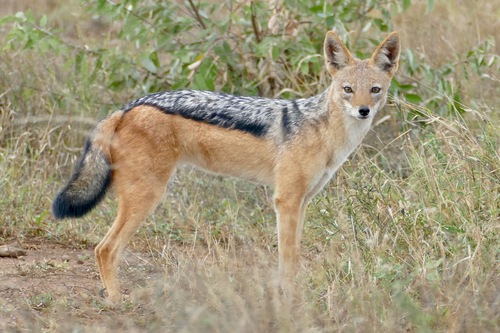
Species that share its range
Sources
Conservation status, range description and population estimate come from the IUCN Red List assessment for Canis aureus. Countries are derived from that range description, not from a mapped country list. Last refreshed on .
The distribution map is drawn from the IUCN Red List spatial data compiled in 2018. IUCN (International Union for Conservation of Nature)