
Ethiopian Wolf
Canis simensis
Red List assessment
Endangeredon the IUCN Red List
- EXExtinct
- EWExtinct in the Wild
- CRCritically Endangered
- ENEndangered
- VUVulnerable
- NTNear Threatened
- LCLeast Concern
The Ethiopian Wolf is recorded in one country, Ethiopia across Africa. The IUCN Red List assesses the Ethiopian Wolf as Endangered. Approximately 500 individuals remaining in the wild, with a declining trend due to periodic disease outbreaks.
- Family
- Canidae
- Order
- Carnivora
- Genus
- Canis
- Countries recorded
- 1
- Continents
- Africa
- Red List category
- Endangered
- Data updated
- August 9, 2026
What is the Ethiopian Wolf?
The Ethiopian wolf is Africa's most endangered carnivore and the only wolf species endemic to Africa. It inhabits high-altitude Afroalpine grasslands of the Ethiopian Highlands, isolated on mountain 'islands' surrounded by lower, human-dominated terrain. Its slender, fox-like build and specialized diet of rodents make it ecologically distinct among wolves. It is remarkable for surviving in extreme isolation with very small, fragmented populations.
Where does the Ethiopian Wolf live?
Ethiopia (Ethiopian Highlands)
Restricted to seven isolated mountain ranges in Ethiopia, including the Bale Mountains, Simien Mountains, Arsi Mountains, and Guassa-Menz area; entire range confined to the Ethiopian Highlands.
Altitude and depth
3,000–4,500 meters above sea level
Seasonal movements
No long-distance migration; some seasonal shifts in rodent activity influence hunting patterns, and breeding is timed to coincide with rodent abundance peaks.
Habitat of the Ethiopian Wolf
Afroalpine grasslands and heathlands above the tree line, characterized by short grasses, herbs, and giant lobelia; also found in moorlands with sparse vegetation.
Adaptations to its environment
Long legs and slender snout adapted for digging out burrowing rodents; thick reddish coat provides insulation against cold highland temperatures; excellent hearing and vision aid in locating prey in open grassland.
Conservation status and numbers
Endangered (EN) according to IUCN, due to small, fragmented population size, restricted range, and ongoing threats from disease and habitat loss.
Estimated population
Approximately 500 individuals remaining in the wild, with a declining trend due to periodic disease outbreaks.
What threatens the Ethiopian Wolf?
Rabies and canine distemper outbreaks from domestic dogs, habitat degradation from overgrazing and agricultural expansion, hybridization with domestic dogs, and human persecution.
Diseases and parasites
Highly susceptible to rabies and canine distemper virus transmitted from domestic dogs; also affected by mange and other canine parasites.
What is being done to protect it?
Ethiopian Wolf Conservation Programme conducts vaccination campaigns for domestic dogs, disease monitoring, and community education; protected areas include Bale Mountains National Park and Simien Mountains National Park.
Recommended actions
Expand rabies/distemper vaccination of domestic dogs, strengthen habitat protection and connectivity between populations, control free-ranging dog populations, and increase community engagement in conservation.
What the Ethiopian Wolf looks like
Reddish-tawny coat with white underparts, throat, and chest markings; black tail tip; long, pointed muzzle resembling a small wolf or jackal.
Size
Body length 84–101 cm, with a tail of 27–40 cm; shoulder height approximately 53–62 cm.
Weight
Males 14.2–19.3 kg; females 11.2–14.15 kg, showing moderate sexual size dimorphism.
Distinctive features
Distinguished from jackals by larger size, more elongated muzzle, and distinctive white markings on throat and legs; resembles a small, slender wolf rather than a jackal despite superficial similarities.
Differences between males and females
Males are notably larger and heavier than females, though coloration is similar between sexes.
Behaviour and diet of the Ethiopian Wolf
Lives in cohesive packs of 3–13 individuals that defend territories communally, but hunts alone or in pairs due to solitary foraging on small rodents.
When it is active
Diurnal, most active during daylight hours when rodent prey is most active above ground.
Diet
Primarily carnivorous, feeding on rodents such as big-headed mole rats and grass rats; occasionally scavenges or eats young hares.
How it feeds and hunts
Solitary stalking and pouncing technique, using stealth to approach rodent burrows before a quick pounce; occasionally digs to extract prey from burrows.
Communication
Uses vocalizations including howls, yips, and growls for territory defense and pack coordination; scent marking via urine and feces establishes territorial boundaries.
Interactions with other species
Competes with domestic dogs for space and is vulnerable to disease transmission from them; occasionally interacts with birds of prey and other rodent predators sharing similar prey base.
Role in its ecosystem
Functions as a specialized apex predator of Afroalpine ecosystems, helping regulate rodent populations and maintaining grassland health.
Reproduction and lifecycle
Breeding season occurs once yearly, typically August–November; gestation lasts about 60–63 days, producing litters of 2–6 pups.
Raising the young
Pups are raised communally within the pack, with subordinate pack members helping to guard and feed young; weaning occurs around 5–10 weeks, with pups becoming independent by around one year.
Maturity and lifespan
Sexual maturity reached at about 2 years; lifespan in the wild averages 8–9 years, with limited data on captivity due to rarity in captive settings.
Taxonomy and naming of the Ethiopian Wolf
Classification
Mammalia > Carnivora > Canidae > Canis > Canis simensis
Scientific synonyms
Simenia simensis; formerly considered a jackal (Canis simensis was once called 'Simien jackal' or 'Simien fox')
What research says
Recent studies
Recent research has focused on disease dynamics and vaccine efficacy in preventing rabies outbreaks, as well as landscape genetics to assess population connectivity and hybridization risk.
Genome and DNA
Genetic studies reveal significant hybridization with domestic dogs in some populations, prompting conservation concern over genetic integrity; diploid chromosome number similar to other Canis species (78).
Compared with similar species
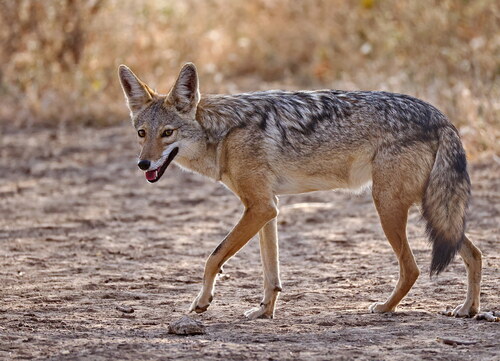
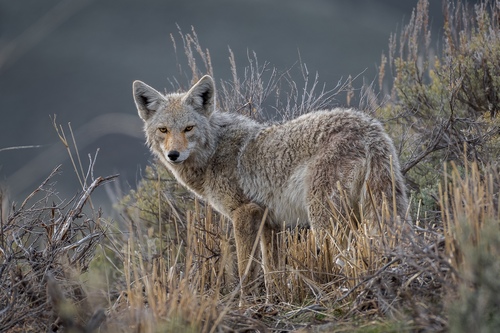
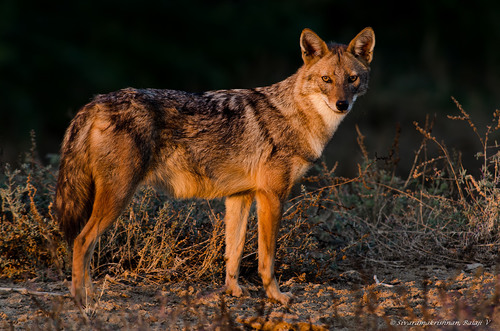
Similar in general form to golden jackals and coyotes but larger and more specialized for high-altitude rodent hunting; unlike gray wolves, it is a solitary hunter despite social pack structure.
The Ethiopian Wolf and people
The Ethiopian wolf is the rarest canid in the world and the only wolf species found in Africa; it has been observed licking nectar from Ethiopian red hot poker flowers, making it an incidental pollinator.
Where and how to see it
Best observed in Bale Mountains National Park, particularly the Sanetti Plateau, during early morning or late afternoon when wolves are most active hunting rodents.
Risks to humans
No notable risk to humans; the species is shy and avoids human contact, though it can be a vector for rabies if infected.
Human uses
No significant direct human use; primarily valued for ecotourism and scientific research on Afroalpine ecosystem conservation.
Myths and legends
In some local Ethiopian traditions, the wolf is viewed with a mix of fear and respect due to its association with high mountain wilderness, though it lacks the extensive folklore surrounding gray wolves elsewhere.
Countries where the Ethiopian Wolf is recorded
The 1 countries named in the range description of its IUCN Red List assessment.
Questions about the Ethiopian Wolf
Where does the Ethiopian Wolf live?
The Ethiopian Wolf is recorded in Ethiopia across Africa. These countries come from the range description of its IUCN Red List assessment, and they are what place the species on the interactive map.
Is the Ethiopian Wolf endangered?
Yes. The IUCN Red List assesses the Ethiopian Wolf as Endangered, one of the three threatened categories. The species faces a very high risk of extinction in the wild — a step below Critically Endangered, but still on a trajectory that ends badly without intervention.
How many are left in the wild?
Approximately 500 individuals remaining in the wild, with a declining trend due to periodic disease outbreaks. This figure comes from the species assessment on the IUCN Red List; population estimates for wild mammals are ranges, not counts, and are revised at each assessment.
What habitat does the Ethiopian Wolf live in?
Afroalpine grasslands and heathlands above the tree line, characterized by short grasses, herbs, and giant lobelia; also found in moorlands with sparse vegetation.
What is the scientific name of the Ethiopian Wolf?
The Ethiopian Wolf is Canis simensis, in the family Canidae, order Carnivora.
Other species in the genus Canis
Other species in the family Canidae
Species that share its range
Sources
Conservation status, range description and population estimate come from the IUCN Red List assessment for Canis simensis. Countries are derived from that range description, not from a mapped country list. Last refreshed on .
The distribution map is drawn from the IUCN Red List spatial data compiled in 2008. IUCN (International Union for Conservation of Nature)