
African Manatee
Trichechus senegalensis
Red List assessment
Vulnerableon the IUCN Red List
- EXExtinct
- EWExtinct in the Wild
- CRCritically Endangered
- ENEndangered
- VUVulnerable
- NTNear Threatened
- LCLeast Concern
The African Manatee is recorded in 10 countries across Africa. The IUCN Red List assesses the African Manatee as Vulnerable. Estimated at fewer than 10,000 mature individuals, with a declining population trend across most of its range.
- Family
- Trichechidae
- Order
- Sirenia
- Genus
- Trichechus
- Countries recorded
- 10
- Continents
- Africa
- Red List category
- Vulnerable
- Data updated
- August 9, 2026
What is the African Manatee?
The African manatee is a large aquatic herbivorous mammal found in coastal marine, estuarine, and freshwater habitats along the west coast of Africa. It is closely related to the American manatee but is adapted to both freshwater rivers and brackish/saltwater coastal zones. Remarkable for its gentle nature and role as an ecosystem engineer in aquatic vegetation, it remains one of the least studied sirenians due to the remoteness and turbidity of its habitat. It is often called a 'sea cow' due to its grazing habits.
Where does the African Manatee live?
Coastal and riverine West and Central Africa, from Senegal to Angola
Ranges along the Atlantic coast of West and Central Africa, from the Senegal River south to the Kwanza River in Angola, including major river systems such as the Niger, Volta, and Congo basins. Found in at least 21 countries including Senegal, Guinea-Bissau, Ivory Coast, Ghana, Nigeria, Cameroon, Gabon, and Angola. Populations are fragmented and patchily distributed.
Altitude and depth
0-10m, typically shallow coastal and riverine waters
Seasonal movements
Some populations exhibit seasonal movements linked to water levels, moving into rivers during rainy seasons and retreating to deeper channels or estuaries during dry seasons.
Habitat of the African Manatee
Inhabits coastal marine waters, estuaries, mangrove-lined lagoons, and slow-moving freshwater rivers and lakes with abundant aquatic vegetation. Prefers warm, shallow waters with access to freshwater sources for drinking and salinity regulation. Also found in man-made reservoirs and irrigation canals in some regions.
Adaptations to its environment
Possesses a streamlined body, paddle-like flippers, and a flattened tail fluke for efficient swimming in both fresh and saltwater. Has specialized kidneys allowing tolerance of varying salinity levels, and thick blubber layer for buoyancy and insulation. Prehensile, bristled upper lip aids in grasping and manipulating aquatic vegetation.
Conservation status and numbers
Listed as Vulnerable by IUCN due to ongoing population decline caused by hunting, habitat degradation, and incidental bycatch, though precise population trends are difficult to quantify due to limited data across its range.
Estimated population
Estimated at fewer than 10,000 mature individuals, with a declining population trend across most of its range.
What threatens the African Manatee?
Major threats include hunting for meat and bushmeat trade, incidental capture in fishing nets, habitat destruction from damming and pollution, and boat strikes. Coastal development and oil exploration in the Gulf of Guinea also degrade critical habitats.
Diseases and parasites
Susceptible to skin lesions, parasitic infections from barnacles and algae, and occasionally bacterial infections; specific pathogen studies remain limited compared to other manatee species.
What is being done to protect it?
Protected under CITES Appendix I and national wildlife laws in several range states; some countries have established marine protected areas and manatee sanctuaries, such as in Guinea-Bissau and Gabon. Conservation NGOs conduct community-based awareness programs and bycatch mitigation projects.
Recommended actions
Strengthen enforcement of anti-poaching laws, expand protected riverine and coastal habitats, reduce bycatch through fishing gear modifications, and increase regional research and monitoring collaboration. Community engagement and alternative livelihood programs are also critical to reduce hunting pressure.
What the African Manatee looks like
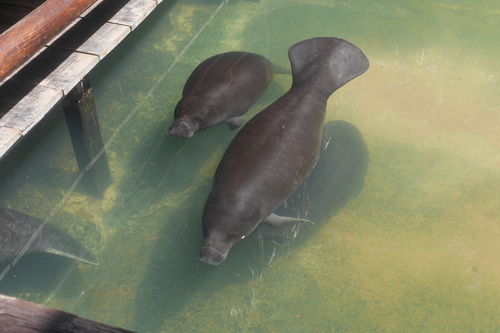
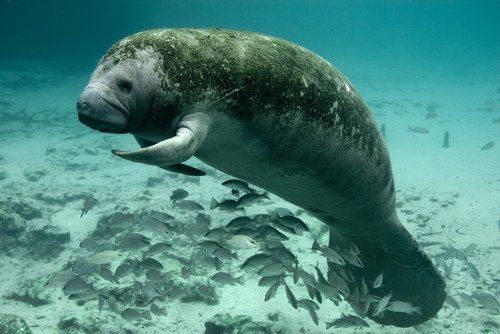
Has a robust, fusiform body covered in thick, wrinkled gray to brownish-gray skin, often with algae growth. The head is small relative to the body, with a blunt snout and a flexible, whiskered upper lip. Flippers are paddle-shaped with vestigial nails, and the tail ends in a broad, rounded paddle-like fluke.
Size
Adults typically measure 3 to 4 meters in body length.
Weight
Adults generally weigh between 350 and 500 kg, with some individuals reaching up to 600 kg.
Distinctive features
Distinguished from the American manatee by subtle skull and dental differences, and from the dugong by its paddle-shaped tail (versus the dugong's fluked, whale-like tail) and different snout orientation. Its skin often appears more mottled due to algae and barnacle growth in coastal waters.
Differences between males and females
Minimal sexual dimorphism; females tend to be slightly larger than males on average.
Behaviour and diet of the African Manatee
Generally solitary or found in small, loose groups of 2-6 individuals, though larger aggregations may form at feeding or resting sites. Social bonds are weakest outside of mother-calf pairs, though individuals may show gregarious behavior in favorable habitats.
When it is active
Primarily diurnal and crepuscular, though activity can occur at any time; spends much of the day feeding, resting, and traveling between feeding grounds.
Diet
Strict herbivore feeding on a wide variety of aquatic and semi-aquatic vegetation, including mangrove leaves, floating and submerged grasses, and overhanging riparian vegetation. Can consume up to 4-9% of its body weight in vegetation daily.
Communication
Communicates through low-frequency vocalizations such as chirps, squeaks, and grunts, especially between mothers and calves. Body contact and touch also play a role in social interactions.
Interactions with other species
Has few natural predators, though large crocodiles and sharks may occasionally prey on calves or weakened individuals. Often coexists with fish species that clean algae from its skin, and interacts indirectly with human fisheries through habitat overlap and bycatch.
Role in its ecosystem
Plays an important ecological role as a grazer of aquatic vegetation, helping maintain healthy waterway ecosystems and channel flow by preventing overgrowth of plants. Its foraging can influence nutrient cycling and vegetation structure in mangroves and rivers.
Reproduction and lifecycle
Breeding can occur year-round with possible peaks tied to rainy seasons; gestation lasts approximately 12-13 months, typically resulting in a single calf. Calving intervals are usually 2-3 years.
Raising the young
Calves are cared for exclusively by the mother, nursing for 1-2 years while also learning to forage on vegetation. The mother-calf bond is strong, with calves often staying close to the mother during early development for protection and guidance.
Maturity and lifespan
Reaches sexual maturity around 3-5 years of age; lifespan in the wild is estimated at 30-40 years, potentially longer in captivity.
Taxonomy and naming of the African Manatee
Classification
Class Mammalia > Order Sirenia > Family Trichechidae > Genus Trichechus > Species Trichechus senegalensis
Scientific synonyms
Manatus senegalensis (Link, 1795)
What research says
Recent studies
Recent research using satellite tagging and environmental DNA (eDNA) sampling has begun to reveal previously unknown movement patterns and habitat use across fragmented West African river systems.
Genome and DNA
Genetic studies indicate a diploid chromosome number similar to other Trichechus species (2n=48/56 varies by source), though comprehensive genomic studies remain limited.
Compared with similar species
Similar in size and ecology to the American manatee (Trichechus manatus) and Amazonian manatee (Trichechus inunguis), but distinguished by its West African range and slightly different skull morphology. Unlike the dugong, it inhabits both fresh and saltwater and has a rounded rather than fluked tail.
The African Manatee and people
African manatees can hold their breath for up to 20 minutes while resting, though they typically surface every few minutes while active. Despite their bulk, they are graceful swimmers capable of somersaults and rolls in the water. They are one of the few large mammals able to move seamlessly between fresh and saltwater habitats.
Where and how to see it
Best observed in protected estuaries and river mouths of Guinea-Bissau, Gabon, and Senegal during calm early morning hours when the water is clear and manatees surface to breathe. Boat-based eco-tours in select protected areas offer the most reliable, low-disturbance viewing opportunities.
Risks to humans
No notable risk to humans; the species is docile and non-aggressive.
Human uses
Historically and currently hunted for meat, oil, and hides in parts of its range, and occasionally used in traditional medicine practices; also valued as an ecotourism attraction in some conservation areas.
Myths and legends
In parts of West Africa, manatees are associated with water spirits and folklore, sometimes considered sacred or taboo to hunt in certain communities, believed to bring misfortune if harmed.
Countries where the African Manatee is recorded
The 10 countries named in the range description of its IUCN Red List assessment.
Questions about the African Manatee
Where does the African Manatee live?
The African Manatee is recorded in Angola, Cameroon, Democratic Republic of the Congo, Gabon and Ghana, among 10 countries in total across Africa. These countries come from the range description of its IUCN Red List assessment, and they are what place the species on the interactive map.
Is the African Manatee endangered?
Yes. The IUCN Red List assesses the African Manatee as Vulnerable, one of the three threatened categories. The species faces a high risk of extinction in the wild. It is the first of the three threatened categories: numbers are falling, the range is shrinking, or the population is small enough that a single bad event could do lasting damage.
How many are left in the wild?
Estimated at fewer than 10,000 mature individuals, with a declining population trend across most of its range. This figure comes from the species assessment on the IUCN Red List; population estimates for wild mammals are ranges, not counts, and are revised at each assessment.
What habitat does the African Manatee live in?
Inhabits coastal marine waters, estuaries, mangrove-lined lagoons, and slow-moving freshwater rivers and lakes with abundant aquatic vegetation.
What is the scientific name of the African Manatee?
The African Manatee is Trichechus senegalensis, in the family Trichechidae, order Sirenia.
Other species in the genus Trichechus
Species that share its range

Sources
Conservation status, range description and population estimate come from the IUCN Red List assessment for Trichechus senegalensis. Countries are derived from that range description, not from a mapped country list. Last refreshed on .
The distribution map is drawn from the IUCN Red List spatial data compiled in 2015. IUCN (International Union for Conservation of Nature)