
Gansu Hamster
Cansumys canus
Red List assessment
Least Concernon the IUCN Red List
- EXExtinct
- EWExtinct in the Wild
- CRCritically Endangered
- ENEndangered
- VUVulnerable
- NTNear Threatened
- LCLeast Concern
The Gansu Hamster is recorded in one country, China across Asia. The IUCN Red List assesses the Gansu Hamster as Least Concern. No precise population estimate exists; the population is presumed stable given its broad distribution and lack of significant documented declines.
- Family
- Cricetidae
- Order
- Rodentia
- Genus
- Cansumys
- Countries recorded
- 1
- Continents
- Asia
- Red List category
- Least Concern
- Data updated
- August 9, 2026
What is the Gansu Hamster?
The Gansu hamster is a small, monotypic rodent endemic to central China, notable for being the sole species in its genus Cansumys. It inhabits rocky, arid, and semi-arid regions of the Loess Plateau and surrounding mountains. Little is known about its ecology compared to other hamsters, making it a somewhat mysterious member of the Cricetidae family. Its restricted range and specialized habitat preferences make it an interesting subject for biogeographic studies of Chinese rodents.
Where does the Gansu Hamster live?
Central China, primarily Gansu, Shaanxi, Ningxia, Sichuan and Hubei provinces
Endemic to central China, with populations recorded in Gansu, Shaanxi, Ningxia, Sichuan, and Hubei provinces. Its range is centered on the Loess Plateau and adjacent mountain ranges in the transition zone between northern and southern China.
Altitude and depth
Typically found at elevations ranging from 500 to 2500 meters above sea level.
Seasonal movements
Likely undergoes reduced activity or torpor during cold winter months typical of temperate rodents, though detailed seasonal studies are lacking.
Habitat of the Gansu Hamster
Found in arid and semi-arid rocky habitats, including rocky outcrops, scrubland, and mountainous terrain with sparse vegetation. Also occurs in agricultural areas and grasslands bordering rocky hillsides. Prefers well-drained substrates suitable for burrowing.
Adaptations to its environment
Possesses cheek pouches for food transport and storage, an adaptation shared with other hamsters for exploiting patchy food resources. Burrowing behavior provides protection from temperature extremes and predators in its rocky habitat. Nocturnal habits help avoid daytime heat and predation.
Conservation status and numbers
Listed as Least Concern (LC) by the IUCN due to its relatively wide distribution across multiple Chinese provinces and presumed stable population, despite limited specific population data.
Estimated population
No precise population estimate exists; the population is presumed stable given its broad distribution and lack of significant documented declines.
What threatens the Gansu Hamster?
Habitat degradation from agricultural expansion and land conversion poses the main threat. Localized threats may include rodenticide use in farming areas where the species overlaps with agricultural land.
What is being done to protect it?
No species-specific conservation programs are currently known; the species may benefit indirectly from protected areas within its range in Gansu and Sichuan provinces.
Recommended actions
Further field surveys are needed to better understand population trends and habitat requirements. Monitoring of agricultural expansion in key range areas would help assess potential future threats.
What the Gansu Hamster looks like
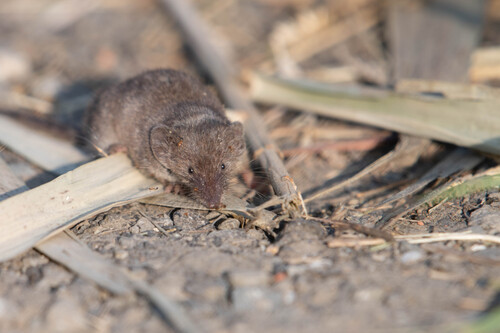
The fur is grayish to grayish-brown on the dorsal side with a lighter, whitish-gray underside, giving rise to the species name 'canus' meaning gray. It has a compact, rounded body typical of hamsters, with small rounded ears and short limbs.
Size
Body length approximately 9-12 cm, with a relatively short tail of about 2-3 cm.
Weight
Estimated weight range of 20-40 grams, typical for small cricetid rodents.
Distinctive features
Distinguished from related Cricetulus species by distinct cranial and dental morphology that led to its classification in a separate monotypic genus. Its grayish coloration and specific skull structure differentiate it from other Chinese hamster species.
Behaviour and diet of the Gansu Hamster
Believed to be largely solitary, consistent with the social behavior of most hamster species, though detailed behavioral studies are scarce.
When it is active
Presumed to be primarily nocturnal or crepuscular, similar to other hamster species, though specific activity pattern studies are limited.
Diet
Omnivorous diet likely consisting of seeds, grains, and other plant material, supplemented occasionally with insects, typical of hamster feeding ecology.
Communication
Likely uses scent marking and simple vocalizations for communication, consistent with other hamster species, though specific studies are lacking.
Interactions with other species
Likely preyed upon by small carnivorous mammals, raptors, and snakes native to its rocky habitat range. May compete with other small rodents for food resources in shared habitats.
Role in its ecosystem
Plays a role in local ecosystems as a seed disperser and prey species, contributing to the food web of central China's rocky and semi-arid habitats.
Reproduction and lifecycle
Breeding biology is poorly documented, but likely follows the general hamster pattern with multiple litters per year, short gestation periods of about 18-21 days, and moderate litter sizes.
Raising the young
Presumed maternal care is provided by the female alone, as is typical in hamsters, with pups nursed and weaned within a few weeks of birth.
Maturity and lifespan
Sexual maturity is likely reached within 2-3 months, consistent with other hamster species; lifespan in the wild is probably 1-2 years, potentially longer in captivity.
Taxonomy and naming of the Gansu Hamster
Classification
Class Mammalia > Order Rodentia > Family Cricetidae > Genus Cansumys > Species Cansumys canus
Scientific synonyms
Cricetulus canus (formerly placed in genus Cricetulus before being assigned its own monotypic genus Cansumys)
What research says
Recent studies
Recent taxonomic and phylogenetic studies have focused on clarifying its relationship to other Cricetidae genera, confirming its distinct generic status through morphological analysis.
Genome and DNA
Limited genetic studies exist; taxonomic revisions using morphological and some molecular data support its placement as a distinct monotypic genus separate from Cricetulus.
Compared with similar species
Similar in general appearance to other Chinese hamsters like Cricetulus species, but distinguished by unique cranial features and its restricted, specialized rocky habitat preference.
The Gansu Hamster and people
The Gansu hamster is the only species in its entire genus, making it a taxonomic curiosity among rodents. Despite being classified over a century ago, relatively little is known about its behavior and ecology compared to more common hamster species like the golden hamster.
Where and how to see it
Best observed at dusk or night in rocky, semi-arid habitats of Gansu or Shaanxi provinces, though sightings are rare due to its cryptic and understudied nature. Patience and knowledge of local rocky outcrop habitats would be needed for any observation attempt.
Risks to humans
No notable risk to humans.
Countries where the Gansu Hamster is recorded
The 1 countries named in the range description of its IUCN Red List assessment.
Questions about the Gansu Hamster
Where does the Gansu Hamster live?
The Gansu Hamster is recorded in China across Asia. These countries come from the range description of its IUCN Red List assessment, and they are what place the species on the interactive map.
Is the Gansu Hamster endangered?
The IUCN Red List assesses the Gansu Hamster as Least Concern. The species is widespread and abundant enough not to qualify for any threatened category. It does not mean the species is safe forever, only that nothing in the current data raises an alarm.
How many are left in the wild?
No precise population estimate exists; the population is presumed stable given its broad distribution and lack of significant documented declines. This figure comes from the species assessment on the IUCN Red List; population estimates for wild mammals are ranges, not counts, and are revised at each assessment.
What habitat does the Gansu Hamster live in?
Found in arid and semi-arid rocky habitats, including rocky outcrops, scrubland, and mountainous terrain with sparse vegetation.
What is the scientific name of the Gansu Hamster?
The Gansu Hamster is Cansumys canus, in the family Cricetidae, order Rodentia.
Other species in the family Cricetidae
Species that share its range
Sources
Conservation status, range description and population estimate come from the IUCN Red List assessment for Cansumys canus. Countries are derived from that range description, not from a mapped country list. Last refreshed on .
The distribution map is drawn from the IUCN Red List spatial data compiled in 2008. IUCN (International Union for Conservation of Nature)