
Eversmann's Hamster
Allocricetulus eversmanni
Red List assessment
Least Concernon the IUCN Red List
- EXExtinct
- EWExtinct in the Wild
- CRCritically Endangered
- ENEndangered
- VUVulnerable
- NTNear Threatened
- LCLeast Concern
The Eversmann's Hamster is recorded in 3 countries across Asia and Europe. The IUCN Red List assesses the Eversmann's Hamster as Least Concern. No precise global population estimate is available; the species is considered locally common to abundant across suitable steppe habitats in Kazakhstan.
- Family
- Cricetidae
- Order
- Rodentia
- Genus
- Allocricetulus
- Countries recorded
- 3
- Continents
- Asia and Europe
- Red List category
- Least Concern
- Data updated
- August 9, 2026
What is the Eversmann's Hamster?
Eversmann's Hamster is a small, stocky rodent of the family Cricetidae, named after the German-Russian naturalist Eduard Friedrich Eversmann. It inhabits open steppe, semi-desert, and grassland ecosystems of Central Asia, particularly across Kazakhstan and adjacent southern Russia. It is one of only two species in the genus Allocricetulus, the other being the Mongolian Hamster (A. curtatus). Notable for its large cheek pouches, burrowing lifestyle, and capacity for winter hibernation, it is well adapted to the extreme seasonal climate of the Eurasian steppes.
Where does the Eversmann's Hamster live?
Primarily Kazakhstan and southwestern Russia (southern Siberia, Ural and Volga-Ural steppes); marginally in northwestern China (Xinjiang)
Widespread across Kazakhstan from the Ural River eastward through the Kazakh steppe and into the Balkhash Basin. Extends into the southern steppe zones of Russia (Orenburg, Chelyabinsk, and adjacent Siberian oblasts) and marginally into the Xinjiang region of northwestern China.
Altitude and depth
Primarily lowland and plateau habitats, typically between 100 and 900 m above sea level, following the steppe belt of Central Asia.
Seasonal movements
Undergoes true hibernation from approximately November to March, entering dormancy in its burrow after accumulating fat reserves and food caches. Activity peaks in spring and summer, with reproductive activity concentrated between April and August.
Habitat of the Eversmann's Hamster
Primarily dry and semi-arid steppes, shortgrass plains, and shrub-steppes. Also found in agricultural margins, fallow fields, and sandy semi-deserts. Prefers open terrain with loose or sandy soils suitable for burrow construction.
Adaptations to its environment
Possesses large, elastic cheek pouches capable of carrying significant quantities of seeds back to underground larders. Its compact, rounded body and thick fur provide insulation against harsh continental winters. Burrowing behavior protects it from temperature extremes and predators, and its kidneys are adapted to conserve water in arid conditions.
Conservation status and numbers
Least Concern (LC) on the IUCN Red List. The species has a wide distribution and is considered relatively common across much of its range, with no evidence of major rapid population decline sufficient to warrant a more threatened category.
Estimated population
No precise global population estimate is available; the species is considered locally common to abundant across suitable steppe habitats in Kazakhstan. Population trend is presumed stable overall, though local declines occur in heavily farmed areas.
What threatens the Eversmann's Hamster?
Agricultural intensification and conversion of native steppe to cropland reduce available habitat and food diversity. Rodenticide use in agri-pest control programs may cause direct mortality. Overgrazing by livestock can degrade steppe grassland quality. Climate-driven shifts in steppe vegetation composition may affect food availability long-term.
Diseases and parasites
Like other Central Asian rodents, it may act as a reservoir host for plague (Yersinia pestis) and is known to harbor ectoparasites including fleas (e.g., Xenopsylla species) and ticks. Endoparasitic helminths have also been recorded. Its role in disease ecology in the Central Asian steppe warrants periodic monitoring.
What is being done to protect it?
The species benefits incidentally from protected areas within its range, including steppe reserves in Kazakhstan (e.g., Naurzum Nature Reserve) and Russia (e.g., Orenburg State Nature Reserve). No species-specific conservation programs are currently in place given its Least Concern status.
Recommended actions
Long-term population monitoring across the steppe belt is advisable to detect any declines. Promotion of integrated pest management practices to reduce reliance on broad-spectrum rodenticides. Maintenance and expansion of steppe nature reserves to preserve habitat integrity.
What the Eversmann's Hamster looks like
Dorsal fur is sandy-brown to ochraceous-buff, often with a faint grayish tinge. The underparts are pale gray to whitish. The demarcation between dorsal and ventral coloration is relatively sharp. The tail is short and bicolored. The cheek pouches are prominent when filled.
Size
Body length 14–18 cm; tail short, 2–4 cm. Ears short and rounded. Overall body proportions are more robust than Cricetulus hamsters.
Weight
Typically 40–90 g; adults can reach up to 100 g prior to hibernation after significant fat accumulation.
Distinctive features
Distinguished from the related Mongolian Hamster (Allocricetulus curtatus) by its larger body size, more ochraceous (warm buff) dorsal color, and broader geographic range extending further west. Compared to Cricetulus species, it has a stouter build and more developed cheek pouches.
Differences between males and females
Sexual dimorphism is minimal; males and females are similar in size and coloration. Males may be marginally larger on average, but this is not reliably distinguishable in the field.
Behaviour and diet of the Eversmann's Hamster
Solitary and territorial outside of the breeding season. Individuals maintain and defend individual burrow systems. Brief social contact occurs during mating; females are solely responsible for raising young.
When it is active
Primarily nocturnal and crepuscular. Activity peaks occur around dusk and before dawn, reducing exposure to diurnal predators. During summer, some activity may extend into cooler daytime hours.
Diet
Omnivorous, with a diet dominated by seeds, grains, roots, and green plant matter. Supplements plant material with invertebrates such as insects, larvae, and earthworms, particularly during the protein-demanding breeding season. Stores seeds and other dry food items in underground larders for winter and spring use.
How it feeds and hunts
Forages on the ground, using its sensitive vibrissae and olfactory senses to locate food items in low-light conditions. Fills cheek pouches efficiently before returning to the burrow. Opportunistically captures slow-moving invertebrates encountered during foraging bouts.
Communication
Uses ultrasonic vocalizations for mother-pup communication. Adults communicate threat and territorial signals through scent marking using glandular secretions and urine. Aggressive postures and tooth chattering are used in agonistic encounters between individuals.
Interactions with other species
Preyed upon by a range of steppe predators including steppe polecats (Mustela eversmanii), corsac foxes (Vulpes corsac), long-legged buzzards (Buteo rufinus), and various owls. Competes for seeds and burrow sites with other small rodents such as voles and ground squirrels. May be considered a minor agricultural pest by local farmers.
Role in its ecosystem
Functions as an important prey item in steppe food webs, supporting populations of mesopredators and raptors. As a seed hoarder, it may contribute incidentally to seed dispersal and plant regeneration in steppe habitats. Its burrowing activity aerates soil and contributes to local soil structure.
Reproduction and lifecycle
Breeding season extends from April to August. Gestation lasts approximately 17–20 days. Litter size ranges from 5 to 12 pups, averaging around 7–8. Females can produce 2–3 litters per season under favorable conditions.
Raising the young
Females alone provide parental care. Pups are born altricial—blind, hairless, and helpless. The female nurses them in the natal burrow for approximately 3 weeks, after which the young are weaned and begin to disperse. Juveniles reach independence quickly.
Maturity and lifespan
Sexual maturity is reached at approximately 6–8 weeks of age. Lifespan in the wild is typically 1–2 years due to high predation pressure. In captivity, individuals may live up to 3 years.
Taxonomy and naming of the Eversmann's Hamster
Classification
Mammalia > Rodentia > Cricetidae > Allocricetulus > Allocricetulus eversmanni (Brandt, 1859)
Subspecies
No firmly established subspecies are currently recognized, though some regional morphological variation has been noted across its steppe range.
Scientific synonyms
Cricetulus eversmanni Brandt, 1859; formerly placed in the genus Cricetulus before molecular and morphological revision elevated Allocricetulus to genus rank.
What research says
Recent studies
Phylogeographic studies of Central Asian Cricetidae have clarified the evolutionary relationships within Allocricetulus, confirming A. eversmanni and A. curtatus as sister taxa with a divergence linked to Pleistocene steppe expansion and contraction cycles. Ecological niche modeling has been used to project potential range shifts under future climate scenarios.
Genome and DNA
The diploid chromosome number reported for Allocricetulus eversmanni is 2n = 22. Molecular phylogenetic studies have confirmed the distinctiveness of the genus Allocricetulus from Cricetulus, supporting its elevation to full genus rank.
Compared with similar species
Compared to the Common Hamster (Cricetus cricetus), Eversmann's Hamster is considerably smaller and lacks the distinctive tricolor patterning of that species. Relative to the Mongolian Hamster (Allocricetulus curtatus), it is larger and occurs further west and north. It resembles gray hamsters of the genus Cricetulus but is more robustly built with a warmer coat coloration.
The Eversmann's Hamster and people
Eversmann's Hamster is named after Eduard Friedrich Eversmann (1794–1860), a pioneering naturalist who described numerous Central Asian species during Russian imperial expeditions. Despite its small size, its cheek pouches can hold a volume of food nearly equal to the size of its own head. Like the larger Common Hamster, it can enter true hibernation—a relatively rare trait among small rodents—allowing it to survive the brutal steppe winters.
Where and how to see it
Best observed at dusk and dawn in open steppe habitats of central Kazakhstan, particularly in the Naurzum or Betpak-Dala steppe regions. Patient observation near burrow entrances after sunset in late spring or summer offers the best chance of a sighting. Binoculars are recommended as individuals are wary and retreat quickly.
Risks to humans
Low risk to humans under normal circumstances. May bite if handled, and as a potential reservoir for plague and tick-borne pathogens in endemic zones, direct contact should be avoided. No venom or other direct hazard.
Human uses
Occasionally considered a minor agricultural pest due to grain hoarding and crop field incursions. Has been used as a laboratory animal in limited biomedical research contexts. Not a significant target of the pet trade or traditional medicine.
Countries where the Eversmann's Hamster is recorded
The 3 countries named in the range description of its IUCN Red List assessment.
Questions about the Eversmann's Hamster
Where does the Eversmann's Hamster live?
The Eversmann's Hamster is recorded in China, Kazakhstan and Russia across Asia and Europe. These countries come from the range description of its IUCN Red List assessment, and they are what place the species on the interactive map.
Is the Eversmann's Hamster endangered?
The IUCN Red List assesses the Eversmann's Hamster as Least Concern. The species is widespread and abundant enough not to qualify for any threatened category. It does not mean the species is safe forever, only that nothing in the current data raises an alarm.
How many are left in the wild?
No precise global population estimate is available; the species is considered locally common to abundant across suitable steppe habitats in Kazakhstan. This figure comes from the species assessment on the IUCN Red List; population estimates for wild mammals are ranges, not counts, and are revised at each assessment.
What habitat does the Eversmann's Hamster live in?
Primarily dry and semi-arid steppes, shortgrass plains, and shrub-steppes.
What is the scientific name of the Eversmann's Hamster?
The Eversmann's Hamster is Allocricetulus eversmanni, in the family Cricetidae, order Rodentia.
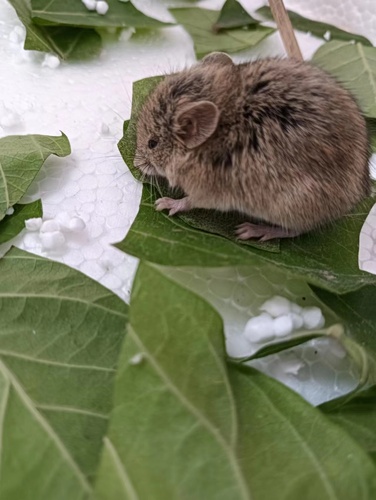
Other species in the genus Allocricetulus
Other species in the family Cricetidae
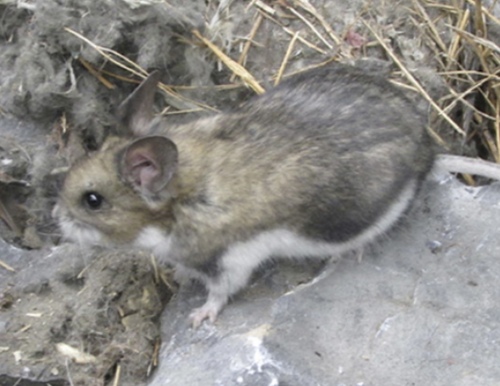
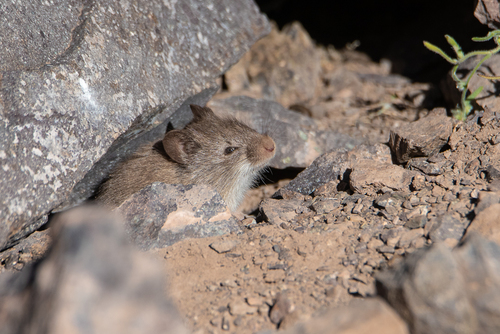
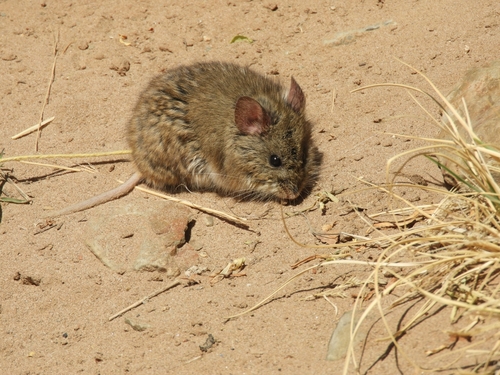
Species that share its range
Sources
Conservation status, range description and population estimate come from the IUCN Red List assessment for Allocricetulus eversmanni. Countries are derived from that range description, not from a mapped country list. Last refreshed on .
The distribution map is drawn from the IUCN Red List spatial data compiled in 2008. IUCN (International Union for Conservation of Nature)