
Capybara
Hydrochoerus hydrochaeris
Red List assessment
Least Concernon the IUCN Red List
- EXExtinct
- EWExtinct in the Wild
- CRCritically Endangered
- ENEndangered
- VUVulnerable
- NTNear Threatened
- LCLeast Concern
The Capybara is recorded in 10 countries across North America and South America. The IUCN Red List assesses the Capybara as Least Concern. Population size is not precisely quantified but is considered large and stable across its range, with local increases noted in some human-modified habitats like ranches and urban wetlands
- Family
- Caviidae
- Order
- Rodentia
- Genus
- Hydrochoerus
- Countries recorded
- 10
- Continents
- North America and South America
- Red List category
- Least Concern
- Data updated
- August 9, 2026
What is the Capybara?
The capybara is the largest living rodent in the world, native to South America where it inhabits wetlands, rivers, and grasslands. It is a highly social, semi-aquatic mammal closely related to guinea pigs. Remarkable for its calm demeanor, it is often seen coexisting peacefully with many other species, earning it a reputation as one of the most sociable animals on Earth.
Where does the Capybara live?
South America, primarily Venezuela, Colombia, Brazil, Argentina, Uruguay, Paraguay, and the Amazon and Pantanal basins
Widely distributed across South America east of the Andes, from Panama through Colombia, Venezuela, Guyana, Brazil, Bolivia, Paraguay, Uruguay, to northern Argentina. Absent from Chile and high Andean regions.
Altitude and depth
Generally found at low altitudes, from sea level up to about 1,300 meters
Seasonal movements
No true migration or hibernation; however, group sizes and movement patterns shift seasonally with water availability, congregating near remaining water sources during dry seasons
Habitat of the Capybara
Found in densely vegetated areas near bodies of water such as rivers, lakes, ponds, marshes, and swamps. They favor savannas, tropical forests, and floodplains like the Pantanal and Llanos with permanent water access.
Adaptations to its environment
Webbed feet enable efficient swimming, while eyes, ears, and nostrils positioned high on the head allow the capybara to remain mostly submerged while alert. Their dense, coarse fur dries quickly, and they can hold their breath underwater for up to five minutes to evade predators.
Conservation status and numbers
Least Concern (LC) according to IUCN; populations are widespread, stable, and in some areas even increasing due to adaptability to human-altered landscapes
Estimated population
Population size is not precisely quantified but is considered large and stable across its range, with local increases noted in some human-modified habitats like ranches and urban wetlands
What threatens the Capybara?
Hunting for meat and hide, habitat loss from agricultural expansion, and occasional culling due to conflicts with livestock or crops in some regions
Diseases and parasites
Susceptible to ticks (including those carrying Brazilian spotted fever), botfly larvae, and various endoparasites; they can also carry pathogens transmissible to livestock
What is being done to protect it?
Protected in some countries through hunting regulations; managed populations exist on ranches for sustainable meat and leather production, which incentivizes habitat preservation in places like Venezuela
Recommended actions
Continued monitoring of hunting pressure, maintenance of wetland habitats, and management of human-wildlife conflict in agricultural areas to sustain healthy populations
What the Capybara looks like
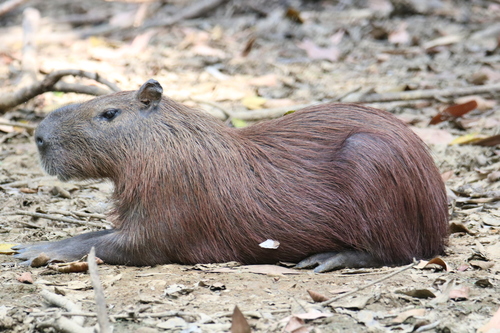
Capybaras have a barrel-shaped body covered in coarse, reddish-brown to grayish fur, with a large blunt head and small ears. Their short legs end in slightly webbed feet with four toes on the front and three on the back.
Size
Body length ranges from 100 to 134 cm, with a shoulder height of approximately 50-62 cm
Weight
Adults typically weigh between 35-66 kg, with some individuals reaching up to 91 kg; females are generally slightly heavier than males
Distinctive features
Distinguished from other rodents by their massive size, lack of a visible tail, and pig-like snout; the related lesser capybara (H. isthmius) is notably smaller
Differences between males and females
Minimal external dimorphism, though females tend to be slightly larger and heavier than males; males possess a prominent scent gland (morrillo) on the snout used for territorial marking
Behaviour and diet of the Capybara
Highly social animals living in groups of 10-20 individuals, though groups can range from 2 to over 100 during dry seasons; groups have a dominant male, several females, offspring, and subordinate males
When it is active
Primarily crepuscular and diurnal, though they may become more nocturnal in areas with high human disturbance or hunting pressure
Diet
Strict herbivores feeding mainly on grasses and aquatic plants, consuming up to 3-3.6 kg of vegetation daily; they also practice coprophagy, re-ingesting their own feces to maximize nutrient absorption from tough plant fibers
Communication
Communicate through a variety of vocalizations including whistles, barks, purrs, and clicks, as well as scent marking via the morrillo gland and anal glands to establish territory and social bonds
Interactions with other species
Natural predators include jaguars, pumas, caimans, and anacondas; capybaras are famously tolerant of other species, often seen with birds like cattle egrets perched on their backs feeding on parasites
Role in its ecosystem
As grazers, capybaras help shape wetland and grassland vegetation structure and serve as an important prey base for large predators, playing a key role in the food web of South American wetland ecosystems
Reproduction and lifecycle
Breeding can occur year-round but often peaks with the onset of the rainy season; gestation lasts about 150 days, resulting in litters of 2-8 pups (average 4) that are precocial and mobile within hours of birth
Raising the young
Offspring are cared for communally within the group, with multiple females nursing pups regardless of parentage; young begin eating grass within a week but continue nursing for up to 16 weeks
Maturity and lifespan
Reach sexual maturity around 12-18 months of age; typical lifespan in the wild is 6-10 years, while captive individuals can live up to 12 years
Taxonomy and naming of the Capybara
Classification
Class Mammalia > Order Rodentia > Family Caviidae > Genus Hydrochoerus > Species Hydrochoerus hydrochaeris
Subspecies
Two recognized subspecies: H. h. hydrochaeris (most of South America) and H. h. isthmius (Panama and northwestern South America, sometimes considered a separate species, the lesser capybara)
Scientific synonyms
Sus hydrochaeris (Linnaeus, 1766), Hydrochoerus capybara
What research says
Recent studies
Recent research has focused on capybara adaptability to urban environments in Brazil and Argentina, as well as their role as reservoir hosts for zoonotic tick-borne pathogens
Genome and DNA
Diploid chromosome number of 2n=66; genomic studies have been used to clarify taxonomic relationships within Hydrochoerus and Caviidae family
Compared with similar species
Similar in ecological niche to the lesser capybara (Hydrochoerus isthmius) but notably larger; often compared to guinea pigs due to shared family Caviidae, though capybaras are vastly larger
The Capybara and people
Capybaras are known for their unusually calm and friendly temperament, often forming bonds with other animals like dogs, monkeys, and birds; they can sleep in water with just their nose exposed, and their name derives from the Guarani language meaning 'master of the grasses.'
Where and how to see it
Best observed at dawn or dusk near water bodies in the Pantanal (Brazil) or the Llanos (Venezuela), where they gather in visible groups; guided wildlife tours in these regions offer high viewing success year-round
Risks to humans
Generally low risk to humans; capybaras are docile but can carry ticks that transmit diseases like Brazilian spotted fever, and bites may occur if provoked or cornered
Human uses
Farmed in parts of South America for meat and leather (particularly in Venezuela), and increasingly kept as exotic pets in some countries; also popular attractions in zoos and wildlife parks worldwide
Myths and legends
In some South American folklore, capybaras are seen as symbols of peace and sociability; the Catholic Church in the 16th century controversially classified capybara meat as fish, allowing its consumption during Lent
Countries where the Capybara is recorded
The 10 countries named in the range description of its IUCN Red List assessment.
Questions about the Capybara
Where does the Capybara live?
The Capybara is recorded in Argentina, Bolivia, Brazil, Chile and Colombia, among 10 countries in total across North America and South America. These countries come from the range description of its IUCN Red List assessment, and they are what place the species on the interactive map.
Is the Capybara endangered?
The IUCN Red List assesses the Capybara as Least Concern. The species is widespread and abundant enough not to qualify for any threatened category. It does not mean the species is safe forever, only that nothing in the current data raises an alarm.
How many are left in the wild?
Population size is not precisely quantified but is considered large and stable across its range, with local increases noted in some human-modified habitats like ranches and urban wetlands This figure comes from the species assessment on the IUCN Red List; population estimates for wild mammals are ranges, not counts, and are revised at each assessment.
What habitat does the Capybara live in?
Found in densely vegetated areas near bodies of water such as rivers, lakes, ponds, marshes, and swamps.
What is the scientific name of the Capybara?
The Capybara is Hydrochoerus hydrochaeris, in the family Caviidae, order Rodentia.
Other species in the genus Hydrochoerus
Other species in the family Caviidae
Species that share its range

Sources
Conservation status, range description and population estimate come from the IUCN Red List assessment for Hydrochoerus hydrochaeris. Countries are derived from that range description, not from a mapped country list. Last refreshed on .
The distribution map is drawn from the IUCN Red List spatial data compiled in 2016. IUCN SSC Small Mammal Specialist Group