
Greater Guinea Pig
Cavia magna
Red List assessment
Least Concernon the IUCN Red List
- EXExtinct
- EWExtinct in the Wild
- CRCritically Endangered
- ENEndangered
- VUVulnerable
- NTNear Threatened
- LCLeast Concern
The Greater Guinea Pig is recorded in 2 countries across South America. The IUCN Red List assesses the Greater Guinea Pig as Least Concern. No precise global population estimate exists; the species is considered locally common in suitable habitat with a presumed stable overall trend.
- Family
- Caviidae
- Order
- Rodentia
- Genus
- Cavia
- Countries recorded
- 2
- Continents
- South America
- Red List category
- Least Concern
- Data updated
- August 9, 2026
What is the Greater Guinea Pig?
Cavia magna, the Greater Guinea Pig, is a wild cavy species native to marshy coastal grasslands of southern Brazil and Uruguay. It is one of the larger members of the genus Cavia, closely related to the ancestor of the domestic guinea pig. It inhabits dense vegetation near wetlands and is primarily active at dawn and dusk. Though not well known outside specialist circles, it plays an important ecological role as a grazer in coastal grassland ecosystems.
Where does the Greater Guinea Pig live?
Coastal southern Brazil (Rio Grande do Sul, Santa Catarina) and Uruguay
Found along the Atlantic coastal lowlands of southern Brazil (Rio Grande do Sul, Santa Catarina) and into Uruguay, generally restricted to low-lying coastal habitats rather than inland regions.
Altitude and depth
Primarily found at low elevations, typically 0-200 meters above sea level, in coastal plains and wetland areas.
Seasonal movements
No true hibernation or long-distance migration; breeding activity may increase during warmer, wetter months when vegetation is most abundant.
Habitat of the Greater Guinea Pig
Prefers humid grasslands, marshes, and dense vegetation along coastal plains, often near lagoons, dunes, and wetland margins. It relies on thick grass cover for shelter and protection from predators.
Adaptations to its environment
Robust body and strong limbs adapted for moving through dense marsh vegetation; a herbivorous digestive system suited to fibrous grasses; cryptic brownish fur provides camouflage against predators in grassland habitats.
Conservation status and numbers
Listed as Least Concern by the IUCN due to a relatively wide distribution and presumed stable population, though localized habitat loss is a concern in parts of its range.
Estimated population
No precise global population estimate exists; the species is considered locally common in suitable habitat with a presumed stable overall trend.
What threatens the Greater Guinea Pig?
Habitat degradation from agricultural expansion, urbanization of coastal areas, drainage of wetlands, and livestock grazing pressure on grassland habitats.
Diseases and parasites
Specific disease and parasite data for this species are limited, but like other cavies it is likely susceptible to common rodent ectoparasites and gastrointestinal parasites.
What is being done to protect it?
Protection occurs indirectly through coastal wetland and grassland reserves in Brazil and Uruguay; no species-specific conservation program is currently documented.
Recommended actions
Continued protection of coastal marsh and grassland habitats, monitoring of population trends, and further taxonomic and ecological research to clarify range and habitat needs.
What the Greater Guinea Pig looks like
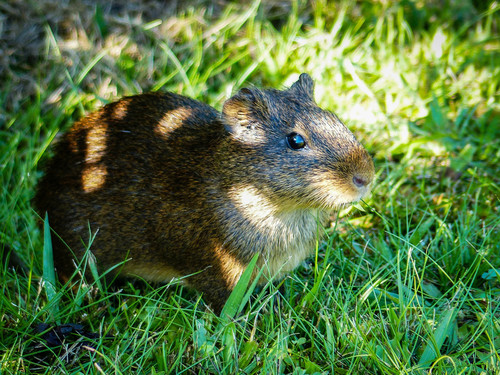
Robust, compact body covered in coarse brownish-gray fur, short rounded ears, short legs, and no visible tail, similar in general body plan to other wild cavies.
Size
Body length typically ranges from 20 to 40 cm, making it larger than the common domestic guinea pig.
Weight
Adults generally weigh between 500 and 1000 grams.
Distinctive features
Distinguished from other Cavia species mainly by its larger body size and skull morphology, along with subtle differences in fur coloration and habitat preference for marshier environments.
Differences between males and females
Sexual dimorphism is minimal, with males and females showing similar size and coloration, though males may be slightly larger.
Behaviour and diet of the Greater Guinea Pig
Generally lives in small, loosely organized groups or family units within suitable habitat patches, with some solitary individuals also observed.
When it is active
Primarily crepuscular and nocturnal, being most active during dawn, dusk, and nighttime hours to avoid predators and heat.
Diet
Herbivorous, feeding mainly on grasses, herbaceous plants, and other vegetation found in marshy and grassland habitats.
Communication
Communicates through vocalizations such as squeaks and chirps, along with body postures and possibly scent marking to signal alarm or social status.
Interactions with other species
Preyed upon by native carnivorous mammals, birds of prey, and reptiles; competes with other small herbivores for grassland and marsh vegetation resources.
Role in its ecosystem
Functions as a grassland grazer, helping to shape vegetation structure in coastal habitats and serving as a prey base for various predators in the food web.
Reproduction and lifecycle
Breeding can occur year-round but may peak in warmer months; gestation lasts about 60-70 days, typical of cavies, with litters usually containing 1-4 precocial young.
Raising the young
Young are born well-developed (precocial) and can move and feed shortly after birth; the mother provides nursing and protection during the initial weeks of life.
Maturity and lifespan
Sexual maturity is likely reached within a few months, consistent with other Cavia species; lifespan in the wild is probably 2-4 years, potentially longer in captivity.
Taxonomy and naming of the Greater Guinea Pig
Classification
Class Mammalia > Order Rodentia > Family Caviidae > Genus Cavia > Species Cavia magna
What research says
Compared with similar species
Larger and more robust than the domestic guinea pig (Cavia porcellus) and other wild relatives such as Cavia aperea, with a preference for wetter, marshier habitats compared to some congeners.
The Greater Guinea Pig and people
Cavia magna is one of the largest wild guinea pig species and is thought to be closely related to the wild ancestors of the domesticated guinea pig kept as pets worldwide.
Where and how to see it
Best observed at dawn or dusk in coastal marsh and grassland reserves of southern Brazil or Uruguay, moving quietly along vegetation edges near wetlands.
Risks to humans
No notable risk to humans.
Countries where the Greater Guinea Pig is recorded
The 2 countries named in the range description of its IUCN Red List assessment.
Questions about the Greater Guinea Pig
Where does the Greater Guinea Pig live?
The Greater Guinea Pig is recorded in Brazil and Uruguay across South America. These countries come from the range description of its IUCN Red List assessment, and they are what place the species on the interactive map.
Is the Greater Guinea Pig endangered?
The IUCN Red List assesses the Greater Guinea Pig as Least Concern. The species is widespread and abundant enough not to qualify for any threatened category. It does not mean the species is safe forever, only that nothing in the current data raises an alarm.
How many are left in the wild?
No precise global population estimate exists; the species is considered locally common in suitable habitat with a presumed stable overall trend. This figure comes from the species assessment on the IUCN Red List; population estimates for wild mammals are ranges, not counts, and are revised at each assessment.
What habitat does the Greater Guinea Pig live in?
Prefers humid grasslands, marshes, and dense vegetation along coastal plains, often near lagoons, dunes, and wetland margins.
What is the scientific name of the Greater Guinea Pig?
The Greater Guinea Pig is Cavia magna, in the family Caviidae, order Rodentia.
Other species in the genus Cavia
Other species in the family Caviidae
Species that share its range
Sources
Conservation status, range description and population estimate come from the IUCN Red List assessment for Cavia magna. Countries are derived from that range description, not from a mapped country list. Last refreshed on .
The distribution map is drawn from the IUCN Red List spatial data compiled in 2016. IUCN SSC Small Mammal Specialist Group