
Shiny Guinea Pig
Cavia fulgida
Red List assessment
Least Concernon the IUCN Red List
- EXExtinct
- EWExtinct in the Wild
- CRCritically Endangered
- ENEndangered
- VUVulnerable
- NTNear Threatened
- LCLeast Concern
The Shiny Guinea Pig is recorded in one country, Brazil across South America. The IUCN Red List assesses the Shiny Guinea Pig as Least Concern. No precise global population estimate exists; considered locally common in suitable habitat with a presumed stable population trend.
- Family
- Caviidae
- Order
- Rodentia
- Genus
- Cavia
- Countries recorded
- 1
- Continents
- South America
- Red List category
- Least Concern
- Data updated
- August 9, 2026
What is the Shiny Guinea Pig?
The Shiny Guinea Pig is a wild cavy species native to the Atlantic Forest region of southeastern Brazil, closely related to the domestic guinea pig's wild ancestors. It is named for its notably glossy fur coat. This species inhabits grasslands, forest edges, and rocky outcrops, playing a role in local ecosystems as a small herbivorous rodent. It remains relatively understudied compared to other cavy species.
Where does the Shiny Guinea Pig live?
Southeastern Brazil, primarily in the states of Minas Gerais, São Paulo, Rio de Janeiro, and Espírito Santo
Restricted to southeastern Brazil, primarily within the Atlantic Forest biome, spanning parts of Minas Gerais, São Paulo, Rio de Janeiro, and Espírito Santo states.
Altitude and depth
Typically found at elevations ranging from near sea level up to 1500 meters, particularly in highland grassland and rocky habitats.
Seasonal movements
No true hibernation or long-distance migration; breeding activity may increase during warmer, wetter months coinciding with greater food availability.
Habitat of the Shiny Guinea Pig
Found in Atlantic Forest edges, grasslands, rocky outcrops (rupestrian fields), and shrubby vegetation zones, often near water sources; prefers areas with dense ground cover for shelter.
Adaptations to its environment
Possesses a compact, low-slung body ideal for moving through dense vegetation and rocky crevices; strong claws aid in digging shallow burrows for shelter from predators and weather.
Conservation status and numbers
Listed as Least Concern (LC) by the IUCN due to its relatively wide distribution and presumed stable population, though localized habitat loss is a concern.
Estimated population
No precise global population estimate exists; considered locally common in suitable habitat with a presumed stable population trend.
What threatens the Shiny Guinea Pig?
Habitat destruction from agricultural expansion, urbanization, and deforestation within the Atlantic Forest biome; predation by domestic and feral animals in fragmented habitats.
Diseases and parasites
Susceptible to various endoparasites and ectoparasites common to wild cavies, including mites and intestinal worms, though specific studies are limited.
What is being done to protect it?
Benefits indirectly from Atlantic Forest conservation initiatives and protected areas within its range, though no species-specific conservation programs are known to exist.
Recommended actions
Continued protection and restoration of Atlantic Forest habitat fragments, population monitoring studies, and research into genetic diversity and distribution limits.
What the Shiny Guinea Pig looks like
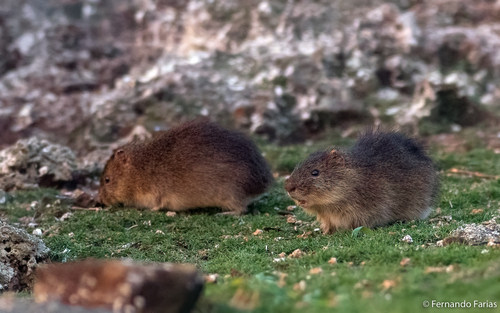
Coat is short, dense, and notably glossy or 'shiny,' giving the species its common name; coloration ranges from grizzled brown to grayish-brown with agouti-like ticking, blending well with grassland and rocky substrates.
Size
Body length typically 20-25 cm, with no external tail visible.
Weight
Adults typically weigh between 500-700 grams.
Distinctive features
Distinguished from other Cavia species primarily by its notably lustrous fur texture and subtle coloration differences; skull and dental morphology also differ slightly from closely related species like Cavia aperea.
Differences between males and females
Minimal sexual dimorphism; males and females are similar in size and coloration, with males sometimes slightly larger.
Behaviour and diet of the Shiny Guinea Pig
Generally social, living in small family groups or loose colonies; exhibits some territorial behavior particularly among breeding males.
When it is active
Primarily crepuscular and nocturnal, with activity peaks at dawn and dusk to avoid predation and extreme temperatures.
Diet
Herbivorous, feeding on grasses, herbaceous plants, leaves, and occasionally bark or roots depending on seasonal availability.
Communication
Communicates through a range of vocalizations including chirps, squeaks, and purrs, as well as scent marking to establish territory and social bonds.
Interactions with other species
Preyed upon by various carnivorous mammals, birds of prey, and snakes native to the Atlantic Forest; may compete with other small rodents for food resources.
Role in its ecosystem
Serves as an important prey species within Atlantic Forest food webs and contributes to seed dispersal and vegetation cycling through its herbivorous grazing habits.
Reproduction and lifecycle
Breeding can occur year-round in favorable conditions, with gestation lasting approximately 60-70 days; litters typically consist of 1-4 precocial young.
Raising the young
Young are born well-developed (precocial) with fur and open eyes, able to move shortly after birth; mothers provide nursing care for a few weeks while young quickly begin supplementing with solid food.
Maturity and lifespan
Reaches sexual maturity around 2-3 months of age; wild lifespan is typically 2-4 years, with captive individuals potentially living longer under controlled conditions.
Taxonomy and naming of the Shiny Guinea Pig
Classification
Class Mammalia > Order Rodentia > Family Caviidae > Genus Cavia > Species Cavia fulgida
Scientific synonyms
Cavia rufescens (sometimes considered a synonym in older literature, though taxonomic status debated)
What research says
Recent studies
Recent phylogenetic studies have helped clarify relationships within the genus Cavia, though Cavia fulgida remains less studied than its congener Cavia aperea.
Genome and DNA
Diploid chromosome number is 2n=64, similar to other Cavia species; genetic studies remain limited compared to the domesticated guinea pig.
Compared with similar species
Closely resembles Cavia aperea (Brazilian guinea pig) but is distinguished by its shinier coat texture and slightly different geographic range and habitat preferences within southeastern Brazil.
The Shiny Guinea Pig and people
Its common name derives from the distinctly glossy appearance of its fur, unusual among wild cavy species; it is one of several wild relatives believed to be ancestral stock contributing to the domestic guinea pig lineage.
Where and how to see it
Best observed during early morning or evening hours in grassland and rocky habitat edges within Atlantic Forest reserves in Minas Gerais or São Paulo state; patience and quiet observation near vegetation cover increase sighting chances.
Risks to humans
No notable risk to humans; this species is not aggressive and poses no venom or significant disease transmission concerns.
Human uses
Not significantly utilized by humans, though wild cavy species like this one are of scientific interest due to their evolutionary relationship with the domesticated guinea pig.
Countries where the Shiny Guinea Pig is recorded
The 1 countries named in the range description of its IUCN Red List assessment.
Questions about the Shiny Guinea Pig
Where does the Shiny Guinea Pig live?
The Shiny Guinea Pig is recorded in Brazil across South America. These countries come from the range description of its IUCN Red List assessment, and they are what place the species on the interactive map.
Is the Shiny Guinea Pig endangered?
The IUCN Red List assesses the Shiny Guinea Pig as Least Concern. The species is widespread and abundant enough not to qualify for any threatened category. It does not mean the species is safe forever, only that nothing in the current data raises an alarm.
How many are left in the wild?
No precise global population estimate exists; considered locally common in suitable habitat with a presumed stable population trend. This figure comes from the species assessment on the IUCN Red List; population estimates for wild mammals are ranges, not counts, and are revised at each assessment.
What habitat does the Shiny Guinea Pig live in?
Found in Atlantic Forest edges, grasslands, rocky outcrops (rupestrian fields), and shrubby vegetation zones, often near water sources; prefers areas with dense ground cover for shelter.
What is the scientific name of the Shiny Guinea Pig?
The Shiny Guinea Pig is Cavia fulgida, in the family Caviidae, order Rodentia.
Other species in the genus Cavia
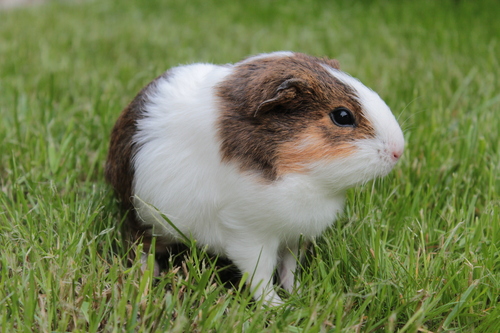
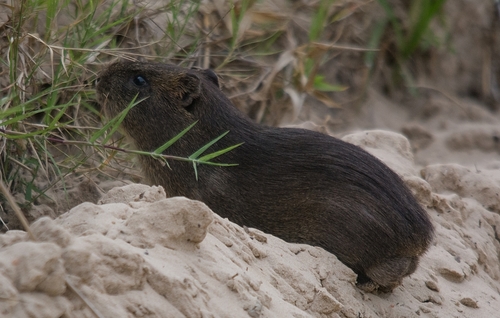
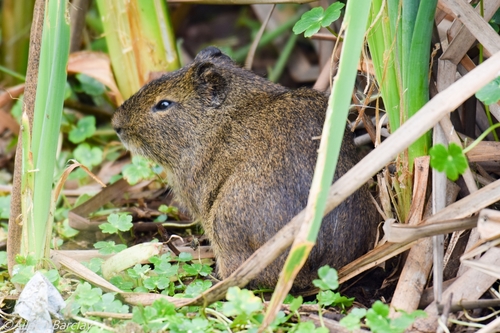
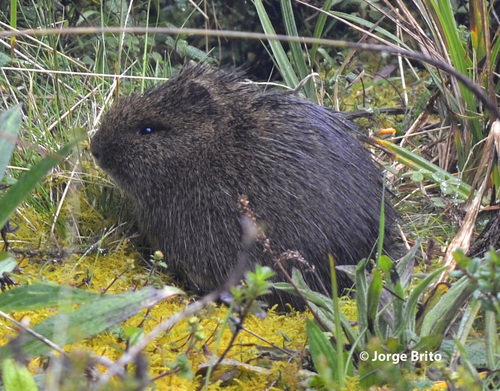
Other species in the family Caviidae
Species that share its range
Sources
Conservation status, range description and population estimate come from the IUCN Red List assessment for Cavia fulgida. Countries are derived from that range description, not from a mapped country list. Last refreshed on .
The distribution map is drawn from the IUCN Red List spatial data compiled in 2016. IUCN SSC Small Mammal Specialist Group