
Jentink's Duiker
Cephalophus jentinki
Red List assessment
Endangeredon the IUCN Red List
- EXExtinct
- EWExtinct in the Wild
- CRCritically Endangered
- ENEndangered
- VUVulnerable
- NTNear Threatened
- LCLeast Concern
The Jentink's Duiker is recorded in 4 countries across Africa. The IUCN Red List assesses the Jentink's Duiker as Endangered. Estimated at fewer than 3,500 mature individuals remaining in the wild, with a declining population trend.
- Family
- Bovidae
- Order
- Artiodactyla
- Genus
- Cephalophus
- Countries recorded
- 4
- Continents
- Africa
- Red List category
- Endangered
- Data updated
- August 9, 2026
What is the Jentink's Duiker?
Jentink's Duiker is one of the largest and most distinctive species of forest duiker, endemic to the Upper Guinea forest block of West Africa. It is remarkable for its striking black-and-white coloration pattern and its status as one of the rarest and most elusive antelope species in the world. First described scientifically in 1892, it remained poorly known to science for decades due to its shy nature and dense forest habitat. Its restricted range and declining population make it a flagship species for West African forest conservation.
Where does the Jentink's Duiker live?
West Africa, primarily Liberia, Sierra Leone, and Ivory Coast
Restricted to the Upper Guinea forest ecosystem in West Africa, spanning Liberia (its stronghold), Sierra Leone, and Ivory Coast (Côte d'Ivoire). Historical range may have included parts of Guinea, though this is unconfirmed. Population is highly fragmented across remaining forest patches.
Altitude and depth
0-600m, primarily in lowland forest areas though can occur in slightly hilly terrain within its range
Habitat of the Jentink's Duiker
Dense primary and secondary lowland tropical rainforest, including closed-canopy evergreen forest with thick understory vegetation. Also found in forest-farmland mosaics and gallery forests near rivers. Prefers areas with dense cover for concealment from predators and hunters.
Adaptations to its environment
Its compact body and relatively short legs allow efficient movement through dense forest understory. The distinctive black-and-white coat pattern may provide disruptive camouflage in dappled forest light. Keen senses of smell and hearing compensate for limited visibility in thick vegetation, aiding in predator detection.
Conservation status and numbers
Endangered (EN) according to IUCN Red List, with population continuing to decline due to habitat loss and unsustainable hunting pressure. The species qualifies for this status due to a severely fragmented range and ongoing decline estimated at more than 50% over recent decades.
Estimated population
Estimated at fewer than 3,500 mature individuals remaining in the wild, with a declining population trend. Precise counts are difficult due to the species' elusive nature and remote habitat.
What threatens the Jentink's Duiker?
Bushmeat hunting is the primary threat, as the species is highly prized for its meat and is easily targeted due to predictable behavior patterns. Habitat loss from logging, agricultural expansion, and mining activities in Liberia and Sierra Leone significantly reduces available forest. Civil conflict in the region historically increased hunting pressure and reduced conservation enforcement capacity.
Diseases and parasites
Specific disease and parasite data for this species is limited, though duikers in general are susceptible to various gastrointestinal parasites and ticks common in tropical forest ungulates.
What is being done to protect it?
Protected within several national parks including Sapo National Park (Liberia), Taï National Park (Ivory Coast), and Gola Rainforest National Park (Sierra Leone). Listed on CITES Appendix I, prohibiting international commercial trade. Various NGOs support anti-poaching patrols and community-based conservation initiatives in the region.
Recommended actions
Strengthen anti-poaching enforcement and community engagement programs to reduce bushmeat hunting pressure. Expand and connect protected forest areas to counter habitat fragmentation. Conduct further population surveys using camera traps and genetic sampling to better understand distribution and abundance.
What the Jentink's Duiker looks like
Distinctive coloration features a dark brown to black head, neck, and forequarters contrasting sharply with pale gray to white hindquarters and rump. The coat has a somewhat rough texture, and both sexes possess short, backward-curving horns. The muzzle is elongated compared to other duiker species.
Size
Shoulder height approximately 70-80 cm; body length around 105-145 cm
Weight
Adults typically weigh between 65-80 kg, making it one of the largest duiker species; males and females are similar in size
Distinctive features
The sharp two-toned black-and-white body pattern is unique among duikers and immediately distinguishes it from other Cephalophus species. It is also notably larger than most forest duikers, with a longer snout adapted for its herbivorous diet.
Differences between males and females
Minimal sexual dimorphism; both males and females possess horns, though male horns may be slightly more robust. Body size is roughly similar between sexes.
Behaviour and diet of the Jentink's Duiker
Primarily solitary or found in monogamous pairs that maintain stable territories. Some evidence suggests small family groups consisting of a pair and their most recent offspring. Territorial behavior includes scent-marking to establish boundaries.
When it is active
Primarily crepuscular and nocturnal, with peak activity during dawn, dusk, and nighttime hours. Rests in dense cover during the hottest parts of the day to avoid heat and predator detection.
Diet
Herbivorous, feeding primarily on fallen fruits, leaves, shoots, and flowers found in the forest understory. Also consumes fungi and occasionally bark. Diet varies seasonally based on fruit and vegetation availability.
Communication
Communication likely includes scent marking via preorbital glands, similar to other duiker species, used for territory demarcation. Vocalizations may include alarm calls or contact sounds between paired individuals, though detailed studies are lacking. Body postures and movements likely convey social signals within pairs.
Interactions with other species
Natural predators include large forest carnivores such as leopards, though human hunting pressure now represents the dominant threat. May coexist with other duiker species and forest ungulates with some ecological niche overlap. Limited documented interspecific interactions due to the species' rarity and elusive behavior.
Role in its ecosystem
Plays a role in seed dispersal through consumption of fruits, contributing to forest regeneration and plant diversity. As a mid-sized herbivore, it also serves as prey for apex forest predators, contributing to the food web. Its presence indicates relatively intact and undisturbed forest ecosystems.
Reproduction and lifecycle
Breeding likely occurs year-round given the species' tropical habitat with minimal seasonal variation. Gestation period is estimated at around 220 days, similar to related duiker species. Typically gives birth to a single offspring per breeding cycle.
Raising the young
Females provide primary care for calves, with young remaining hidden in dense vegetation for protection during early life stages. Weaning likely occurs within a few months, though specific data for this species is limited. Calves may stay with the mother for an extended period before becoming independent.
Maturity and lifespan
Sexual maturity is estimated to occur around 1-2 years of age, consistent with other duiker species. Lifespan in the wild is unknown but likely 10-15 years; captive individuals may live slightly longer with veterinary care.
Taxonomy and naming of the Jentink's Duiker
Classification
Mammalia > Artiodactyla > Bovidae > Cephalophus > Cephalophus jentinki
Scientific synonyms
Cephalophorus jentinki (original genus name); occasionally listed as Cephalophus (Cephalophorus) jentinki in older taxonomic revisions
What research says
Recent studies
Recent camera trap surveys in Sapo National Park and Gola Rainforest have provided updated distribution data and confirmed continued presence in key protected areas. Genetic studies are limited but ongoing research aims to clarify population structure and connectivity across fragmented habitats.
Compared with similar species
Distinguished from the similarly sized Yellow-backed Duiker (Cephalophus silvicultor) by its distinctive black-and-white pattern rather than a yellow dorsal patch. Compared to smaller forest duikers like the Red Duiker, Jentink's Duiker is notably larger and has a more elongated snout.
The Jentink's Duiker and people
Jentink's Duiker was one of the last large African mammals to be scientifically described, remaining virtually unknown to Western science until the late 19th century. It is sometimes called a 'living fossil' due to its rarity and the mystery surrounding its behavior. Despite being one of the largest duikers, it remains one of the least studied due to its extreme elusiveness.
Where and how to see it
Best observed in protected areas like Sapo National Park (Liberia) or Gola Rainforest National Park (Sierra Leone) with experienced local guides, though sightings are extremely rare due to the species' shy and elusive nature. Early morning or dusk camera trap footage offers the most reliable way to document the species' presence. Patience and quiet, slow movement through dense forest are essential for any chance of observation.
Risks to humans
No notable risk to humans; this is a shy, non-aggressive herbivore that avoids human contact whenever possible.
Human uses
Hunted extensively for bushmeat by local communities, representing a significant source of protein and income in some rural West African areas. Not commonly used in traditional medicine compared to other African wildlife species, though localized cultural practices may exist.
Countries where the Jentink's Duiker is recorded
The 4 countries named in the range description of its IUCN Red List assessment.
Questions about the Jentink's Duiker
Where does the Jentink's Duiker live?
The Jentink's Duiker is recorded in Guinea, Ivory Coast, Liberia and Sierra Leone across Africa. These countries come from the range description of its IUCN Red List assessment, and they are what place the species on the interactive map.
Is the Jentink's Duiker endangered?
Yes. The IUCN Red List assesses the Jentink's Duiker as Endangered, one of the three threatened categories. The species faces a very high risk of extinction in the wild — a step below Critically Endangered, but still on a trajectory that ends badly without intervention.
How many are left in the wild?
Estimated at fewer than 3,500 mature individuals remaining in the wild, with a declining population trend. This figure comes from the species assessment on the IUCN Red List; population estimates for wild mammals are ranges, not counts, and are revised at each assessment.
What habitat does the Jentink's Duiker live in?
Dense primary and secondary lowland tropical rainforest, including closed-canopy evergreen forest with thick understory vegetation.
What is the scientific name of the Jentink's Duiker?
The Jentink's Duiker is Cephalophus jentinki, in the family Bovidae, order Artiodactyla.
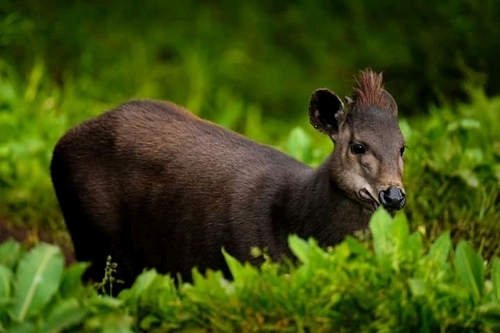
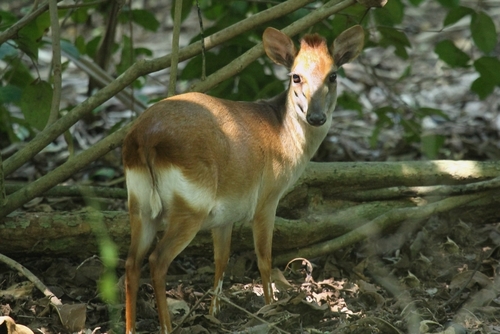
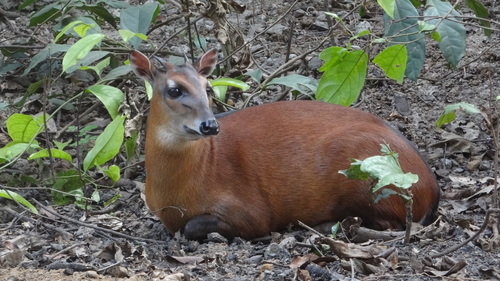
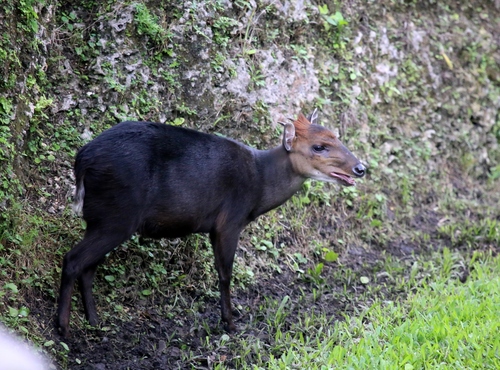
Other species in the genus Cephalophus
Other species in the family Bovidae
Sources
Conservation status, range description and population estimate come from the IUCN Red List assessment for Cephalophus jentinki. Countries are derived from that range description, not from a mapped country list. Last refreshed on .
The distribution map is drawn from the IUCN Red List spatial data compiled in 2016. IUCN (International Union for Conservation of Nature)