
Bare-tailed Woolly Opossum
Caluromys philander
Red List assessment
Least Concernon the IUCN Red List
- EXExtinct
- EWExtinct in the Wild
- CRCritically Endangered
- ENEndangered
- VUVulnerable
- NTNear Threatened
- LCLeast Concern
The Bare-tailed Woolly Opossum is recorded in 9 countries across South America. The IUCN Red List assesses the Bare-tailed Woolly Opossum as Least Concern. No precise global population estimate exists, but the species is considered common and widespread within suitable habitat; population trend is stable.
- Family
- Didelphidae
- Order
- Didelphimorphia
- Genus
- Caluromys
- Countries recorded
- 9
- Continents
- South America
- Red List category
- Least Concern
- Data updated
- August 9, 2026
What is the Bare-tailed Woolly Opossum?
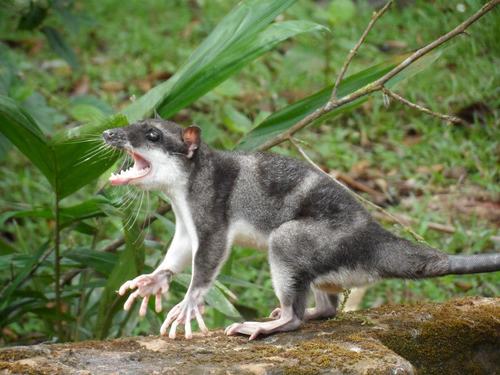
The Bare-tailed Woolly Opossum is a small, arboreal marsupial native to the tropical forests of South America. It is named for its distinctive prehensile tail, which is furred at the base but bare toward the tip. Known for its large eyes adapted to nocturnal life and its agile climbing abilities, this species plays an important role in seed dispersal within its forest ecosystem. It is one of the more commonly encountered opossums in the Amazon canopy.
Where does the Bare-tailed Woolly Opossum live?
Northern and central South America, including the Amazon Basin countries and the Guianas
Widely distributed across northern and central South America, including Venezuela, the Guianas (Guyana, Suriname, French Guiana), Brazil (Amazon Basin), Colombia, Ecuador, Peru, Bolivia, and Trinidad. Its range extends from the Orinoco Basin through the Amazon rainforest.
Altitude and depth
Typically found from sea level up to approximately 1,200 meters elevation in forested regions.
Seasonal movements
Breeding may show slight seasonal peaks correlated with fruit availability, but the species is active year-round without hibernation or migration.
Habitat of the Bare-tailed Woolly Opossum
Primarily inhabits tropical and subtropical moist lowland forests, including primary and secondary rainforest, gallery forests, and forest edges. Also found in plantations and disturbed forest areas near human settlements. Strongly arboreal, rarely descending to the ground.
Adaptations to its environment
Possesses a long prehensile tail for grasping branches, large forward-facing eyes for nocturnal vision, and opposable hallux for enhanced grip while climbing. Its woolly fur provides insulation in humid forest environments, and its agile, cat-like movements allow it to navigate the forest canopy efficiently.
Conservation status and numbers
Listed as Least Concern (LC) by the IUCN due to its wide distribution, presumed large population, and tolerance of some habitat disturbance. Population trend is considered stable across most of its range.
Estimated population
No precise global population estimate exists, but the species is considered common and widespread within suitable habitat; population trend is stable.
What threatens the Bare-tailed Woolly Opossum?
Primary threats include deforestation for agriculture and logging, habitat fragmentation, and localized hunting. Climate change impacts on forest ecosystems could pose future risks.
Diseases and parasites
Known to host various ectoparasites such as ticks and mites, as well as endoparasites including nematodes; specific disease studies are limited.
What is being done to protect it?
Benefits from protection within numerous national parks and reserves across the Amazon Basin, including areas in Brazil, Peru, and the Guianas. No species-specific conservation programs exist, but habitat protection efforts indirectly support the species.
Recommended actions
Continued protection of Amazonian and Guiana Shield forests, monitoring of population trends in fragmented habitats, and further ecological research on seed dispersal roles to inform conservation planning.
What the Bare-tailed Woolly Opossum looks like
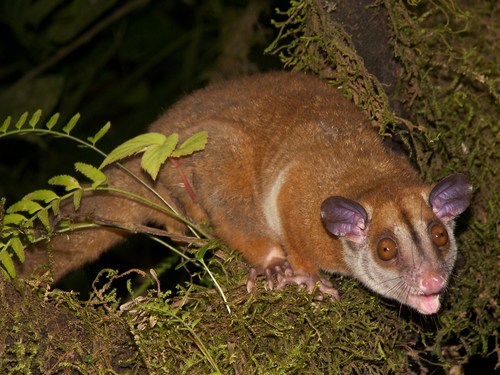
The fur is soft and woolly, ranging from grayish-brown to reddish-brown on the back with a paler, often yellowish or cream-colored underside. Distinctive dark rings encircle the large, prominent eyes. The tail is furred at the base but becomes bare and prehensile toward the tip, often with a pale tip.
Size
Body length ranges from 24 to 30 cm, with a prehensile tail of similar or greater length, typically 33-43 cm.
Weight
Adults typically weigh between 150 and 400 grams, with males slightly larger than females on average.
Distinctive features
Distinguished from other Caluromys species by its bare-tipped tail, smaller size, and specific coloration patterns; differs from true opossums (Didelphis) by its woolly fur, larger eyes, and more arboreal lifestyle.
Differences between males and females
Sexual dimorphism is minimal, though males tend to be marginally larger and heavier than females.
Behaviour and diet of the Bare-tailed Woolly Opossum
Primarily solitary, coming together mainly for mating. Individuals maintain overlapping home ranges and communicate via scent marking to establish territory boundaries.
When it is active
Strictly nocturnal, being most active during the night while resting in tree hollows, dense foliage, or abandoned nests during the day.
Diet
Omnivorous diet consisting mainly of fruit, nectar, and flowers, supplemented with insects, small vertebrates, and occasionally bird eggs. Fruit and nectar make up a significant portion of its diet, making it an important pollinator and seed disperser.
How it feeds and hunts
Forages opportunistically through the canopy, using its prehensile tail and grasping hands to access fruit and flowers; insects and small prey are caught through active searching and pouncing.
Communication
Communicates primarily through scent marking using scent glands, as well as vocalizations such as hisses and clicks during aggressive or defensive encounters.
Interactions with other species
Preyed upon by owls, snakes, and small carnivorous mammals; competes with other arboreal frugivores for food resources. Plays a mutualistic role with many plant species through pollination and seed dispersal.
Role in its ecosystem
Serves as an important seed disperser and pollinator within tropical forest ecosystems, contributing to forest regeneration and plant diversity through its frugivorous and nectarivorous feeding habits.
Reproduction and lifecycle
Breeding can occur year-round with possible peaks tied to fruit abundance; gestation lasts about 25 days, and litters typically contain 2-5 young that are carried in the mother's pouch before being left in nests.
Raising the young
Females provide all parental care, nursing young in the pouch for several weeks before they are weaned and become independent at around 4-5 months of age. Males play no role in offspring care.
Maturity and lifespan
Sexual maturity is typically reached around 6-8 months of age; lifespan in the wild is estimated at 2-3 years, while captive individuals may live up to 5 years.
Taxonomy and naming of the Bare-tailed Woolly Opossum
Classification
Mammalia > Didelphimorphia > Didelphidae > Caluromys > Caluromys philander
Subspecies
Several subspecies recognized including C. p. philander (Guianas, northern Brazil), C. p. affinis (Venezuela), C. p. trinitatis (Trinidad), and C. p. dichurus (western Amazon), differing slightly in coloration and range.
Scientific synonyms
Didelphis philander (original combination by Linnaeus, 1758)
What research says
Recent studies
Recent ecological studies have focused on its role in seed dispersal networks within fragmented Amazonian forests and its resilience to moderate habitat disturbance.
Genome and DNA
Limited specific genomic studies exist, though didelphid marsupials generally have diploid chromosome numbers around 2n=14, useful for comparative marsupial genetics.
Compared with similar species
Similar to the Central American Woolly Opossum (Caluromys derbianus) but smaller and with a distinctly bare-tipped tail; differs from Didelphis species by its more specialized frugivorous diet and greater arboreality.
The Bare-tailed Woolly Opossum and people
This opossum can hang and maneuver using its tail almost like a fifth limb; it is one of the few marsupials known to feed extensively on nectar, acting as a pollinator for certain rainforest plants.
Where and how to see it
Best observed at night in undisturbed tropical forest areas of the Amazon or Guiana Shield using a spotlight to catch its eyeshine in the canopy; patience and knowledge of fruiting trees increase chances of sighting.
Risks to humans
No notable risk to humans; it is a shy, non-aggressive animal that avoids contact and poses no known disease transmission risk.
Myths and legends
No widely documented myths or legends are specifically associated with this species, though opossums in general feature in various South American folk traditions as clever nocturnal creatures.
Countries where the Bare-tailed Woolly Opossum is recorded
The 9 countries named in the range description of its IUCN Red List assessment.
Questions about the Bare-tailed Woolly Opossum
Where does the Bare-tailed Woolly Opossum live?
The Bare-tailed Woolly Opossum is recorded in Bolivia, Brazil, Colombia, Ecuador and French Guiana, among 9 countries in total across South America. These countries come from the range description of its IUCN Red List assessment, and they are what place the species on the interactive map.
Is the Bare-tailed Woolly Opossum endangered?
The IUCN Red List assesses the Bare-tailed Woolly Opossum as Least Concern. The species is widespread and abundant enough not to qualify for any threatened category. It does not mean the species is safe forever, only that nothing in the current data raises an alarm.
How many are left in the wild?
No precise global population estimate exists, but the species is considered common and widespread within suitable habitat; population trend is stable. This figure comes from the species assessment on the IUCN Red List; population estimates for wild mammals are ranges, not counts, and are revised at each assessment.
What habitat does the Bare-tailed Woolly Opossum live in?
Primarily inhabits tropical and subtropical moist lowland forests, including primary and secondary rainforest, gallery forests, and forest edges.
What is the scientific name of the Bare-tailed Woolly Opossum?
The Bare-tailed Woolly Opossum is Caluromys philander, in the family Didelphidae, order Didelphimorphia.
Other species in the genus Caluromys
Other species in the family Didelphidae
Species that share its range

Sources
Conservation status, range description and population estimate come from the IUCN Red List assessment for Caluromys philander. Countries are derived from that range description, not from a mapped country list. Last refreshed on .
The distribution map is drawn from the IUCN Red List spatial data compiled in 2015. IUCN (International Union for Conservation of Nature)