
Black-shouldered Opossum
Caluromysiops irrupta
Red List assessment
Least Concernon the IUCN Red List
- EXExtinct
- EWExtinct in the Wild
- CRCritically Endangered
- ENEndangered
- VUVulnerable
- NTNear Threatened
- LCLeast Concern
The Black-shouldered Opossum is recorded in 4 countries across South America. The IUCN Red List assesses the Black-shouldered Opossum as Least Concern. No reliable population estimate exists due to the species' rarity and difficulty of detection; the population trend is presumed stable to possibly declining based on habitat loss trends.
- Family
- Didelphidae
- Order
- Didelphimorphia
- Genus
- Caluromysiops
- Countries recorded
- 4
- Continents
- South America
- Red List category
- Least Concern
- Data updated
- August 9, 2026
What is the Black-shouldered Opossum?
The Black-shouldered Opossum is a rare and enigmatic arboreal marsupial endemic to the western Amazon basin. It is the sole species in its genus and is notable for its striking coloration and specialized rainforest lifestyle. Very little is known about its ecology due to its rarity and elusive nocturnal habits. It is considered one of the least-studied didelphid marsupials in South America.
Where does the Black-shouldered Opossum live?
Western Amazon Basin, primarily Peru, with records in Ecuador, Bolivia, and Brazil
Restricted to the western Amazon basin, including eastern Peru (Loreto, Madre de Dios), northern Bolivia, and adjacent parts of Brazil (Acre) and possibly Ecuador. Its range is patchy and poorly documented due to low detection rates.
Altitude and depth
Generally found at low elevations, from near sea level up to approximately 500-800m in the Amazon lowlands.
Habitat of the Black-shouldered Opossum
Primarily found in lowland tropical rainforest and pristine terra firme forest, with a preference for undisturbed primary forest canopy. It appears to be sensitive to habitat degradation and rarely found in secondary growth.
Adaptations to its environment
Possesses a strong prehensile tail and sharp claws for climbing and navigating the forest canopy. Large eyes provide enhanced night vision for its nocturnal, arboreal lifestyle. Its coloration may provide camouflage against tree bark and shadows in the forest canopy.
Conservation status and numbers
Listed as Least Concern by the IUCN, though this classification is based on limited data given the species' rarity and low detection rates. Some researchers argue the species may be more threatened than currently recognized due to habitat specificity.
Estimated population
No reliable population estimate exists due to the species' rarity and difficulty of detection; the population trend is presumed stable to possibly declining based on habitat loss trends.
What threatens the Black-shouldered Opossum?
Deforestation and habitat fragmentation from logging, agriculture, and oil/gas extraction in the Amazon basin represent the primary threats. Its apparent dependence on undisturbed primary forest makes it vulnerable to forest degradation.
What is being done to protect it?
The species benefits indirectly from protected areas within its range, such as Manu National Park in Peru and various Amazonian reserves. No species-specific conservation programs currently exist.
Recommended actions
Increased survey and monitoring efforts are needed to better understand distribution and population status. Protection of primary forest habitat within its range and inclusion in broader Amazon conservation initiatives are recommended.
What the Black-shouldered Opossum looks like
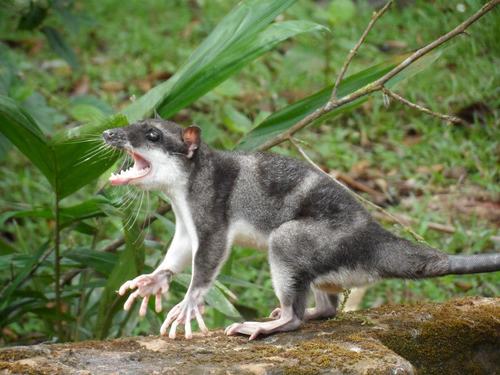
Distinctive grayish to buffy fur with a notable black stripe running across the shoulders, giving the species its common name. Large dark eyes are surrounded by dark rings, and the tail is partially furred at the base with a naked, prehensile tip.
Size
Head-body length approximately 25-32 cm, with a tail nearly as long or longer than the body, around 28-38 cm.
Weight
Approximately 300-450 grams for adults.
Distinctive features
The prominent black shoulder stripe and grayish coloration distinguish it from other Caluromys species, which lack this marking and tend to have more uniform woolly fur. It is also generally larger and more robust than woolly opossums.
Differences between males and females
No significant sexual dimorphism has been documented; males and females appear similar in size and coloration.
Behaviour and diet of the Black-shouldered Opossum
Believed to be largely solitary, as is typical for most didelphid marsupials, though social behavior remains poorly studied in this species.
When it is active
Nocturnal and arboreal, active primarily at night in the forest canopy and rarely observed on the ground.
Diet
Omnivorous diet likely including fruit, nectar, and small invertebrates, similar to related woolly opossums. Specific dietary studies are lacking, but its dentition suggests a mixed diet.
How it feeds and hunts
Likely forages opportunistically in the canopy for fruit, nectar, and insects rather than actively hunting prey.
Communication
Likely uses scent marking and vocalizations typical of didelphid marsupials, though specific communication behaviors have not been studied.
Interactions with other species
Potential predators include large owls, snakes, and carnivorous mammals present in the Amazon canopy, though specific predator-prey relationships are undocumented. It may compete with other frugivorous marsupials like Caluromys species for food resources.
Role in its ecosystem
Likely plays a role as a seed disperser and possibly pollinator through nectar feeding, contributing to forest regeneration and plant reproduction in its rainforest habitat.
Reproduction and lifecycle
Reproductive biology is poorly documented; likely follows the general didelphid pattern with short gestation and pouch-rearing of young, though litter size and breeding season are unknown.
Raising the young
As with other marsupials, females likely carry young in a pouch or attached to fur after leaving the pouch, though specific parental behaviors have not been documented for this species.
Maturity and lifespan
Specific data on age of sexual maturity and lifespan are unavailable, but related didelphid marsupials typically reach maturity within a year and live 2-4 years in the wild.
Taxonomy and naming of the Black-shouldered Opossum
Classification
Mammalia > Didelphimorphia > Didelphidae > Caluromysiops > Caluromysiops irrupta
What research says
Recent studies
Recent camera-trap and biodiversity surveys in Peruvian and Bolivian Amazon reserves have provided a handful of new distribution records, but comprehensive ecological studies remain absent as of recent literature.
Compared with similar species
Compared to the more common woolly opossums (Caluromys spp.), Caluromysiops irrupta is distinguished by its black shoulder stripe, grayer fur, and generally larger size. It occupies a similar ecological niche but is far rarer and less studied.
The Black-shouldered Opossum and people
This species is so rarely encountered that it was not scientifically described until 1951, and sightings remain exceptionally uncommon even in well-surveyed Amazon reserves. It is the only species in its entire genus, making it a taxonomic curiosity.
Where and how to see it
Best chances of observation are during night walks with spotlights in primary rainforest reserves such as Manu National Park in Peru, though sightings are extremely rare even for experienced researchers. Patience and knowledgeable local guides greatly improve chances of detection.
Risks to humans
No notable risk to humans; it is a shy, small arboreal animal that avoids human contact.
Countries where the Black-shouldered Opossum is recorded
The 4 countries named in the range description of its IUCN Red List assessment.
Questions about the Black-shouldered Opossum
Where does the Black-shouldered Opossum live?
The Black-shouldered Opossum is recorded in Bolivia, Brazil, Ecuador and Peru across South America. These countries come from the range description of its IUCN Red List assessment, and they are what place the species on the interactive map.
Is the Black-shouldered Opossum endangered?
The IUCN Red List assesses the Black-shouldered Opossum as Least Concern. The species is widespread and abundant enough not to qualify for any threatened category. It does not mean the species is safe forever, only that nothing in the current data raises an alarm.
How many are left in the wild?
No reliable population estimate exists due to the species' rarity and difficulty of detection; the population trend is presumed stable to possibly declining based on habitat loss trends. This figure comes from the species assessment on the IUCN Red List; population estimates for wild mammals are ranges, not counts, and are revised at each assessment.
What habitat does the Black-shouldered Opossum live in?
Primarily found in lowland tropical rainforest and pristine terra firme forest, with a preference for undisturbed primary forest canopy.
What is the scientific name of the Black-shouldered Opossum?
The Black-shouldered Opossum is Caluromysiops irrupta, in the family Didelphidae, order Didelphimorphia.
Other species in the family Didelphidae
Species that share its range

Sources
Conservation status, range description and population estimate come from the IUCN Red List assessment for Caluromysiops irrupta. Countries are derived from that range description, not from a mapped country list. Last refreshed on .
The distribution map is drawn from the IUCN Red List spatial data compiled in 2025. IUCN (International Union for Conservation of Nature)