
Virginia Opossum
Didelphis virginiana
Red List assessment
Least Concernon the IUCN Red List
- EXExtinct
- EWExtinct in the Wild
- CRCritically Endangered
- ENEndangered
- VUVulnerable
- NTNear Threatened
- LCLeast Concern
The Virginia Opossum is recorded in 4 countries across North America. The IUCN Red List assesses the Virginia Opossum as Least Concern. No precise global estimate exists, but population is considered large and stable to increasing, given the species' broad range and high reproductive rate.
- Family
- Didelphidae
- Order
- Didelphimorphia
- Genus
- Didelphis
- Countries recorded
- 4
- Continents
- North America
- Red List category
- Least Concern
- Data updated
- August 9, 2026
What is the Virginia Opossum?
The Virginia Opossum is North America's only native marsupial, a resilient and highly adaptable generalist found throughout much of the United States, Mexico, and Central America. It is remarkable for its prehensile tail, opposable thumbs on hind feet, and famous defensive behavior of 'playing possum' (thanatosis). Highly opportunistic, it thrives in both wild and urban environments, making it one of the most successful marsupials outside Australia.
Where does the Virginia Opossum live?
United States, Mexico, and Central America; most abundant in the eastern and central United States
Ranges from southern Ontario, Canada, through the entire eastern and central United States, into Mexico and Central America as far south as Costa Rica. Range has expanded westward and northward in recent decades due to human land-use changes.
Altitude and depth
Sea level to approximately 3000m in some mountainous regions of Mexico and Central America, though most common in lowland areas.
Seasonal movements
No true hibernation, but activity decreases significantly during severe winter cold; opossums may remain denned for days during extreme weather. Breeding is seasonal, typically peaking in late winter/early spring and again in summer in northern populations.
Habitat of the Virginia Opossum
Highly adaptable, inhabiting deciduous forests, woodlands, farmlands, marshes, and suburban/urban areas. Prefers areas near water sources and dense understory for cover. Often found in human-modified landscapes including parks, gardens, and agricultural edges.
Adaptations to its environment
Prehensile tail and opposable hind-foot thumbs allow excellent climbing ability. Resistance to many snake venoms and low body temperature make it resistant to rabies. Omnivorous diet and thanatosis (playing dead) behavior provide survival advantages against predators.
Conservation status and numbers
Listed as Least Concern by IUCN due to widespread distribution, large population, and adaptability to human-altered habitats. Population trend is stable to increasing across most of its range.
Estimated population
No precise global estimate exists, but population is considered large and stable to increasing, given the species' broad range and high reproductive rate.
What threatens the Virginia Opossum?
Vehicle collisions are a major source of mortality; habitat loss in some regions; predation by domestic dogs and cats; occasional persecution as a perceived pest.
Diseases and parasites
Susceptible to fleas, ticks, mites, and intestinal parasites; can carry Sarcocystis neurona (linked to equine protozoal myeloencephalitis) but has notably low susceptibility to rabies.
What is being done to protect it?
No specific conservation programs are targeted at this species due to its stable status; general wildlife protection laws apply in most US states and Mexico. Urban wildlife management programs sometimes address human-opossum conflicts.
Recommended actions
Continued habitat connectivity to reduce road mortality, public education to dispel myths about disease risk, and monitoring of range expansion effects on native ecosystems.
What the Virginia Opossum looks like
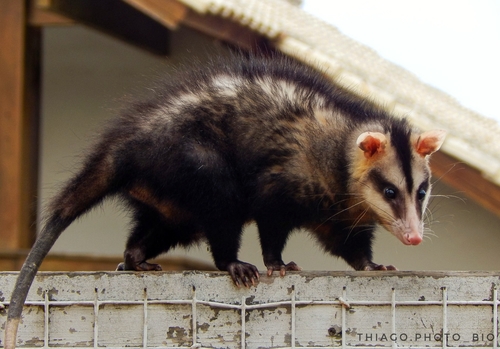
Grizzled grayish-white fur with a pointed pink snout, large black eyes, and thin, hairless black ears often tipped with pink or white. The tail is long, scaly, and mostly hairless, colored pinkish-gray to black.
Size
Body length 33-55 cm (13-22 in) with a tail adding 25-54 cm (10-21 in); total length up to 100 cm.
Weight
Typically 1.9-6.4 kg (4-14 lbs), with males generally larger than females; weight varies seasonally.
Distinctive features
Distinguished from other Didelphis species by its whitish face and body fur, black ear tips, and being the only opossum native to temperate North America. Its 50 teeth are the most of any North American land mammal.
Differences between males and females
Males are typically larger and heavier than females, with a bifurcated (forked) penis being a diagnostic reproductive feature; females have a well-developed pouch.
Behaviour and diet of the Virginia Opossum
Solitary and largely asocial except during breeding season and when females carry young; adults actively avoid each other outside mating encounters.
When it is active
Primarily nocturnal and crepuscular, foraging mainly at night and resting in dens during the day.
Diet
Omnivorous generalist consuming insects, small vertebrates, carrion, fruits, seeds, eggs, and human refuse; diet shifts opportunistically based on availability.
How it feeds and hunts
Forages by slowly walking and sniffing along the ground, using an acute sense of smell to locate food; opportunistic scavenger rather than active predator, though it will catch slow-moving prey like insects, amphibians, and eggs.
Communication
Uses hisses, clicks, growls, and screeches for defense and communication; scent marking via specialized glands also plays a role in social interactions.
Interactions with other species
Preyed upon by owls, hawks, foxes, coyotes, bobcats, and domestic dogs; competes with raccoons and skunks for similar food resources and denning sites.
Role in its ecosystem
Plays a role as an opportunistic omnivore and scavenger, helping control insect and small vertebrate populations while also serving as prey for larger carnivores; contributes to nutrient cycling through carrion consumption.
Reproduction and lifecycle
Breeding season occurs from January to October depending on latitude, with females producing 1-3 litters per year; gestation is remarkably short at 12-13 days.
Raising the young
Underdeveloped young crawl into the mother's pouch after birth and nurse for about 2 months; after leaving the pouch, juveniles ride on the mother's back for several more weeks before becoming independent at around 3-4 months.
Maturity and lifespan
Sexual maturity reached at 6-8 months; lifespan is short, typically 1-2 years in the wild and up to 4 years in captivity.
Taxonomy and naming of the Virginia Opossum
Classification
Class Mammalia > Order Didelphimorphia > Family Didelphidae > Genus Didelphis > Species Didelphis virginiana
Subspecies
Multiple subspecies recognized including D. v. virginiana (eastern US), D. v. pigra (southeastern US), D. v. californica (western US/Mexico), and D. v. yucatanensis (Yucatan Peninsula), though taxonomy is debated.
Scientific synonyms
Didelphis marsupialis virginiana (former classification treating it as a subspecies of the Common Opossum)
What research says
Recent studies
Recent research has focused on its genome as a marsupial model for studying immune resistance to snake venom and its unusually low body temperature's role in rabies resistance.
Genome and DNA
Diploid chromosome number is 2n=22; the opossum genome has been sequenced and is used as a model organism in comparative genomics and marsupial-eutherian evolutionary studies.
Compared with similar species
Similar to the Common Opossum (Didelphis marsupialis) found further south, but distinguished by whiter fur, black-tipped ears, and more northern/temperate range; generally larger than most other Didelphidae species.
The Virginia Opossum and people
Opossums have a body temperature too low to sustain the rabies virus, making them one of the least likely mammals to carry rabies. They can consume thousands of ticks per season through grooming, earning them a reputation as natural pest controllers. Their famous 'playing dead' act is an involuntary physiological response, not a conscious choice.
Where and how to see it
Best observed at dusk or during nighttime hours near wooded edges, suburban gardens, or areas with accessible food sources; using a red-filtered flashlight minimizes disturbance while spotting them.
Risks to humans
No notable risk to humans; opossums are generally non-aggressive and rarely transmit disease, though bites can occur if cornered or handled.
Human uses
Historically hunted for meat and fur in parts of the rural United States; increasingly valued in pest control for their tick-eating behavior and used in scientific research as a marsupial model organism.
Myths and legends
Featured in Native American folklore as a trickster figure known for cunning survival tactics; often symbolizes resourcefulness and adaptability in North American cultural traditions.
Countries where the Virginia Opossum is recorded
The 4 countries named in the range description of its IUCN Red List assessment.
Questions about the Virginia Opossum
Where does the Virginia Opossum live?
The Virginia Opossum is recorded in Canada, Costa Rica, Mexico and United States across North America. These countries come from the range description of its IUCN Red List assessment, and they are what place the species on the interactive map.
Is the Virginia Opossum endangered?
The IUCN Red List assesses the Virginia Opossum as Least Concern. The species is widespread and abundant enough not to qualify for any threatened category. It does not mean the species is safe forever, only that nothing in the current data raises an alarm.
How many are left in the wild?
No precise global estimate exists, but population is considered large and stable to increasing, given the species' broad range and high reproductive rate. This figure comes from the species assessment on the IUCN Red List; population estimates for wild mammals are ranges, not counts, and are revised at each assessment.
What habitat does the Virginia Opossum live in?
Highly adaptable, inhabiting deciduous forests, woodlands, farmlands, marshes, and suburban/urban areas.
What is the scientific name of the Virginia Opossum?
The Virginia Opossum is Didelphis virginiana, in the family Didelphidae, order Didelphimorphia.
Other species in the genus Didelphis
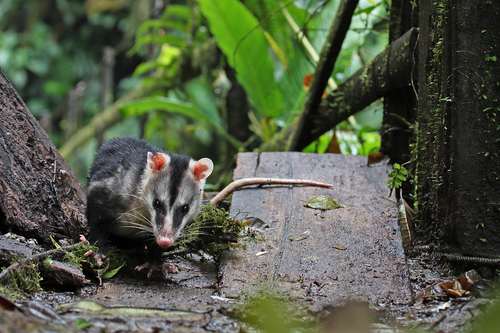
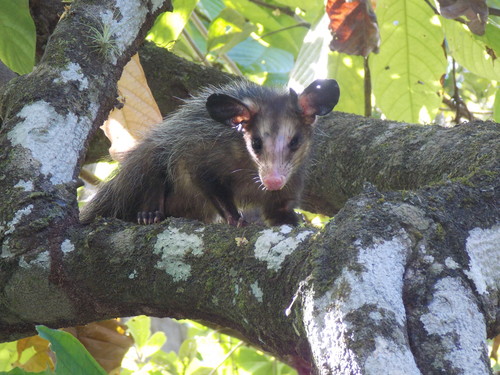
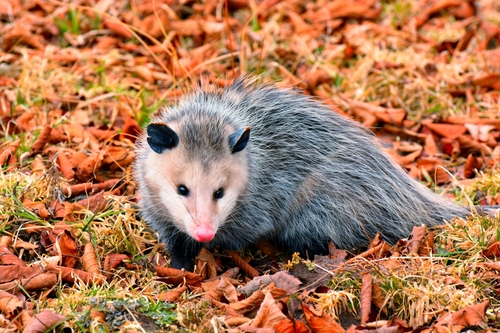
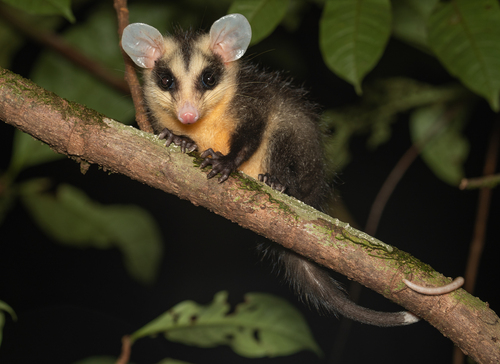
Other species in the family Didelphidae
Species that share its range
Sources
Conservation status, range description and population estimate come from the IUCN Red List assessment for Didelphis virginiana. Countries are derived from that range description, not from a mapped country list. Last refreshed on .
The distribution map is drawn from the IUCN Red List spatial data compiled in 2008. IUCN (International Union for Conservation of Nature)