
Water Opossum
Chironectes minimus
Red List assessment
Least Concernon the IUCN Red List
- EXExtinct
- EWExtinct in the Wild
- CRCritically Endangered
- ENEndangered
- VUVulnerable
- NTNear Threatened
- LCLeast Concern
The Water Opossum is recorded in 5 countries across North America and South America. The IUCN Red List assesses the Water Opossum as Least Concern. No precise global population estimate exists; considered uncommon to locally common but with a presumed stable to slightly declining trend due to habitat loss.
- Family
- Didelphidae
- Order
- Didelphimorphia
- Genus
- Chironectes
- Countries recorded
- 5
- Continents
- North America and South America
- Red List category
- Least Concern
- Data updated
- August 9, 2026
What is the Water Opossum?
The Water Opossum, or Yapock, is the only living marsupial that is truly aquatic and semi-aquatic in habit, found near freshwater streams and rivers from Mexico to Argentina. It is remarkable for its webbed hind feet, waterproof fur, and a pouch present in both sexes that seals shut for swimming. This unique adaptation makes it the sole semi-aquatic marsupial species alive today.
Where does the Water Opossum live?
Central and South America, from southern Mexico to northern Argentina
Ranges from southern Mexico (Veracruz) through Central America including Costa Rica and Panama, into South America across the Amazon Basin, extending south to northern Argentina and Uruguay.
Altitude and depth
Sea level to approximately 1500 meters elevation, always associated with freshwater aquatic habitats.
Seasonal movements
No true hibernation or migration; breeding may occur year-round in tropical zones but can peak with rainy seasons in some regions.
Habitat of the Water Opossum
Riparian zones along clear, fast-flowing freshwater streams, rivers, and lakes bordered by tropical and subtropical forest; requires well-vegetated banks with abundant cover for denning.
Adaptations to its environment
Possesses webbed hind feet for propulsion, dense water-repellent fur, and a muscular sphincter that seals the marsupial pouch shut during swimming to protect young from water. Sensitive forepaw whiskers and fingers aid in tactile hunting underwater in murky conditions.
Conservation status and numbers
Listed as Least Concern by IUCN due to its wide geographic range and presumed large population, though it is patchily distributed and dependent on clean freshwater habitats.
Estimated population
No precise global population estimate exists; considered uncommon to locally common but with a presumed stable to slightly declining trend due to habitat loss.
What threatens the Water Opossum?
Habitat degradation from deforestation, water pollution, damming of rivers, and agricultural runoff affecting stream quality; also incidental capture in fishing nets.
Diseases and parasites
Limited specific data exists, but like other opossums it may host various ectoparasites (fleas, ticks) and endoparasites (nematodes, trematodes).
What is being done to protect it?
Protected indirectly through numerous national parks and reserves across its range that safeguard riparian habitats; no dedicated species-specific conservation programs currently exist.
Recommended actions
Protect and restore riparian corridors, reduce water pollution, conduct population surveys to clarify distribution and abundance, and raise awareness of freshwater ecosystem conservation.
What the Water Opossum looks like
Distinctive marbled gray and black fur pattern with a pale underside, a black facial mask, and a mostly hairless, laterally compressed tail. The muzzle bears long, sensitive whiskers used for underwater foraging.
Size
Head-body length 27-32 cm, with a long prehensile-like tail of 37-41 cm.
Weight
Approximately 604-790 grams for adults, with males typically slightly larger than females.
Distinctive features
The presence of fully webbed hind feet and a sealable pouch in both sexes distinguishes it from all other opossums; its striking black-and-white marbled fur pattern is unique among didelphids.
Differences between males and females
Males are slightly larger than females on average, but both sexes possess a pouch, an unusual trait among marsupials where typically only females do.
Behaviour and diet of the Water Opossum
Solitary and territorial, with individuals maintaining home ranges along stream segments and interacting mainly for mating.
When it is active
Strictly nocturnal, foraging at night in and along water bodies and resting in burrows or dens during the day.
Diet
Carnivorous, feeding primarily on freshwater crustaceans, fish, amphibians, and aquatic insects.
How it feeds and hunts
Forages by swimming and diving in streams, using highly sensitive forepaw digits to detect and grasp prey in murky or dark water rather than relying on sight.
Communication
Communicates primarily through scent marking of territory and vocalizations such as hisses or growls during aggressive encounters; body language plays a role in mating and territorial disputes.
Interactions with other species
Preyed upon by larger carnivores such as caimans, large fish, and birds of prey; competes with other semi-aquatic predators like otters for similar prey resources.
Role in its ecosystem
Functions as a mid-level aquatic predator helping regulate populations of freshwater invertebrates and small vertebrates, contributing to freshwater ecosystem balance.
Reproduction and lifecycle
Breeding can occur multiple times per year in favorable conditions; gestation is very short (about 12-14 days, typical of marsupials), with young completing development in the pouch.
Raising the young
Females carry and nurse altricial young in the pouch for several weeks; the pouch's watertight seal allows females to continue swimming and foraging while carrying offspring.
Maturity and lifespan
Sexual maturity is reached around one year of age; lifespan in the wild is estimated at 2-3 years, potentially longer in captivity.
Taxonomy and naming of the Water Opossum
Classification
Class Mammalia > Order Didelphimorphia > Family Didelphidae > Genus Chironectes > Species Chironectes minimus
Scientific synonyms
Didelphis minima (original combination by Zimmermann, 1780); Chironectes variegatus, Chironectes panamensis
What research says
Recent studies
Recent research has focused on its ecological niche as a semi-aquatic marsupial and comparative studies of pouch morphology and swimming adaptations relative to other mammals.
Genome and DNA
Diploid chromosome number reported as 2n=22, consistent with many didelphid marsupials, though detailed genomic studies remain limited.
Compared with similar species
Unlike terrestrial opossums such as the Virginia Opossum, the Water Opossum is uniquely adapted for aquatic life with webbed feet and a sealable pouch; it more closely parallels convergent aquatic adaptations seen in otters despite being a marsupial.
The Water Opossum and people
It is the only marsupial where males also possess a pouch, used to protect their genitals while swimming; its pouch can seal completely watertight, allowing females to swim freely with young inside without drowning them.
Where and how to see it
Best observed at night along quiet, clear forest streams in Central and South America using red-filtered flashlights, particularly in protected areas like Costa Rica's lowland rainforest reserves; patience and quiet observation near water's edge increase chances of sighting.
Risks to humans
No notable risk to humans; it is shy, non-aggressive, and avoids human contact.
Human uses
Not commonly used commercially, though occasionally hunted incidentally or for local bushmeat in some rural areas; not significant in trade or traditional medicine.
Myths and legends
Not widely featured in major folklore, though in some Central and South American rural communities it is sometimes mistaken for or confused with other semi-aquatic mammals like otters due to its habits.
Countries where the Water Opossum is recorded
The 5 countries named in the range description of its IUCN Red List assessment.
Questions about the Water Opossum
Where does the Water Opossum live?
The Water Opossum is recorded in Argentina, Costa Rica, Mexico, Panama and Uruguay across North America and South America. These countries come from the range description of its IUCN Red List assessment, and they are what place the species on the interactive map.
Is the Water Opossum endangered?
The IUCN Red List assesses the Water Opossum as Least Concern. The species is widespread and abundant enough not to qualify for any threatened category. It does not mean the species is safe forever, only that nothing in the current data raises an alarm.
How many are left in the wild?
No precise global population estimate exists; considered uncommon to locally common but with a presumed stable to slightly declining trend due to habitat loss. This figure comes from the species assessment on the IUCN Red List; population estimates for wild mammals are ranges, not counts, and are revised at each assessment.
What habitat does the Water Opossum live in?
Riparian zones along clear, fast-flowing freshwater streams, rivers, and lakes bordered by tropical and subtropical forest; requires well-vegetated banks with abundant cover for denning.
What is the scientific name of the Water Opossum?
The Water Opossum is Chironectes minimus, in the family Didelphidae, order Didelphimorphia.
Other species in the family Didelphidae
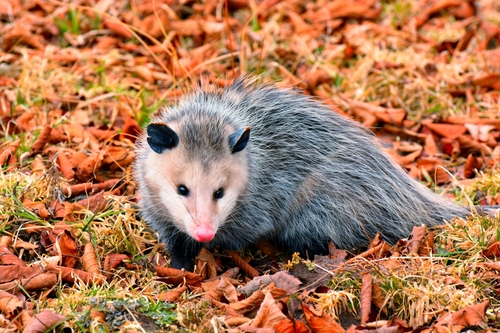
Species that share its range
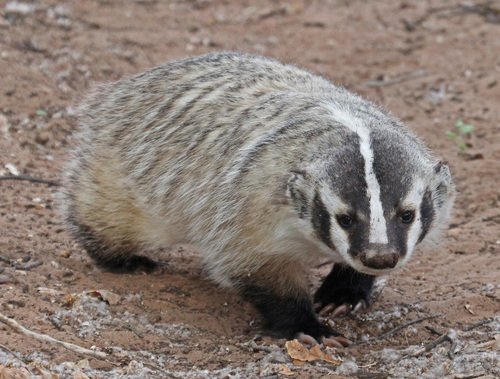
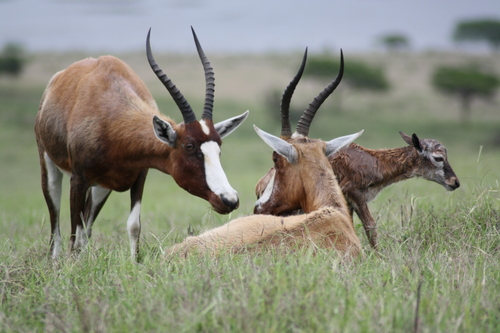
Sources
Conservation status, range description and population estimate come from the IUCN Red List assessment for Chironectes minimus. Countries are derived from that range description, not from a mapped country list. Last refreshed on .
The distribution map is drawn from the IUCN Red List spatial data compiled in 2008. IUCN (International Union for Conservation of Nature)