
Andean Night Monkey
Aotus miconax
Red List assessment
Endangeredon the IUCN Red List
- EXExtinct
- EWExtinct in the Wild
- CRCritically Endangered
- ENEndangered
- VUVulnerable
- NTNear Threatened
- LCLeast Concern
The Andean Night Monkey is recorded in one country, Peru across South America. The IUCN Red List assesses the Andean Night Monkey as Endangered. No precise global population estimate is available.
- Family
- Aotidae
- Order
- Primates
- Genus
- Aotus
- Countries recorded
- 1
- Continents
- South America
- Red List category
- Endangered
- Data updated
- August 9, 2026
What is the Andean Night Monkey?
The Andean Night Monkey (Aotus miconax) is a medium-sized, strictly nocturnal primate endemic to the montane forests of northern and central Peru. It is one of only a handful of truly nocturnal primates on Earth, a distinction made possible by its remarkably enlarged eyes. Found at higher elevations than most other night monkey species, it endures the cool temperatures of Andean cloud forests with the aid of dense, insulating fur. Its Endangered status reflects serious population decline driven primarily by accelerating deforestation and habitat fragmentation along Peru's eastern Andes.
Where does the Andean Night Monkey live?
Northern and central Peru, restricted to the eastern slopes of the Andes, primarily in the departments of Amazonas, San Martín, La Libertad, and Huánuco
Strictly endemic to Peru. Known range covers the eastern slopes of the Andes in the departments of Amazonas, San Martín, La Libertad, and Huánuco, with possible presence in parts of Cajamarca. Its distribution is patchy and fragmented due to ongoing deforestation.
Altitude and depth
Typically found between 1,000 and 3,200 m above sea level, with most confirmed records between 1,500 and 2,900 m. This makes it one of the highest-altitude-dwelling primates in the Americas.
Seasonal movements
No hibernation or long-distance seasonal migration documented. Diet shifts seasonally in response to fruit availability, with greater reliance on insects and leaves during low-fruiting periods. The species remains resident year-round within its montane range.
Habitat of the Andean Night Monkey
Montane tropical forests and cloud forests on the eastern Andean slopes, typically in areas with dense, continuous canopy cover and abundant fruiting trees. Also uses transitional forests between cloud forest and Amazonian foothill forest, and has been recorded in secondary forest adjacent to primary habitat.
Adaptations to its environment
Possesses disproportionately large, forward-facing eyes with a high density of rod photoreceptors, enabling excellent vision in near-darkness and moonlit conditions. Dense, soft fur provides insulation against cold Andean nights at high elevations. The monogamous, small-group social structure reduces foraging competition in a habitat where nocturnal food resources are limited.
Conservation status and numbers
Endangered (EN) on the IUCN Red List (last assessed 2019). The species meets criterion A2c, with an estimated ongoing population reduction of at least 50% over three generations, primarily attributable to habitat loss and degradation across its restricted and fragmented range.
Estimated population
No precise global population estimate is available. The population is considered small, highly fragmented, and declining, with no evidence of recovery. Remaining subpopulations are isolated by agricultural lands and degraded habitats.
What threatens the Andean Night Monkey?
Principal threats are deforestation for agriculture (particularly coffee, cacao, and coca cultivation), illegal logging, and expanding rural settlements on the eastern Andean slopes. Road construction into previously inaccessible montane forest opens new areas to human exploitation. Capture for the illegal pet trade and historical capture for biomedical research represent additional pressures.
Diseases and parasites
The genus Aotus is notably susceptible to human malaria parasites (Plasmodium falciparum, P. vivax), which led to their historical use in biomedical malaria research. Endoparasites including helminths and protozoans, as well as ectoparasites such as ticks and mites, have been documented in related Aotus species. Specific parasitological surveys for A. miconax are lacking.
What is being done to protect it?
Listed on CITES Appendix II, regulating international trade. Portions of its range fall within Peruvian protected areas including Río Abiseo National Park and Alto Mayo Protected Forest. Peruvian law prohibits hunting and trade of native primate species. NGO-led and university research programs in Peru are conducting field surveys to better define its distribution and abundance.
Recommended actions
Priority actions include expanding and effectively managing protected areas on the eastern Andean slopes, strengthening enforcement of deforestation bans, and conducting systematic camera-trap and acoustic monitoring surveys to quantify population status. Community-based conservation programs engaging local farmers with sustainable land-use alternatives are essential, alongside corridor restoration to reconnect fragmented subpopulations.
What the Andean Night Monkey looks like
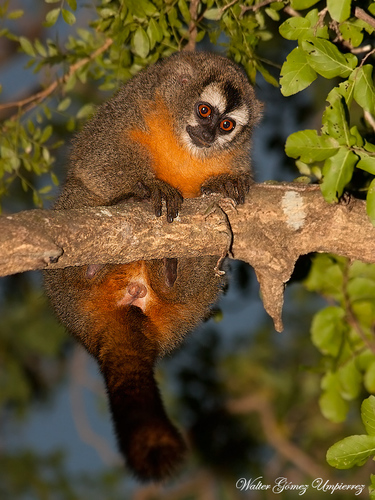
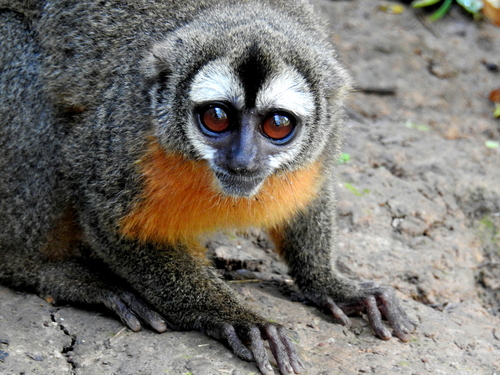
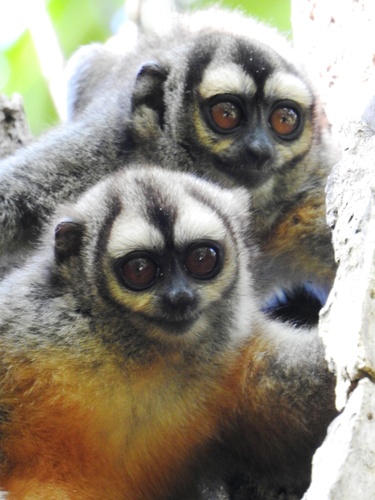
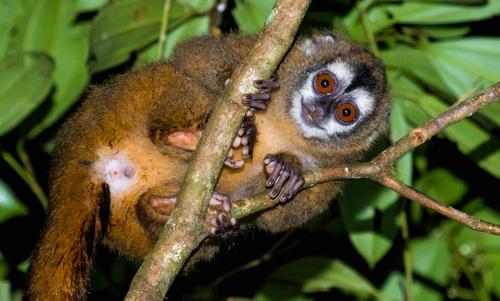
The dorsal fur is dense and soft, ranging from grey-brown to dark brown. Ventral fur is pale yellowish to orange-tinged. The face bears three prominent dark stripes: a central stripe descending from the crown and two lateral stripes flanking the large, dark, forward-facing eyes — giving the face a distinctive owl-like appearance. The tail is long, bushy, and non-prehensile.
Size
Head-body length approximately 24–48 cm; tail length approximately 22–42 cm; total length roughly 50–85 cm. Like all Aotus, it is a relatively compact, rounded-bodied primate.
Weight
Approximately 800–1,250 g. Sexual size dimorphism is minimal, with males and females of similar body mass.
Distinctive features
Distinguished from sympatric or nearby Aotus species such as Aotus nancymaae by its strictly montane distribution (above ~1,000 m), denser and thicker pelage adapted to cooler temperatures, and subtle differences in ventral fur coloration and facial stripe intensity. Its geographic isolation in Andean cloud forests is itself a key field identifier.
Differences between males and females
Sexual dimorphism is minimal; males and females are nearly identical in size, weight, and coloration. This is consistent with the strictly monogamous mating system typical of the genus Aotus.
Behaviour and diet of the Andean Night Monkey
Lives in small, monogamous family groups typically comprising one adult pair and one to three offspring of varying ages. Groups are strongly territorial and actively defend home ranges through vocalizations and scent marking. Pair bonds are stable and long-term.
When it is active
Strictly nocturnal. Activity commences shortly after sunset and often peaks during the first few hours of darkness and again near dawn. On bright moonlit nights, activity levels may be elevated (so-called 'cathemeral' tendencies under lunar influence have been debated in the genus). During daylight hours, individuals rest communally in tree hollows, vine tangles, or dense foliage.
Diet
Omnivorous. Diet is dominated by ripe fruit, supplemented with leaves, flowers, nectar, arthropods (insects and spiders), and occasionally small vertebrates such as lizards or frogs. Seasonal fruit scarcity leads to increased reliance on invertebrates and foliage.
How it feeds and hunts
Forages by moving quietly through the forest canopy and understory, exploiting its large eyes to detect arthropods and small prey in low light. Insects are caught with rapid manual grabs. Fruiting trees are relocated through spatial memory and olfactory cues within well-known home ranges.
Communication
Vocal repertoire includes low resonant hoots used for inter-group spacing, high-pitched screams for alarm, and softer contact calls within the family group. Scent marking via specialized chest and throat glands is used to demarcate territorial boundaries. Visual signals include body postures, tail positions, and arching displays during territorial encounters.
Interactions with other species
Natural predators likely include large nocturnal raptors (e.g., spectacled owl, Pulsatrix perspicillata), ocelots (Leopardus pardalis), and other nocturnal mammalian carnivores. Competes with other arboreal frugivores for food resources. Acts as a seed disperser for fruiting trees in its cloud forest habitat, contributing to forest regeneration.
Role in its ecosystem
Occupies the role of mid-canopy nocturnal frugivore and invertebrate predator. As a seed disperser, it contributes to plant diversity and forest structure. Serving as prey for nocturnal apex predators, it is integrated into Andean montane forest food webs. Its nocturnal niche minimizes direct competition with diurnal primates.
Reproduction and lifecycle
Breeding appears to occur year-round, though births may show a seasonal peak correlated with fruit availability. Gestation lasts approximately 133 days. Litter size is typically one infant; twins are rare. Infants are weaned at approximately 6–8 months of age.
Raising the young
Paternal investment is exceptionally high: the adult male is the primary infant carrier, responsible for approximately 80–90% of carrying time, handing the infant to the mother only for nursing. Older offspring also participate in carrying and socializing younger siblings. This level of paternal and alloparental care is highly unusual among primates.
Maturity and lifespan
Sexual maturity is reached at approximately 2–3 years of age. Estimated wild lifespan is 10–15 years. Captive individuals of closely related species have lived up to 20 years under managed care.
Taxonomy and naming of the Andean Night Monkey
Classification
Mammalia > Primates > Aotidae > Aotus > Aotus miconax
Scientific synonyms
Originally described as Aotus trivirgatus miconax (Thomas, 1927); treated for many decades as a subspecies of Aotus trivirgatus before being elevated to full species status based on morphological and geographic evidence.
What research says
Recent studies
Recent field surveys using camera traps and acoustic monitoring in the departments of Amazonas and San Martín have contributed new data on the species' elevational range and habitat preferences. Genetic studies are ongoing to clarify phylogenetic boundaries between A. miconax and closely related Andean and Amazonian Aotus species. Conservation assessments have highlighted previously unrecorded subpopulations in transitional forest zones.
Genome and DNA
The genus Aotus displays one of the most remarkable karyotypic diversities among primates, with diploid chromosome numbers ranging from 2n = 46 to 2n = 56 across species. The precise karyotype of A. miconax has not been definitively published. The Aotus genome has been of significant interest to biomedical researchers studying malaria susceptibility and immune response pathways.
Compared with similar species
Most closely related to Aotus nancymaae (Nancy Ma's Night Monkey), a lowland Peruvian species with thinner fur and a slightly different facial pattern, found below approximately 1,000 m. Both belong to the 'red-necked' Aotus group characterized by orange-tinged ventral fur. Compared to grey-necked species such as A. vociferans of Colombia and Ecuador, A. miconax has warmer ventral coloration, denser montane-adapted fur, and a higher-altitude distribution.
The Andean Night Monkey and people
1) The Andean Night Monkey is one of fewer than a dozen truly nocturnal primates on the planet — an evolutionary rarity in an order dominated by diurnal species. 2) Its father is among the most devoted parents in the primate world, carrying the infant almost continuously and acting as the primary caregiver from birth. 3) It thrives at altitudes above 3,000 m, enduring nightly temperatures near freezing in Andean cloud forests — an environment few tropical primates could survive.
Where and how to see it
Best observed on clear, moonlit nights in the cloud forests of Amazonas and San Martín departments, Peru. The Alto Mayo Protected Forest and areas near the town of Moyobamba offer accessible opportunities. Guided night walks with an experienced local guide are strongly recommended. Listening for their low, resonant hooting calls is the most reliable detection method; a red-filtered headlamp minimizes disturbance to the animals.
Risks to humans
No notable risk to humans under normal circumstances. As with all wild primates, biting is possible if an individual is cornered or handled. A theoretical risk of zoonotic disease transmission exists, as is the case with all non-human primates, but documented cases involving this species are extremely rare.
Human uses
The genus Aotus has been used extensively in biomedical research on malaria, as individuals are susceptible to Plasmodium falciparum and P. vivax infection, contributing significantly to vaccine development. This led to historical capture pressure on wild populations. Aotus miconax is now protected under Peruvian national legislation and CITES Appendix II, prohibiting commercial capture and trade. No significant traditional medicinal or subsistence-hunting uses specific to this species are documented.
Myths and legends
In some Andean and Amazonian communities, night monkeys are associated with nocturnal spirits or supernatural beings due to their large luminous eyes and haunting calls emanating from the dark forest. Specific myths exclusively attributed to A. miconax are not well documented in the scientific or ethnographic literature, though local names often reference their ghostly or owl-like nocturnal nature.
Countries where the Andean Night Monkey is recorded
The 1 countries named in the range description of its IUCN Red List assessment.
Questions about the Andean Night Monkey
Where does the Andean Night Monkey live?
The Andean Night Monkey is recorded in Peru across South America. These countries come from the range description of its IUCN Red List assessment, and they are what place the species on the interactive map.
Is the Andean Night Monkey endangered?
Yes. The IUCN Red List assesses the Andean Night Monkey as Endangered, one of the three threatened categories. The species faces a very high risk of extinction in the wild — a step below Critically Endangered, but still on a trajectory that ends badly without intervention.
How many are left in the wild?
No precise global population estimate is available. This figure comes from the species assessment on the IUCN Red List; population estimates for wild mammals are ranges, not counts, and are revised at each assessment.
What habitat does the Andean Night Monkey live in?
Montane tropical forests and cloud forests on the eastern Andean slopes, typically in areas with dense, continuous canopy cover and abundant fruiting trees.
What is the scientific name of the Andean Night Monkey?
The Andean Night Monkey is Aotus miconax, in the family Aotidae, order Primates.
Other species in the genus Aotus


Species that share its range

Sources
Conservation status, range description and population estimate come from the IUCN Red List assessment for Aotus miconax. Countries are derived from that range description, not from a mapped country list. Last refreshed on .
The distribution map is drawn from the IUCN Red List spatial data compiled in 2019. IUCN (International Union for Conservation of Nature)