
Wrinkle-lipped Free-tailed Bat
Mops plicatus
Red List assessment
Least Concernon the IUCN Red List
- EXExtinct
- EWExtinct in the Wild
- CRCritically Endangered
- ENEndangered
- VUVulnerable
- NTNear Threatened
- LCLeast Concern
The Wrinkle-lipped Free-tailed Bat is recorded in 9 countries across Asia. The IUCN Red List assesses the Wrinkle-lipped Free-tailed Bat as Least Concern. Global population is unknown precisely but is considered large, with individual colonies such as Deer Cave estimated to contain 2-3 million bats; overall trend is believed stable to locally declining depending on region.
- Family
- Molossidae
- Order
- Chiroptera
- Genus
- Mops
- Countries recorded
- 9
- Continents
- Asia
- Red List category
- Least Concern
- Data updated
- August 9, 2026
What is the Wrinkle-lipped Free-tailed Bat?
The Wrinkle-lipped Free-tailed Bat is a medium-sized insectivorous bat renowned for forming some of the largest bat colonies on Earth, including the famous Deer Cave colony in Gulomantan, Sarawak, Borneo, which hosts millions of individuals. It plays a critical ecological role as a mass consumer of insects, particularly moths, providing significant natural pest control services to surrounding agricultural lands. Its free tail, wrinkled lips, and swift flight make it well adapted to high-speed aerial insect hunting.
Where does the Wrinkle-lipped Free-tailed Bat live?
Southeast Asia, including Borneo, Thailand, Vietnam, Cambodia, Laos, Myanmar, and parts of Indonesia and the Philippines
Widely distributed across Southeast Asia including Borneo (Malaysia, Indonesia, Brunei), Thailand, Cambodia, Laos, Vietnam, Myanmar, and the Philippines, with the largest known colonies found in Sarawak's Mulu National Park.
Altitude and depth
Typically found from sea level up to about 1,000 meters elevation, with cave roosts often located in limestone karst formations in lowland to hill regions.
Seasonal movements
No true hibernation occurs due to the tropical climate, but foraging activity and emergence patterns can shift slightly with insect abundance across wet and dry seasons.
Habitat of the Wrinkle-lipped Free-tailed Bat
Primarily found in limestone caves in tropical lowland and hill forests, though it also roosts in man-made structures. It forages over forests, agricultural land, and open areas near its cave roosts.
Adaptations to its environment
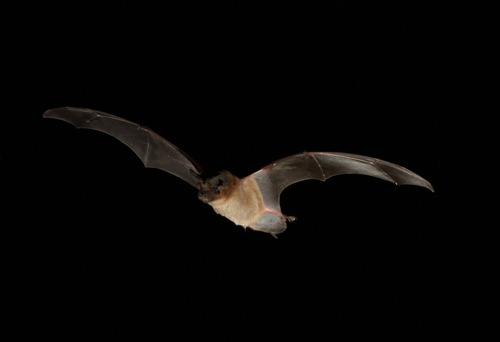
This species has narrow, long wings adapted for fast, sustained flight over long distances to reach foraging grounds far from cave roosts. Echolocation calls are tuned for detecting small flying insects in open air space, and its robust jaw and wrinkled lips aid in processing hard-bodied prey.
Conservation status and numbers
Listed as Least Concern by the IUCN due to its wide distribution and generally large population sizes, though some colonies have experienced local declines from cave disturbance and habitat loss.
Estimated population
Global population is unknown precisely but is considered large, with individual colonies such as Deer Cave estimated to contain 2-3 million bats; overall trend is believed stable to locally declining depending on region.
What threatens the Wrinkle-lipped Free-tailed Bat?
Main threats include cave disturbance and destruction (mining, tourism, guano harvesting), deforestation reducing foraging habitat, pesticide use reducing insect prey availability, and hunting for bushmeat or guano collection in some regions.
Diseases and parasites
Known to host various ectoparasites such as bat flies and mites, and like many bat species may carry coronaviruses and other viruses relevant to zoonotic disease research.
What is being done to protect it?
Key roosting sites like Deer Cave are protected within Gunung Mulu National Park (a UNESCO World Heritage Site), and some countries have regulations protecting cave ecosystems and bat roosts from disturbance.
Recommended actions
Priority actions include protecting major cave roosts from disturbance and guano over-harvesting, promoting sustainable ecotourism practices, monitoring population trends at key colonies, and raising awareness about the ecological benefits of bats for pest control.
What the Wrinkle-lipped Free-tailed Bat looks like
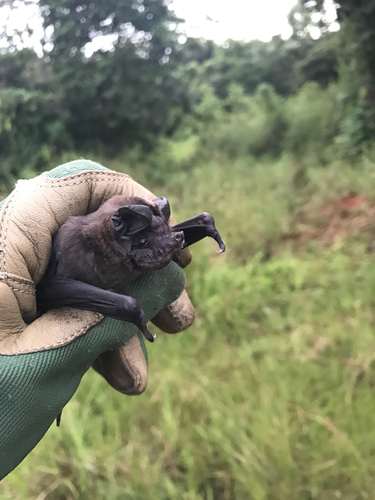
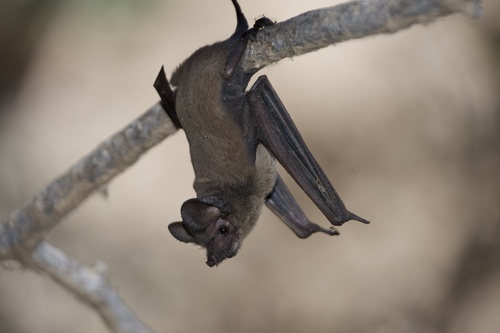
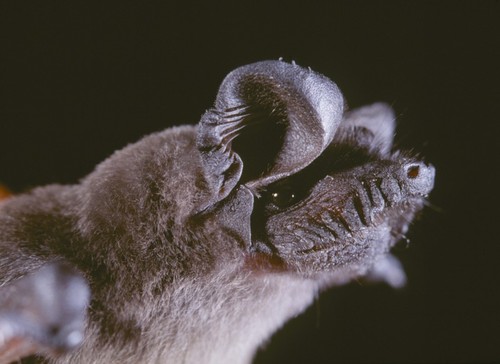
This bat has short, dense brown to blackish-brown fur, a broad flattened head, and characteristic wrinkled or folded lips used to manipulate prey. Its tail extends freely beyond the short tail membrane, a defining trait of free-tailed bats.
Size
Body length approximately 6-8 cm, with a wingspan of roughly 30-35 cm and a tail length of about 3.5-4.5 cm.
Weight
Typically weighs between 12-20 grams, with no significant difference in weight between sexes.
Distinctive features
Distinguished from related Mops and Chaerephon species by its skull shape, wing proportions, and the specific pattern of lip wrinkles; genetic and morphological analysis is often needed to separate it from very similar congeners.
Behaviour and diet of the Wrinkle-lipped Free-tailed Bat
Highly social and colonial, forming some of the largest bat aggregations in the world with millions of individuals roosting together in single caves, often alongside other bat species.
When it is active
Strictly nocturnal, emerging at dusk in massive swirling columns from cave entrances to forage, and returning at dawn.
Diet
Insectivorous, feeding primarily on moths and other flying insects such as beetles and true bugs, captured during fast aerial pursuit.
How it feeds and hunts
Uses echolocation to detect and track flying insects while hunting in open airspace at moderate to high altitudes, often traveling many kilometers from the roost to reach productive foraging grounds.
Communication
Communicates primarily through echolocation calls for navigation and hunting, along with social vocalizations for maintaining contact within dense roosting colonies.
Interactions with other species
Predated upon by birds of prey such as bat hawks and falcons that specialize in catching bats during mass emergences, as well as snakes and other cave-dwelling predators near roost entrances.
Role in its ecosystem
Serves as a keystone insect predator, consuming enormous quantities of insects nightly, which helps regulate agricultural pest populations and forest insect communities over large areas.
Reproduction and lifecycle
Breeding is generally aseasonal or loosely tied to local climate patterns, with females giving birth to a single pup after a gestation period of about 2-3 months.
Raising the young
Females roost together in maternity colonies within the larger cave population, nursing and caring for their single pup until it becomes capable of independent flight and foraging after several weeks.
Maturity and lifespan
Sexual maturity is typically reached within the first year of life; lifespan in the wild is estimated at 5-10 years, though some molossid bats can live longer under favorable conditions.
Taxonomy and naming of the Wrinkle-lipped Free-tailed Bat
Classification
Class Mammalia > Order Chiroptera > Family Molossidae > Genus Mops > Species Mops plicatus
Subspecies
Several subspecies have been proposed across its range, though taxonomy remains debated; some authorities treat populations in Borneo, mainland Southeast Asia, and the Philippines as distinct subspecies, but this requires further genetic study.
Scientific synonyms
Chaerephon plicatus (widely used synonym in older and some current literature)
What research says
Recent studies
Recent research has focused on the ecological and economic value of insect predation by this species for agriculture, as well as virological surveys examining its role as a natural reservoir for various bat-borne viruses.
Genome and DNA
Specific genome sequencing data for this species is limited, though it has been included in broader phylogenetic and virome studies of Southeast Asian bat populations.
Compared with similar species
Closely resembles other free-tailed bats in the genus Mops and Chaerephon, but can be differentiated by subtle skull morphology, lip wrinkle patterns, and echolocation call frequencies; the Deer Cave population is one of the most studied due to its extraordinary size.
The Wrinkle-lipped Free-tailed Bat and people
The Deer Cave colony in Borneo can consume an estimated 15 tons of insects in a single night. Their nightly emergence forms a dramatic swirling column visible from great distances, sometimes compared in scale to a tornado of bats.
Where and how to see it
The best place to observe this species is Gunung Mulu National Park in Sarawak, Borneo, particularly at Deer Cave during the dusk emergence, ideally during the dry season for optimal viewing conditions.
Risks to humans
No notable risk to humans directly, though as with all bats, caution should be taken to avoid direct contact due to potential virus transmission; guano exposure can pose respiratory risks if inhaled in enclosed spaces.
Human uses
Guano from large colonies has historically been collected and used as agricultural fertilizer, and the species contributes significant economic value through natural pest control services for regional agriculture.
Myths and legends
In parts of Southeast Asia, large bat colonies like this are viewed with a mix of fascination and superstition, occasionally linked to folklore about cave spirits, though specific legends about this species are not well documented.
Countries where the Wrinkle-lipped Free-tailed Bat is recorded
The 9 countries named in the range description of its IUCN Red List assessment.
Questions about the Wrinkle-lipped Free-tailed Bat
Where does the Wrinkle-lipped Free-tailed Bat live?
The Wrinkle-lipped Free-tailed Bat is recorded in Brunei, Cambodia, Indonesia, Laos and Malaysia, among 9 countries in total across Asia. These countries come from the range description of its IUCN Red List assessment, and they are what place the species on the interactive map.
Is the Wrinkle-lipped Free-tailed Bat endangered?
The IUCN Red List assesses the Wrinkle-lipped Free-tailed Bat as Least Concern. The species is widespread and abundant enough not to qualify for any threatened category. It does not mean the species is safe forever, only that nothing in the current data raises an alarm.
How many are left in the wild?
Global population is unknown precisely but is considered large, with individual colonies such as Deer Cave estimated to contain 2-3 million bats; overall trend is believed stable to locally declining depending on region. This figure comes from the species assessment on the IUCN Red List; population estimates for wild mammals are ranges, not counts, and are revised at each assessment.
What habitat does the Wrinkle-lipped Free-tailed Bat live in?
Primarily found in limestone caves in tropical lowland and hill forests, though it also roosts in man-made structures.
What is the scientific name of the Wrinkle-lipped Free-tailed Bat?
The Wrinkle-lipped Free-tailed Bat is Mops plicatus, in the family Molossidae, order Chiroptera.
Other species in the genus Mops

Other species in the family Molossidae

Sources
Conservation status, range description and population estimate come from the IUCN Red List assessment for Mops plicatus. Countries are derived from that range description, not from a mapped country list. Last refreshed on .
The distribution map is drawn from the IUCN Red List spatial data compiled in 2020. IUCN (International Union for Conservation of Nature)