
Greater Northern Free-tailed Bat
Mops jobensis
Red List assessment
Least Concernon the IUCN Red List
- EXExtinct
- EWExtinct in the Wild
- CRCritically Endangered
- ENEndangered
- VUVulnerable
- NTNear Threatened
- LCLeast Concern
The Greater Northern Free-tailed Bat is recorded in 3 countries across Asia and Oceania. The IUCN Red List assesses the Greater Northern Free-tailed Bat as Least Concern. No precise global population estimate exists, but the species is considered common and widespread within its range, with a presumed stable population trend.
- Family
- Molossidae
- Order
- Chiroptera
- Genus
- Mops
- Countries recorded
- 3
- Continents
- Asia and Oceania
- Red List category
- Least Concern
- Data updated
- August 9, 2026
What is the Greater Northern Free-tailed Bat?
The Greater Northern Free-tailed Bat is a medium-sized insectivorous bat belonging to the free-tailed bat family, found across tropical northern Australia and New Guinea. It is named for its long tail that extends well beyond the interfemoral membrane, a hallmark of molossid bats. This species is notable for its fast, agile flight and its ecological role as a nocturnal insect predator in tropical and subtropical ecosystems. It roosts in tree hollows, buildings, and rock crevices, often in large colonies.
Where does the Greater Northern Free-tailed Bat live?
Northern Australia (Queensland, Northern Territory, Western Australia) and New Guinea (Papua New Guinea and Indonesian Papua).
Distributed across northern Australia including Queensland, the Northern Territory, and parts of Western Australia, extending north into New Guinea including Papua New Guinea and Indonesian Papua. Its range is largely tropical and subtropical, following monsoonal climate zones.
Altitude and depth
Typically found from sea level up to around 1000 meters elevation, mostly in lowland tropical regions.
Seasonal movements
No true hibernation due to tropical climate; may show some seasonal movement patterns linked to insect abundance and monsoon rains, with increased activity during wet season.
Habitat of the Greater Northern Free-tailed Bat
Found in tropical woodlands, savanna, monsoon forests, and coastal lowlands; often associated with open forest edges and areas near water where insect prey is abundant. Also uses urban and semi-urban environments, roosting in buildings and man-made structures.
Adaptations to its environment
Possesses long, narrow wings adapted for fast, sustained flight in open airspace, allowing efficient long-distance foraging for aerial insects. Its free tail and robust body are typical molossid adaptations for crevice-dwelling and rapid flight. Echolocation calls are tuned for detecting prey in open, uncluttered habitats.
Conservation status and numbers
Listed as Least Concern by the IUCN due to its wide distribution, presumed large population, and tolerance of a variety of habitats including modified landscapes. No significant range-wide population decline has been documented.
Estimated population
No precise global population estimate exists, but the species is considered common and widespread within its range, with a presumed stable population trend.
What threatens the Greater Northern Free-tailed Bat?
Habitat loss from land clearing and urbanization, disturbance of roost sites (especially in buildings), and pesticide use reducing insect prey availability are potential localized threats. Climate change impacts on monsoon patterns could also affect prey availability.
Diseases and parasites
Like many bats, may host ectoparasites such as mites and bat flies, and can be a reservoir for various viruses, though no major disease outbreaks are specifically documented for this species.
What is being done to protect it?
Protected under general wildlife protection laws in Australia and Papua New Guinea; benefits indirectly from protected areas and national parks within its range. No species-specific conservation programs are currently in place due to its stable status.
Recommended actions
Continued monitoring of roost sites, protection of tree hollows and old-growth habitat, and public education to reduce disturbance of urban roosts are recommended to maintain population stability.
What the Greater Northern Free-tailed Bat looks like
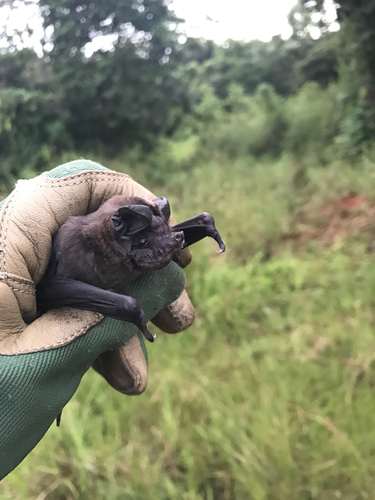
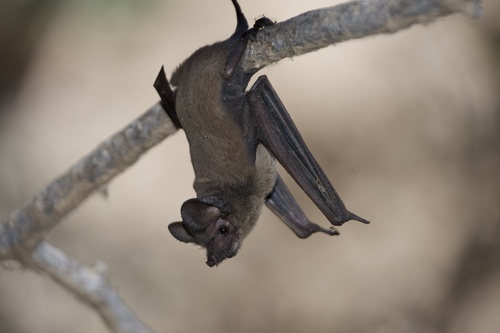
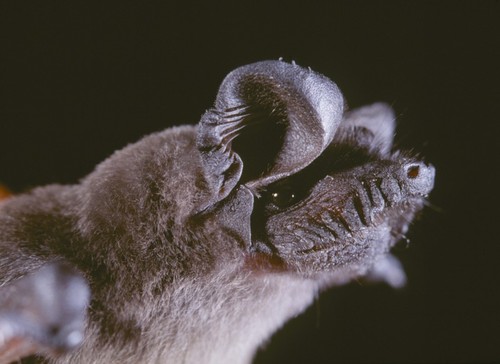
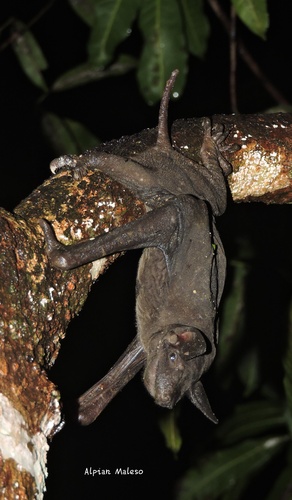
Fur is generally dark brown to blackish-brown, dense and short, with paler underparts. It has a robust, streamlined body typical of molossid bats, with a long tail extending beyond the tail membrane and wrinkled lips characteristic of free-tailed bats.
Size
Body length approximately 6-8 cm, with a wingspan of around 30-35 cm.
Weight
Typically weighs between 15-25 grams.
Distinctive features
Distinguished from similar molossids by its larger size, skull morphology, and specific echolocation call frequency; the long protruding tail and broad, wrinkled muzzle help differentiate it from vesper bats.
Differences between males and females
Minimal sexual dimorphism; males and females are similar in size and coloration, though males may be slightly larger.
Behaviour and diet of the Greater Northern Free-tailed Bat
Highly social, roosting in colonies that can range from a few dozen to several thousand individuals, often sharing roosts with other bat species.
When it is active
Nocturnal, emerging at dusk to forage and returning to roost before dawn.
Diet
Insectivorous, feeding primarily on flying insects such as moths, beetles, and other aerial arthropods caught during flight.
How it feeds and hunts
Uses echolocation to detect and track insect prey while flying fast and high above the canopy or open areas, employing aerial hawking techniques typical of molossid bats.
Communication
Communicates through high-frequency echolocation calls for navigation and prey detection, as well as social vocalizations within roosts for group cohesion and mother-pup recognition.
Interactions with other species
Preyed upon by owls, snakes, and some raptors; competes with other insectivorous bats for aerial insect resources. Often coexists with other bat species in shared roost sites.
Role in its ecosystem
Plays an important ecological role as a nocturnal insect predator, helping to regulate insect populations including agricultural pests, contributing to ecosystem balance in tropical woodlands and savannas.
Reproduction and lifecycle
Breeding likely occurs once or twice per year, coinciding with wet season insect abundance; gestation lasts about 2-3 months, with females typically giving birth to a single pup.
Raising the young
Females care for their single pup, nursing it in the roost until it is capable of flight and independent foraging, usually within a few weeks to a couple of months.
Maturity and lifespan
Sexual maturity is generally reached within the first year of life; lifespan in the wild is estimated at 5-10 years, though molossid bats in general can live longer under favorable conditions.
Taxonomy and naming of the Greater Northern Free-tailed Bat
Classification
Class Mammalia > Order Chiroptera > Family Molossidae > Genus Mops > Species Mops jobensis
Scientific synonyms
Formerly placed in genus Chaerephon or Tadarida; sometimes cited as Chaerephon jobensis in older literature.
What research says
Recent studies
Recent taxonomic revisions have clarified the placement of this species within Mops rather than Chaerephon, based on morphological and molecular studies of Australasian free-tailed bats.
Compared with similar species
Similar to other Mops and Chaerephon species in the region, but distinguished by larger body size and specific cranial features; closely related to the Little Northern Free-tailed Bat (Mops ridei), which is smaller.
The Greater Northern Free-tailed Bat and people
This bat can fly at high speeds over long distances each night in search of insects, sometimes covering many kilometers. It is one of the largest free-tailed bats in Australia, and its wrinkled lips are thought to help funnel air and enhance echolocation calls.
Where and how to see it
Best observed at dusk near roost sites such as tree hollows or buildings in northern Australia or New Guinea, particularly during the wet season when insect activity is high; bat detectors can help identify their echolocation calls.
Risks to humans
No notable risk to humans, though as with all bats, direct handling should be avoided due to potential disease transmission risks such as lyssaviruses.
Countries where the Greater Northern Free-tailed Bat is recorded
The 3 countries named in the range description of its IUCN Red List assessment.
Questions about the Greater Northern Free-tailed Bat
Where does the Greater Northern Free-tailed Bat live?
The Greater Northern Free-tailed Bat is recorded in Australia, Indonesia and Papua New Guinea across Asia and Oceania. These countries come from the range description of its IUCN Red List assessment, and they are what place the species on the interactive map.
Is the Greater Northern Free-tailed Bat endangered?
The IUCN Red List assesses the Greater Northern Free-tailed Bat as Least Concern. The species is widespread and abundant enough not to qualify for any threatened category. It does not mean the species is safe forever, only that nothing in the current data raises an alarm.
How many are left in the wild?
No precise global population estimate exists, but the species is considered common and widespread within its range, with a presumed stable population trend. This figure comes from the species assessment on the IUCN Red List; population estimates for wild mammals are ranges, not counts, and are revised at each assessment.
What habitat does the Greater Northern Free-tailed Bat live in?
Found in tropical woodlands, savanna, monsoon forests, and coastal lowlands; often associated with open forest edges and areas near water where insect prey is abundant.
What is the scientific name of the Greater Northern Free-tailed Bat?
The Greater Northern Free-tailed Bat is Mops jobensis, in the family Molossidae, order Chiroptera.
Other species in the genus Mops

Other species in the family Molossidae

Sources
Conservation status, range description and population estimate come from the IUCN Red List assessment for Mops jobensis. Countries are derived from that range description, not from a mapped country list. Last refreshed on .
The distribution map is drawn from the IUCN Red List spatial data compiled in 2019. IUCN (International Union for Conservation of Nature)