
Wilson's Spiny Mouse
Acomys wilsoni
Red List assessment
Least Concernon the IUCN Red List
- EXExtinct
- EWExtinct in the Wild
- CRCritically Endangered
- ENEndangered
- VUVulnerable
- NTNear Threatened
- LCLeast Concern
The Wilson's Spiny Mouse is recorded in 5 countries across Africa. The IUCN Red List assesses the Wilson's Spiny Mouse as Least Concern. No precise global population estimate exists.
- Family
- Muridae
- Order
- Rodentia
- Genus
- Acomys
- Countries recorded
- 5
- Continents
- Africa
- Red List category
- Least Concern
- Data updated
- August 9, 2026
What is the Wilson's Spiny Mouse?
Wilson's Spiny Mouse is a small East African rodent belonging to the genus Acomys, notable for the stiff, spine-like guard hairs covering its dorsal surface. It inhabits rocky outcrops, dry coastal bushland, and semi-arid scrublands across Kenya and Tanzania. Like other spiny mice, it is remarkable for its precocial young (born relatively well-developed) and the genus's noted capacity for exceptional wound regeneration. It was first formally described by de Winton in 1901 and is considered part of the broader wilsoni species complex.
Where does the Wilson's Spiny Mouse live?
East Africa, primarily Kenya, Tanzania, Somalia, and potentially southern Ethiopia and Uganda
Primarily found in coastal and eastern Kenya (including areas near Malindi, the Tana River delta, and Tsavo), northern and coastal Tanzania, and parts of southern Somalia. Records suggest the range may extend marginally into southern Ethiopia and northeastern Uganda.
Altitude and depth
Mainly found from sea level to approximately 1,500 m elevation, most commonly in lowland and mid-elevation zones of the East African coast and interior scrublands.
Seasonal movements
No significant seasonal migration recorded. Activity patterns may shift slightly with rainfall seasonality, with foraging intensity potentially increasing after rains when food resources are more abundant.
Habitat of the Wilson's Spiny Mouse
Wilson's Spiny Mouse favors semi-arid to arid rocky habitats, coastal bushland, dry savanna scrub, and thorn-bush thickets. It is closely associated with rocky substrates such as boulder fields and stone outcrops that offer shelter from predators. It can also occur in coastal lowland forests and degraded bush edges.
Adaptations to its environment
The stiffened, spine-like dorsal hairs offer some protection against predators and may reduce water loss in arid conditions. The feet are adapted for gripping rocky surfaces, aiding movement over boulder fields. Members of the genus Acomys possess a remarkable ability to autotomize and regenerate skin with minimal scarring, a trait under active scientific investigation.
Conservation status and numbers
Least Concern (LC) on the IUCN Red List. The species has a sufficiently broad range and is presumed to maintain adequate population sizes in its preferred rocky and semi-arid habitats; no major population-wide decline has been documented.
Estimated population
No precise global population estimate exists. The population trend is considered stable overall, though local declines may occur in heavily degraded areas.
What threatens the Wilson's Spiny Mouse?
Habitat degradation through agricultural expansion, charcoal production, and overgrazing that reduces shrub cover and rocky microhabitats. Predation pressure from domestic cats and rats in peri-urban areas may also be locally significant.
Diseases and parasites
Like other murid rodents, likely hosts ectoparasites (fleas, ticks, mites) and endoparasites (nematodes, cestodes). Acomys species have been identified as reservoirs for certain zoonotic pathogens in East Africa, though specific data for A. wilsoni are limited.
What is being done to protect it?
The species benefits indirectly from protected areas within its range, including Tsavo National Park (Kenya) and various coastal forest reserves. No species-specific conservation program has been established, given its Least Concern status.
Recommended actions
Monitoring population trends in areas of rapid land-use change; protecting coastal bush and rocky habitats from agricultural encroachment; controlling invasive predators (feral cats, black rats) in sensitive localities.
What the Wilson's Spiny Mouse looks like
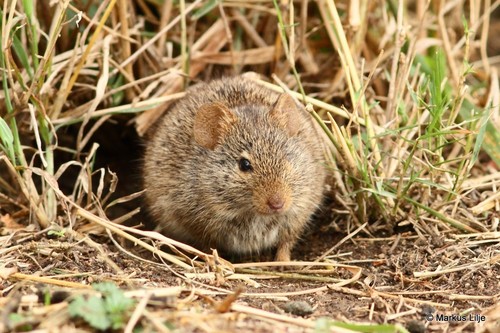
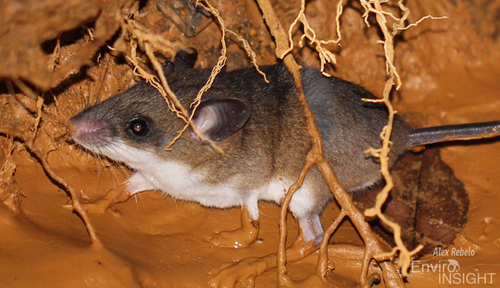
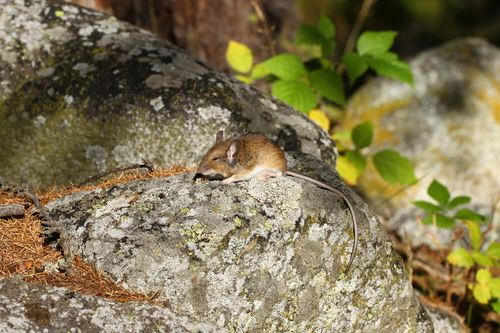
Dorsal fur is grayish-brown to tawny, with distinctly stiff, flattened spine-like hairs interspersed among softer fur on the back. The ventral surface is white or pale gray. Large, prominent eyes are characteristic of the genus, as are large, rounded naked ears. The tail is relatively slender and lightly haired.
Size
Body length approximately 7–12 cm (head-body); tail length 7–11 cm. A small, compact mouse broadly typical of the Acomys genus.
Weight
Typically 20–45 g; some sexual size variation possible but data are limited for this species specifically.
Distinctive features
Distinguished from sympatric spiny mice such as Acomys percivali (Percival's Spiny Mouse) by its somewhat smaller size, relatively dull brownish dorsal coloration, and geographic range details. Positive identification typically requires measurement and, when possible, molecular analysis due to overlap with related taxa.
Differences between males and females
Sexual dimorphism is minimal; males and females are similar in size and coloration, as is typical for Acomys species.
Behaviour and diet of the Wilson's Spiny Mouse
Spiny mice of the genus Acomys tend to be gregarious and may form small social groups or aggregations, particularly around shared shelter sites such as rock crevices. Wilson's Spiny Mouse likely follows this pattern, with groups of several individuals sharing refugia.
When it is active
Primarily nocturnal, with peak activity occurring after dusk and before dawn. During the day individuals retreat to rock crevices, dense thorn scrub, or underground burrows to avoid heat and predators.
Diet
Omnivorous; diet includes seeds, plant material, insects, and other invertebrates. Like other Acomys, it likely capitalizes opportunistically on available food resources, with seed consumption dominating in dry seasons and invertebrate prey increasing after rains.
How it feeds and hunts
Forages actively on the ground and among rocks, using its vibrissae and large eyes to detect and locate invertebrate prey. Seeds are gleaned from the ground surface and low vegetation. No specialized hunting technique beyond typical small-rodent opportunistic foraging.
Communication
Uses ultrasonic vocalizations, squeaks, and scent marking (via urine and glandular secretions) for conspecific communication. Body posturing and vibrissae movement are likely used in close-range social interactions.
Interactions with other species
Predated upon by owls (notably barn owl Tyto alba and scops owls), small carnivores (genets, mongooses, servals), and snakes. Competes for food and shelter with other small rodents in its community, including other Acomys species and murids such as Mus and Mastomys.
Role in its ecosystem
Functions as a granivore and invertebrate consumer, contributing to seed predation and potentially minor seed dispersal. As a prey species, it forms part of the diet of numerous small to medium predators, linking primary productivity to higher trophic levels in semi-arid East African ecosystems.
Reproduction and lifecycle
Breeds throughout the year in favorable conditions, with peaks potentially associated with rainy seasons. Gestation is approximately 38–42 days, longer than most murids of similar size, resulting in well-developed precocial young. Litter sizes range from 1 to 5, typically 2–3 young.
Raising the young
The female provides primary parental care; communal nursing (alloparental care) has been documented in Acomys species more broadly and may occur in this species. Young are born with eyes open, furred, and mobile within days, reducing parental dependency compared to altricial rodents.
Maturity and lifespan
Sexual maturity is reached at approximately 6–8 weeks in closely related Acomys species. Wild lifespan is estimated at 1–3 years; captive individuals may reach 4–5 years under optimal conditions.
Taxonomy and naming of the Wilson's Spiny Mouse
Classification
Mammalia > Rodentia > Muridae (tribe Acomyini, sometimes elevated to family Acomyidae) > Acomys > Acomys wilsoni
Scientific synonyms
Originally described by de Winton in 1901; occasionally referred to informally under broader Acomys complex groupings, but no widely recognized senior synonyms are established.
What research says
Recent studies
The broader genus Acomys has attracted considerable scientific attention due to its extraordinary skin regeneration capability (documented most extensively in A. cahirinus and A. kempi), and researchers continue to explore whether this trait is conserved across the genus. Phylogenomic studies refining species boundaries within the wilsoni complex are ongoing.
Genome and DNA
Detailed karyotypic data for A. wilsoni are not well established in the literature. Related Acomys species typically show 2n = 36–68 depending on species; the genus has been the subject of genomic studies on skin regeneration but specific A. wilsoni genomic work is limited.
Compared with similar species
Wilson's Spiny Mouse is closely related to Percival's Spiny Mouse (A. percivali) and the widespread Cairo Spiny Mouse (A. cahirinus). It differs from A. cahirinus in its East African range and generally smaller body. A. kempi (Kemp's Spiny Mouse) of the same region is similarly sized but tends to inhabit more rocky, arid micro-habitats and may differ in fur texture and cranial morphology.
The Wilson's Spiny Mouse and people
Spiny mice of the genus Acomys are among the very few mammals known to fully regenerate complex skin tissue — including hair follicles, sweat glands, and cartilage — without scarring, a discovery with enormous implications for human wound-healing research. Their young are born remarkably precocial: fully furred, eyes open, and able to run within hours of birth. The stiff spiny hairs that give the group its name are actually modified guard hairs rather than true spines like those of a hedgehog.
Where and how to see it
Best observed at night along rocky hillsides, dry riverbeds, and thorn-scrub edges in coastal and eastern Kenya, particularly within or near Tsavo East/West National Parks and the Tana River region. A red-light headlamp minimizes disturbance while allowing observation of their foraging behavior. Patient, quiet waiting near rock crevices at dusk is the most reliable approach.
Risks to humans
No notable risk to humans. Like most small wild rodents, it may carry ectoparasites or zoonotic organisms if handled; standard precautions (gloves, avoidance of bites) are advisable for researchers.
Human uses
Not commonly used in traditional medicine or trade. The genus Acomys is used as a laboratory model in biomedical research, particularly in studies of diabetes (some Acomys species develop type 2 diabetes-like conditions) and wound regeneration, though laboratory work typically uses A. cahirinus rather than A. wilsoni.
Countries where the Wilson's Spiny Mouse is recorded
The 5 countries named in the range description of its IUCN Red List assessment.
Questions about the Wilson's Spiny Mouse
Where does the Wilson's Spiny Mouse live?
The Wilson's Spiny Mouse is recorded in Ethiopia, Kenya, Somalia, Tanzania and Uganda across Africa. These countries come from the range description of its IUCN Red List assessment, and they are what place the species on the interactive map.
Is the Wilson's Spiny Mouse endangered?
The IUCN Red List assesses the Wilson's Spiny Mouse as Least Concern. The species is widespread and abundant enough not to qualify for any threatened category. It does not mean the species is safe forever, only that nothing in the current data raises an alarm.
How many are left in the wild?
No precise global population estimate exists. This figure comes from the species assessment on the IUCN Red List; population estimates for wild mammals are ranges, not counts, and are revised at each assessment.
What habitat does the Wilson's Spiny Mouse live in?
Wilson's Spiny Mouse favors semi-arid to arid rocky habitats, coastal bushland, dry savanna scrub, and thorn-bush thickets.
What is the scientific name of the Wilson's Spiny Mouse?
The Wilson's Spiny Mouse is Acomys wilsoni, in the family Muridae, order Rodentia.
Other species in the genus Acomys
Other species in the family Muridae
Sources
Conservation status, range description and population estimate come from the IUCN Red List assessment for Acomys wilsoni. Countries are derived from that range description, not from a mapped country list. Last refreshed on .
The distribution map is drawn from the IUCN Red List spatial data compiled in 2008. IUCN (International Union for Conservation of Nature)